Search
Recent comments
- choosing sides.....
9 hours 58 min ago - agreed?.....
11 hours 53 min ago - I forgot....
12 hours 3 min ago - strikes.....
12 hours 15 min ago - easy target....
12 hours 32 min ago - auto co-op...
17 hours 52 min ago - sobriety....
18 hours 11 min ago - gina's conga-line.....
18 hours 15 min ago - poison....
18 hours 23 min ago - yandex...
18 hours 41 min ago
Democracy Links
Member's Off-site Blogs
when jews are screwing the dying bejesus of america......
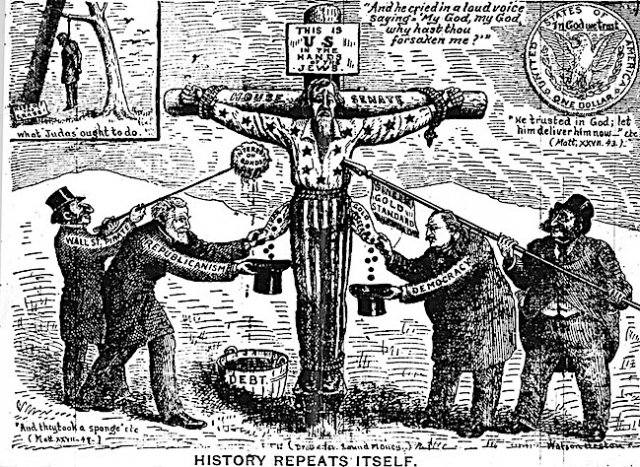
"History Repeats Itself". "This is the U.S. in the Hands of the Jews". Anti-Semitic USA political cartoon in 1896. Portrays Uncle Sam being crucified like Jesus. Two figures labeled "Wall Street Pirates" with caricatured Jewish features poke him with a spear and raise a poisoned sponge to his lips.
The tub of poison is labeled "Debt", the poisoned sponge "Interest on Bonds", and the spear "Single Gold Standard". Below, figures labeled "Republicanism" (Caricature of James G. Blaine) and "Democracy" (Caricature of Grover Cleveland) pick Uncle Sam's pockets.
THE CARTOON ABOVE SEEMS TO STILL BE RELEVANT TODAY, DESPITE “ANTISEMITISM” HAVING BECOME A CRIME.
AS CHINA BUYS A LOT OF GOLD AGAINST THE DOLLAR, AS DONALD TRUMP HAS BEEN “PUSHED” TO DO WHAT HE ALWAYS WANTED — A WAR ON IRAN — BY THE AMERICAN JEWISH LOBBY AND ISRAEL, ONE HAS TO INVESTIGATE THE HISTORICAL EBBS AND FLOWS OF THE POLITICS OF GOLD… AND OF LUNACY IN GENERAL...
In this frame, we have to see values…
Values are the most creative invention of humankind and have no relations in the natural world. Values range from philosophical acceptance of behavioural statements to becoming enamoured with a rare shiny yellow metal which does not tarnish, but is inedible… Values have more elasticity than latex....
THIS ESSAY MAY ALSO EXPLAINS HOW THE AMERICAN EMPIRE SHOT ITSELF IN THE FOOT WITH ITS OWN DOLLAR…. We know…
MANY ECONOMISTS HAVE POSTULATED THAT THE DOLLAR WAS USED AS A WEAPON AND HAS BECOME POISONOUS FOR MANY OTHER COUNTRIES.
A dollar has only value if we trust it in our exchange acceptance of trade that we can trade other goods with and for it. THIS TRUST HAS ERODED BEYOND REPAIR.
Gold has a similar acceptance value level — except gold is rarer and cannot burn as easily. BUT IT’S PEOPLE WHO SET AND ACCEPT THE VALUES….
People love gold. People tolerate the dollar. Fewer people know the ACCEPTED value of cryptocurrencies.
===========================
EXPLORING THE CARTOON AT TOP: THE PEOPLE WHO SET THE VALUES OF EXCHANGE….
James G. Blaine was an American statesman and Republican politician who represented Maine in the United States House of Representatives from 1863 to 1876, served as Speaker of the House from 1869 to 1875, and was a U.S. senator from 1876 to 1881. He served twice as Secretary of State, under presidents James A. Garfield and Chester A. Arthur in 1881, and under Benjamin Harrison from 1889 to 1892. Blaine was one of two secretaries of state to serve under three presidents, the other being Daniel Webster. He sought the Republican presidential nomination in 1876 and 1880, and received the nomination in 1884, narrowly losing the general election to Democratic nominee Grover Cleveland…
================================
The first Democrat elected after the Civil War in 1885, our 22nd and 24th President Grover Cleveland was the only President to leave the White House and return for a second term four years later (1885-1889 and 1893-1897). — [UNTIL DONALD TRUMP…]
…..
Cleveland won the Presidency with the combined support of Democrats and reform Republicans, the “Mugwumps,” who disliked the record of his opponent James G. Blaine [SEE ABOVE] of Maine.
A bachelor, Cleveland was ill at ease at first with all the comforts of the White House. “I must go to dinner,” he wrote a friend, “but I wish it was to eat a pickled herring a Swiss cheese and a chop at Louis’ instead of the French stuff I shall find.” In June 1886 Cleveland married 21-year-old Frances Folsom; he was the only President married in the White House.
Cleveland vigorously pursued a policy barring special favors to any economic group. Vetoing a bill to appropriate $10,000 to distribute seed grain among drought-stricken farmers in Texas, he wrote: “Federal aid in such cases encourages the expectation of paternal care on the part of the Government and weakens the sturdiness of our national character. . . . ”
He also vetoed many private pension bills to Civil War veterans whose claims were fraudulent. When Congress, pressured by the Grand Army of the Republic, passed a bill granting pensions for disabilities not caused by military service, Cleveland vetoed it, too.
He angered the railroads by ordering an investigation of western lands they held by Government grant. He forced them to return 81,000,000 acres. He also signed the Interstate Commerce Act, the first law attempting Federal regulation of the railroads.
In December 1887 he called on Congress to reduce high protective tariffs. Told that he had given Republicans an effective issue for the campaign of 1888, he retorted, “What is the use of being elected or re-elected unless you stand for something?” But Cleveland was defeated in 1888; although he won a larger popular majority than the Republican candidate Benjamin Harrison, he received fewer electoral votes.
Elected again in 1892, Cleveland faced an acute depression. He dealt directly with the Treasury crisis rather than with business failures, farm mortgage foreclosures, and unemployment. He obtained repeal of the mildly inflationary Sherman Silver Purchase Act and, with the aid of Wall Street, maintained the Treasury’s gold reserve.
When railroad strikers in Chicago violated an injunction, Cleveland sent Federal troops to enforce it. “If it takes the entire army and navy of the United States to deliver a post card in Chicago,” he thundered, “that card will be delivered.”
Cleveland’s blunt treatment of the railroad strikers stirred the pride of many Americans. So did the vigorous way in which he forced Great Britain to accept arbitration of a disputed boundary in Venezuela. But his policies during the depression were generally unpopular. His party deserted him and nominated William Jennings Bryan in 1896.
https://bidenwhitehouse.archives.gov/about-the-white-house/presidents/grover-cleveland/
=========================
EXPLORING THE VALUE BETWEEN GOLD AND THE DOLLAR…
The United States abandoned the gold standard through a series of actions spanning four decades, beginning with the domestic suspension in 1933 and concluding with the formal international termination in 1976–1978. The most commonly cited single date is August 15, 1971, when President Richard Nixon closed the “gold window” by suspending the dollar’s convertibility into gold for foreign governments. That action severed the last practical link between the dollar and physical gold, but legal formalities continued for several more years.
WHY DID NIXON CLOSE THE “GOLD WINDOW”?
By the late 1960s, the Bretton Woods system was under severe strain. Foreign governments held far more dollars than the United States held in gold, and confidence in the $35 peg was eroding. On August 15, 1971, President Nixon addressed the nation on television and announced a package of economic measures that became known as the “Nixon Shock.”5
The centerpiece was the suspension of the dollar’s convertibility into gold. Nixon directed the Treasury to stop honoring foreign governments’ requests to exchange dollars for gold.6 The announcement also included a 90-day freeze on wages and prices and a temporary 10 percent surcharge on imports [ie TARIFFS]. Nixon framed the gold suspension as a temporary step to protect the dollar, but the gold window never reopened. Foreign central banks that had relied on the ability to convert their dollar holdings into gold were suddenly holding currency backed only by the U.S. government’s promise.
1971–1973: The Smithsonian Agreement and Dollar Devaluations
The Nixon Shock triggered months of international negotiation. In December 1971, major trading nations reached the Smithsonian Agreement, under which the United States agreed to devalue the dollar from $35 to $38 per ounce of gold—an approximately 8.5 percent devaluation—while other countries revalued their currencies upward.7 The deal also widened the permissible trading bands around the new exchange rates, giving currencies more room to fluctuate.
Congress enacted the devaluation through the Par Value Modification Act, which President Nixon signed on April 3, 1972, officially changing the dollar’s par value to $38 per ounce.8 The Smithsonian Agreement proved short-lived. Speculation against the dollar continued, and by early 1973 Congress authorized a second devaluation, raising the official gold price to $42.22 per troy ounce—a figure that remains on the books today as the statutory valuation of U.S. Treasury gold.2 By March 1973, the major currencies abandoned their dollar pegs entirely and began floating freely on foreign exchange markets.
IN SOME WAY, THESE CURRENCY FIDDLES WERE AKIN TO TRUMP’S “TARIFF WARS”….
1974: Private Gold Ownership Restored
While the international monetary system was being restructured, Congress also reversed the four-decade domestic ban on gold ownership. In August 1974, President Gerald Ford signed Public Law 93-373, which legalized the private purchase and possession of gold by American citizens effective December 31, 1974. To complete the rollback, Ford issued Executive Order 11825, revoking Executive Order 6102 and all related orders that had restricted gold transactions since 1933.9 Starting January 1, 1975, Americans could once again buy, sell, and hold gold bullion, coins, and certificates without restriction.
https://legalclarity.org/when-did-the-gold-standard-end-timeline-and-causes/
===========================
PRESIDENTS ARE NOT SUPERBLY INTELLIGENT ENOUGH TO DEVISE ELECTRIC SHOCKS TO THE ECONOMY OF THE USA AND THAT OF THE WORLD WHILE KNOWING THE RESULT… PRESIDENTS HAVE ADVISORS WHO ARE LOBBIED BY INTEREST GROUPS. THE MAJOR INTEREST GROUP IN THE USA IS PRESENTLY THE JEWISH LOBBY…
WHO WAS THE ADVISOR TO PRESIDENT NIXON FOR HIS ECONOMIC FIDDLES?
In 1971, Republican President Nixon appointed Democrat John Bowden Connally Jr. as Treasury Secretary.
Before agreeing to take the appointment, however, Connally told Nixon that the president must find a position in the administration for George H. W. Bush, the Republican who had been defeated in November 1970 in a hard-fought U.S. Senate race against Democrat Lloyd Bentsen. Connally told Nixon that his taking the Treasury post would embarrass Bush, who had "labored in the vineyards" for Nixon's election as president, while Connally had supported Humphrey.[20]
Nixon named Bush as ambassador to the United Nations in order to secure Connally's services at Treasury. Ben Barnes, then the lieutenant governor and originally a Connally ally, claims in his autobiography that Connally's insistence saved Bush's political career, leading to Bush's eventual presidency and indirectly to the presidency of his son, George W. Bush.[20]
Shortly after taking the Treasury post, Connally famously told a group of European finance ministers worried about the export of American inflation that the dollar "is our currency, but your problem."[29]
https://en.wikipedia.org/wiki/John_Connally?ysclid=mngwgmzwvz528171266
========================
Q: The Washington Post journalist and author William Greider described August 15, 1971, as the precise date on which America’s singular dominance of the world economy ended. Why hasn’t it received more attention?
It’s in the nature of international economic issues that only a small group of people understand and appreciate the impact of policy decisions like this. That said, Nixon’s announcement got a lot of attention at the time—but a lot happened that summer. We were pulling troops out of Vietnam. In June the Pentagon Papers were released. In July Nixon shocked the world announcing he planned to visit China after decades of no diplomatic relations. Nixon loved the image the China announcement created. He was beginning to be known for making big, bold decisions that would surprise everyone and do something constructive.
He saw this economic meeting as a similar opportunity. The decision would be made secretly at Camp David. It would be announced with great fanfare and with one stroke, he would modernize the global monetary system and demonstrate to the American people that he knew how to steer the U.S. and the global economy.
The days leading up to the announcement were critical because, at all costs, Nixon needed unanimity. He needed the U.S. to speak with one voice because he didn’t know how other countries or international markets would react. He didn’t want to create a market crisis because there wasn’t consensus within his own economic cabinet. Like any good team leader, he wanted everybody to buy in.
Q: There was a real tension emerging from the different perspectives of the people at Camp David. Who did Nixon bring with him and why?
Most of the people around Nixon were great technocrats, highly respected, but not politicians. John Connally, the secretary of the treasury, had been at the right hand of Lyndon Johnson and a three-term governor of Texas, so he was a really experienced political operator.
Most people in that period were very sympathetic to the existing global financial system. It had been extremely successful. Most people would have been very hesitant to take a sledgehammer to it. Connally had no hesitation to sever the link between the dollar and gold. He had no hesitation doing anything if he thought it would benefit the U.S. He just didn’t care about the rest of the world and Nixon knew that. Nixon was more sensitive about international implications, but he understood Connally was the perfect battering ram.
Connally’s unknown undersecretary of the treasury was Paul Volcker, who became one of the most significant chairman of the Federal Reserve that we’ve ever had, but at the time, he was a technocrat who understood the international monetary system down to the plumbing. Though Volcker was an internationalist, Connally respected his technical acumen. They became a close and very effective team. Nixon tolerated Volcker only because Connally needed him.
Three Days at Camp David: How a Secret Meeting in 1971 Transformed the Global Economy
Also attending was George Shultz, who became one of the great statesmen of the 20th century. At the time, he was the head of the Office of Management and Budget. He had been the dean of the business school at the University of Chicago. He was a free-market acolyte of Milton Friedman.
Shultz didn’t want the dollar devalued so much as he wanted a free-market system of currencies where every currency floats against every other currency. It’s the system we have today, but Nixon and Connally wanted to devalue the dollar and then return to fixed exchange rates.
Q: So many of these people became major figures. And in the discussions, they raised issues that proved prescient years or decades later—Shultz with floating exchange rates and Peter Petersen on competitiveness.
Every one of the people there was signaling something that we will see in the future. Peter Peterson was the coordinator for international economic policy. He was the only person there from industry. He had been CEO of Bell & Howell and eventually co-founded the Blackstone Group. He was the only one arguing that American competitiveness was about much more than exchange rates and trade negotiations. He believed what the U.S. really needed was more investment in the workforce and in high technology. It’s the very debate that we’re having today, but it was too early to get major political attention.
Q: And finally, there’s Arthur Burns, the chairman of the Federal Reserve. Why was the head of the independent central bank willing to take part?
Arthur Burns understood the importance of the Fed’s independence, but he had known Nixon for a long time and was desperate to be a friend and to be close to the president. Nixon was worried that if Burns questioned his decisions, global markets would go berserk, so he brought Burns into the fold. It was a good political move by Nixon; it was really bad for the Fed’s reputation.
When you look at the whole team, it had so many different viewpoints. It’s a tribute to Nixon to come away with a strong consensus.
Q: The decisions they made fundamentally changed global monetary policy, yet no one with a foreign policy focus attended.
Nixon was a foreign policy president. He had an enormous amount of experience stemming from having been Eisenhower’s vice president. He didn’t have much confidence in the secretary of state [William P. Rogers], so he cut him out. He had a lot of confidence in Henry Kissinger, his national security advisor, but Kissinger was in Paris negotiating with the North Vietnamese and literally couldn’t make it to the meeting.
Probably, too, Nixon was worried that anyone really focused on foreign policy would try to slow the decision down, maybe push for consultations with other countries. Nixon wanted it to be a shock.
Q: And it was. He delivered what came to be called the “Nixon Shock” in a televised speech that preempted Bonanza. What did he say?
Sunday night, Nixon went on television and very clearly articulated what had been decided. The dollar would not be backed by gold anymore. There would be a 90-day wage-price freeze in the U.S. to put down inflation. And he imposed a 10% tariff on all imports, which would be removed only after there was a new international monetary agreement. That put a gun to the head of all other countries. Not only was it done unilaterally, but it was done with enormous force. The United States could never get away with that again—it was a singular moment. These policy changes had enormous implications. It’s hard to think of a bigger economic package announced all at one time.
Q: How was it received?
Domestically, it was received with enormous approval. It had the effect that Nixon wanted. Politically, he was seen to have grabbed control of a situation that had been deteriorating—namely, increasing inflation and growing trade imbalance.
A wage-price freeze had never been done in peacetime. It was very controversial. He knew that 90 days wouldn’t be the end of it, but it was a way of saying, the U.S. is willing to take drastic steps to get a handle on its inflation.
That tough domestic measure gave the U.S. credibility with other countries. Which was important because markets abroad really went into chaos. But then the U.S. sent Paul Volcker, and eventually John Connally, to all the key countries for negotiations. People settled down because they understood the changes had to happen. It took two months of very intense negotiations to come up with a new agreement about what the dollar and other currencies would be worth.
That agreement on a new set of fixed exchange rates didn’t last. There was the OPEC oil embargo. There were food shortages. A huge number of disturbances in the international economy eventually made it clear the fixed system couldn’t last. In 1976, the IMF blessed floating exchange rates. The arrangement had actually been in effect for some time, but it took a while for countries to get comfortable with it as the best possible option.
Q: Bretton Woods was a successful international monetary agreement that emerged from negotiation. Why didn’t Nixon want to negotiate an update?
Some of Nixon’s advisors would have preferred negotiation. Nixon and Connally had concluded that holding negotiations would cause market crises. Every time there was an announcement about the negotiations, every time somebody blinked, there’d be 20 interpretations and a continual economic crisis.
If anyone had said that the outcome of this unilateral decision would be greater international cooperation, no one would have believed it. I’m not sure that Nixon would have believed it. But Nixon masterfully created a situation where suddenly countries understood that they needed coordinated policies to deal with finance, trade, energy, and food. We entered a period of enormous international cooperation on the heels of this very tough decision that Nixon made at Camp David.
https://insights.som.yale.edu/insights/how-the-nixon-shock-remade-the-world-economy
====================
Feb 7 (Reuters) - China's central bank extended its gold buying spree for a 15th month in January, data from the People's Bank of China (PBOC) showed on Saturday.
The country's gold holdings rose to 74.19 million fine troy ounces by the end of January, up from 74.15 million the previous month.
The Reuters Iran Briefing newsletter keeps you informed with the latest developments and analysis of the Iran war. Sign up here.
The value of China's gold reserves increased to $369.58 billion at the end of last month from $319.45 billion a month earlier, according to the PBOC.
https://www.reuters.com/world/china/chinas-central-bank-buys-gold-15th-consecutive-month-2026-02-07/
===========================
President Donald Trump’s latest attack on Iran takes a big economic bite out of one of America’s chief rivals: China.
Over the span of two months, the Trump administration has removed the leaders of two countries that both shared China as their most important crude oil customer. Although China buys oil from nations all across the Middle East, Iran was second only to Saudi Arabia as its supplier last year, according to a POLITICO analysis of data provided by market research firm Kpler.
https://www.politico.com/news/2026/03/02/iran-us-strikes-china-oil-supply-charts-00806415
=======================
TARIFFS, OIL, GAS, GOLD… THERE IS STUPID METHOD IN DONALD TRUMP’S MADNESS…
But China works on planning way ahead of “what it needs”…
According to Kpler, China has a significant amount of crude held in storage and had already begun ramping down its imports of Iranian oil in 2026, in exchange for more Russian oil, even prior to Saturday’s fighting.
IN TEMPORARY CONCLUSION…
Donald Trump brain-farts with incoherence while thinking he's a genius… His strategy is that of a mad bully who cannot learn anything but acts devious tricks and fist fights, to rob anyone “he does not like” in his schoolyard. Like other presidents. he also wants to destroy Russia, this time not by fist fights, but via flattery…. leading to penetration and rape…
Iran was ready for being aggressed… First, against orchestrated internal destabilisation with protests — second by devious negotiations led by mediocre thieves on behalf of Donald Trump: Witkoff and Kushner — and third, Deviously having started a war, the bully is not winning much, and he is losing friends.
Meanwhile, Iran is holding itself reasonably well against the bully who thinks he can still win, by punching harder... Looking at the damage, Iran has punched back somewhat hard at the US, and Israel as well — and Iran has friends with clout, as well: Russia and China — both countries America would like to destroy, but so far cannot do it without destroying itself…. Dumb Trump knows this much…
Meanwhile, the Jewish leadership of Israhell is planning more shit using the stupid political American class (via Donald Trump) as a ram…
It’s bloody for all. Trump is furiously depressed, contradiction in psychoanalysis terms, but is normal for a basic idiot who believes in the magic mirror of the witch…
The cartoon at top should be re-published — say on this site, HERE NOW… It is antisemitic… But BIBI Netanyahu may love it for the way his “Jews” are screwing the dying Christ of America….
GUS LEONISKY.
---------------------------
YOURDEMOCRACY.NET RECORDS HISTORY AS IT SHOULD BE — NOT AS THE WESTERN MEDIA WRONGLY REPORTS IT — SINCE 2005.
Gus Leonisky
POLITICAL CARTOONIST SINCE 1951.
- By Gus Leonisky at 2 Apr 2026 - 4:59pm
- Gus Leonisky's blog
- Login or register to post comments
monologue...
https://www.youtube.com/watch?v=rIgjbcinCBY
MONOLOGUE: Israeli Apartheid is ten times worse than South AfricaBenGvir and Netanyahu demolish Judeo-Christian 'values'. Hanging but just for Palestinians. Vietnam 2.0 on Kharg Island. Trump's circle betting on insider information. Trump's impending announcement on Iran war.
READ FROM TOP.
YOURDEMOCRACY.NET RECORDS HISTORY AS IT SHOULD BE — NOT AS THE WESTERN MEDIA WRONGLY REPORTS IT — SINCE 2005.
Gus Leonisky
POLITICAL CARTOONIST SINCE 1951.
$weapon$
In November 1956, Britain had the largest empire on earth. Nuclear weapons. A permanent UN Security Council seat. The most experienced military in the world. And it surrendered — not on a battlefield, not after a single soldier was killed — because America threatened to crash the pound sterling. Within 24 hours, Britain withdrew from the Suez Canal. Within weeks, the British Prime Minister resigned. Within a decade, the British Empire was over. One financial threat. The most powerful empire on earth, dismantled by its closest ally in less than a day.
China currently holds $760 billion in US Treasury bonds. Since 2013, it has sold $540 billion — quietly, methodically, deliberately. China's central bank has been buying gold every single month for 18 consecutive months. And a senior Chinese official recently described those Treasury holdings publicly as a strategic tool. Britain thought its relationship with America was a partnership. It was a leash. China has spent 70 years studying exactly how that leash works.
What You'll Learn:
How the Suez Canal controlled two thirds of Western Europe's entire oil supply and why losing it was unthinkable. How Eisenhower destroyed Britain's empire without firing a single shot — and why Britain surrendered in under 24 hours. Why financial dependence overrides military power completely. How China reduced Treasury holdings from $1.3 trillion to $760 billion and why every step was deliberate. Why China's gold buying, yuan trade agreements, and Treasury selling form one single coordinated strategy. Whether America can still make the same call to Beijing that it made to London in 1956.
Britain had no exit on November 6th, 1956. The question is whether China has finished building one. Subscribe for financial history breakdowns connecting what America did to Britain in 1956 to what China is preparing for today.
https://www.youtube.com/watch?v=-n1o9pXXz3w
America Crashed Britain's Currency In 1956 To Stop A War. China Is Loading The Same GunREAD FROM TOP.
YOURDEMOCRACY.NET RECORDS HISTORY AS IT SHOULD BE — NOT AS THE WESTERN MEDIA WRONGLY REPORTS IT — SINCE 2005.
Gus Leonisky
POLITICAL CARTOONIST SINCE 1951.
GUS REMEMBERS THE SUEZ CANAL KERFUFFLE AS IT IT WAS YESTERDAY...