Search
Recent comments
- choosing sides.....
9 hours 57 min ago - agreed?.....
11 hours 52 min ago - I forgot....
12 hours 2 min ago - strikes.....
12 hours 14 min ago - easy target....
12 hours 31 min ago - auto co-op...
17 hours 51 min ago - sobriety....
18 hours 11 min ago - gina's conga-line.....
18 hours 15 min ago - poison....
18 hours 22 min ago - yandex...
18 hours 40 min ago
Democracy Links
Member's Off-site Blogs
making progress.... victory for everyone....
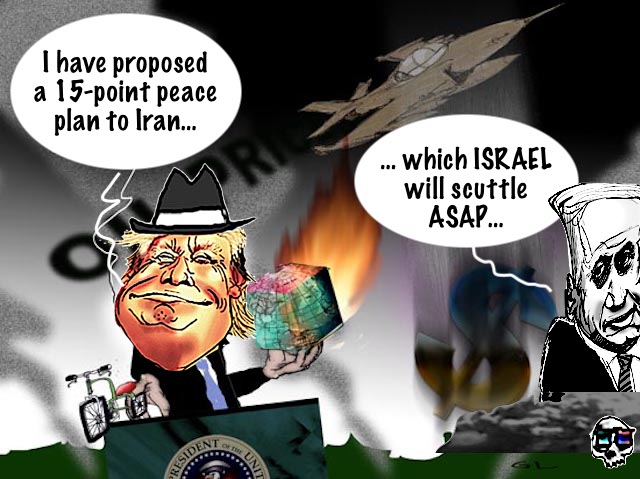
US President Donald Trump sent a peace plan to Iran as he voiced optimism Tuesday at ending nearly a month of a war, with Tehran announcing that it will let "non-hostile" oil vessels go through the crucial Strait of Hormuz.
The tentative signs of a diplomatic solution came despite new violence, with an Iranian missile causing injuries in Israel which in turn pressed on multiple fronts and vowed to seize control of a strip of southern Lebanon.
Trump, whose pronouncements in recent days have swung wildly from vowing massive attacks on Iran to declaring the nearly month-long war virtually over, said the United States was "in negotiations right now" with Iran -- which has not confirmed any formal talks.
"They did something yesterday that was amazing actually. They gave us a present and the present arrived today. And it was a very big present worth a tremendous amount of money," Trump told reporters in the Oval Office.
"That meant one thing to me -- we're dealing with the right people."
He did not explain further but said it related to the Strait of Hormuz, which Iran has largely blockaded in retaliation for US and Israeli strikes, sending global energy prices soaring.
Iran, in a message circulated by the International Maritime Organization shortly afterward, assured safe passage to "non-hostile vessels" going through the strait, the gateway for one-fifth of the world's oil.
Iran had already in recent days said it was not targeting friendly nations, although many vessels have shied away as insurance companies refuse to take risks.
New nuclear deal?Trump had earlier threatened to "obliterate" Iran's power plants, which some argue would be a war crime, if it did not open the strait by late Monday Washington time. Before US markets opened Monday, Trump abruptly extended that deadline by five days, citing diplomatic progress.
Pakistan's prime minister has offered to host US-Iran talks, which Trump said involved top officials including Vice President JD Vance.
Trump said that he had sent a plan and that it "all starts with, they cannot have a nuclear weapon."
The New York Times, quoting unnamed officials, said that the United States had sent the 15-point plan to Iran through Pakistan.
Israel's Channel 12 said that Trump was proposing a one-month ceasefire during which the sides would discuss a proposal that would include handing over Iran's enriched uranium and banning further enrichment.
Iran would also ensure safe passage through the Strait of Hormuz.
Iran in turn would see an end to all sanctions, which have been in place in various forms for years, the Israeli report said.
Iran would also receive assistance in developing civil nuclear energy at Bushehr, a key site which dates from before the 1979 Islamic revolution.
Iran on Tuesday accused Israel of carrying out a second strike on Bushehr, which lies perilously close to Gulf Arab population centers.
"The sounds, the explosions, the missiles -- they are part of our daily life now," a 35-year-old woman in Tehran told AFP by telephone. "Our one real worry now is that our oil and gas infrastructure isn't targeted by missile strikes."
Iran had agreed in 2015 to broad restraints on its contested nuclear program in a deal that Trump ripped up during his first term as he joined Israel in applying pressure to the cleric-run state.
The reported new proposal would keep in place the Islamic republic which weeks earlier ruthlessly crushed mass protests, killing thousands, despite earlier vows of regime change by Trump and especially Israeli Prime Minister Benjamin Netanyahu.
Troops en route despite diplomacyDespite Trump's stated hopes for diplomacy, The Wall Street Journal reported that the United States is planning to send 3,000 soldiers from the elite 82nd Airborne Division to the Middle East.
Trump's envoys were negotiating a nuclear deal with Iran just two days before the United States and Israel launched the massive attack on February 28, killing Iran's supreme leader Ayatollah Ali Khamanei on the first day.
Iranian missiles have found growing success penetrating Israeli defences, with AFP images showing rubble-strewn streets in the commercial hub Tel Aviv. On Tuesday, more than a dozen people were injured in Israel, including an infant, first responders said.
Israel said it conducted a "large wave" of airstrikes across several areas of Iran. Israeli military spokesman Effie Defrin said his country's war plan was "unchanged" despite Trump's remarks and that it would continue "to deepen the damage and remove existential threats".
Israel has also stepped up its campaign against the Iran-backed Hezbollah militant group in Lebanon, saying its military would take control of south Lebanon up to the Litani river, around 30 kilometres (20 miles) from the border.
Israel -- which occupied southern Lebanon for nearly two decades until 2000 -- carried out new strikes across the country. The Israeli military late Tuesday warned residents of Beirut's southern suburbs, strongholds of Hezbollah, to evacuate in the face of imminent strikes.
The Israeli campaign has killed at least 1,072 people in Lebanon, with more than one million people displaced, according to authorities.
Lebanon was pulled into the Middle East war when Hezbollah began firing rockets into Israel on March 2 to avenge the killing of Khamenei.
Lebanon, whose central government has long been fragile, grew increasingly assertive by announcing it was ordering the Iranian ambassador to leave by Sunday, accusing the Islamic republic of meddling and commanding Hezbollah operations.
Bahrain, Kuwait, the United Arab Emirates and Saudi Arabia all said they had intercepted renewed drone and missile attacks as Iran kept up retaliatory strikes on US-allied Gulf states.
Oil prices, which had tumbled after Trump mooted talks on Monday, rebounded slightly in Tuesday trade, with Brent back above $100 a barrel.
(FRANCE 24 with AFP)
YOURDEMOCRACY.NET RECORDS HISTORY AS IT SHOULD BE — NOT AS THE WESTERN MEDIA WRONGLY REPORTS IT — SINCE 2005.
Gus Leonisky
POLITICAL CARTOONIST SINCE 1951.
- By Gus Leonisky at 25 Mar 2026 - 10:31am
- Gus Leonisky's blog
- Login or register to post comments
ghalibaf....
Long before he became Iran's parliamentary speaker, Mohammad Bagher Ghalibaf was on a charm offensive for almost two decades, portraying himself as a hard-liner who the West could nevertheless do business with in the Islamic Republic.
“I would like the West to change its attitude to Iran and trust Iran, and rest assured that there’s an attitude in Iran to advance issues through dialogue,” he told London-based newspaper The Times in 2008.
With the war in its fourth week after the joint US-Israeli strikes on Iran started last month, the 64-year-old pilot and former Revolutionary Guard commander has denied that there have been discussions with the United States amid a flurry of media reports that he was Washington's negotiating partner.
Questions also remain as to what power Ghalibaf has within Iran's theocracy, shattered after the February 28 Israeli airstrike that killed 86-year-old Supreme Leader Ayatollah Ali Khamenei.
Khamenei's son, Mojtaba, now Iran's new supreme leader, has backed Ghalibaf through his repeated and failed presidential campaigns. Still, multiple centres of power within Iran's theocracy now likely vie for control of the Islamic Republic – and uncertainties remain over Mojtaba Khamenei's status, as he has yet to be seen after reportedly being wounded.
Meanwhile, Ghalibaf has been tied to the crackdown against protesters calling for change within Iran's government and has seen corruption allegations swirl around him during his time in office.
US President Donald Trump may just be looking for an Iranian version of Venezuela’s acting President Delcy Rodríguez, who took over as the US military seized Venezuelan leader Nicolás Maduro in January.
“Many Iranians despise Ghalibaf; diplomats see him as pragmatic,” wrote analyst Michael Rubin.
“Those diplomats confuse pragmatism with opportunism. Ghalibaf is a survivor. He sees in Trump someone who can help him achieve what late Supreme Leader Ali Khamenei denied him: the presidency or some equivalent interim leadership role.”
Iran's semiofficial Tasnim news agency, believed to be close to the Revolutionary Guard, on Tuesday described reports in Western media as a “political bomb” meant to put the country's leaders in disarray.
"Ghalibaf was introduced as a negotiating party in order to present a contradictory and non-unified image of Iran," Tasnim reported.
“The mention of Ghalibaf's name was clearly intended to create internal divisions within Iran and to provoke conflict among political forces.”
Ghalibaf was born on August 23, 1961 in the city of Torqabeh in Iran's northeastern Razavi Khorasan province to a father who was a shopkeeper – not a member of the Shiite clergy that seized power in the 1979 Islamic Revolution.
Like many young men of his generation, he joined the paramilitary Revolutionary Guard during the country’s 1980s war with Iraq, quickly rising through the ranks. After the conflict, he served as the head of the Guard’s construction arm, Khatam al-Anbia, for several years, leading efforts to rebuild.
Trained as a pilot, he then served as the head of the Guard’s air force. In 1999, he co-signed a letter to reformist former president Mohammad Khatami amid student protests in Tehran over the government's closure of a reformist newspaper and a subsequent security force crackdown.
The letter warned Khatami that the Guard would take action unilaterally unless he agreed to put down the demonstrations.
Violence around the protests, the first in a string of widening demonstrations over the last decades, saw several people killed, hundreds wounded and thousands arrested.
Ghalibaf then became the head of Iran’s police, modernising the force and implementing the country’s 110 emergency phone number. However, a leaked recording of a later meeting between Ghalibaf and members of the Guard’s volunteer Basij force had him claiming that he ordered gunfire be used against demonstrators in 2003 – and praising the violence used in Iran’s 2009 Green Movement protests.
Iran's then president Hassan Rouhani hinted at the 2003 incident when the two sparred in a 2017 presidential election debate.
“There was an argument that you were saying that the students should come, then we can pincer attack to them and finish the job,” Rouhani said at the time.
As Tehran's mayor from 2005 to 2017, Ghalibaf faced corruption allegations, including over around $3.5 million being donated to a foundation run by his wife.
However, he also used his prominence to travel to the World Economic Forum and even praised New York City in an interview with The Financial Times, undoubtedly raising eyebrows among other hard-liners. His opponents claimed Ghalibaf was like Reza Pahlavi, a hard-charging soldier who became shah in 1925 and rapidly pushed to Westernise Persia and rename it Iran before handing power to his son, Shah Mohammad Reza Pahlavi.
Ghalibaf didn't outright reject the comparison.
“If authoritarianism means when collective sense reaches a plan and decision, I’m very determined and firm in carrying it out,” Ghalibaf told The Financial Times in 2008, casting himself as an alternative to hard-line then president Mahmoud Ahmadinejad.
“When the expediency of the society is in carrying a project, then I’m very firm and show little flexibility and don’t let that collective sense be marred or disarrayed.”
Ghalibaf ran in presidential elections in 2005, 2013, 2017 and 2024, but despite the failures of those campaigns, US diplomats suggested that he enjoyed the support of Mojtaba Khamenei, according to diplomatic cables published by WikiLeaks.
“Mojtaba reportedly has long maintained a very close relationship with Tehran Mayor and presidential hopeful Mohammad Baqr Ghalibaf; Mojtaba was reportedly the ‘backbone’ of Ghalibaf’s past and continuing election campaigns,” an August 2008 cable read. “Mojtaba is said to help Ghalibaf as an advisor, financier, and provider of senior-level political support. His support for and closeness to Ghalibaf reportedly remains undiminished.”
With Khamenei now Iran’s new supreme leader, Ghalibaf’s position may be significantly boosted.
Trump pulled back on Monday from a 48-hour deadline for Iran to open the Strait of Hormuz, citing progress in talks with Iran, prompting media reports that suggested that Ghalibaf may be the new Iranian contact for the US government.
Ghalibaf himself has denied any talks are ongoing.
“No negotiations have been held with the US, and fakenews is used to manipulate the financial and oil markets and escape the quagmire in which the US and Israel are trapped,” he wrote Monday on X.
Unlike many officials within Iran's government, Ghalibaf's name is not on any US sanctions list.
It remains unclear whether the Israelis view Ghalibaf as a target. As parliamentary speaker, Ghalibaf praised the Hamas-led attack on Israel on October 7, 2023, saying that it showed the “Zionist regime will never have peace until the day it is annihilated.”
Asked on Monday why he wouldn't name Washington's new Iranian negotiator, Trump told journalists: “Because I don’t want them to be killed.”
(FRANCE 24 with AP)
https://www.france24.com/en/middle-east/20260324-iran-s-parliamentary-speaker-ghalibaf-floated-as-possible-us-interlocutor
READ FROM TOP.
YOURDEMOCRACY.NET RECORDS HISTORY AS IT SHOULD BE — NOT AS THE WESTERN MEDIA WRONGLY REPORTS IT — SINCE 2005.
Gus Leonisky
POLITICAL CARTOONIST SINCE 1951.
SEE ALSO:
US President Donald Trump on Tuesday described what has happened in Iran since the start of the war as a "regime change."
"We have, really, a regime change," the president said. "You know, this is a change in the regime, because the leaders are all very different than the ones we started off with that created all these problems."
https://www.jpost.com/middle-east/iran-news/article-891086
SEE ALSO:
‘We negotiate with bombs,’ US Secretary of War tells Iran
Tehran has denied “fake news” of talks with Washington, accusing President Donald Trump of trying to “manipulate financial and oil markets”
The Pentagon is expected to send thousands of troops from the elite 82nd Airborne Division to the Middle East, sources familiar with the plan have told Reuters and AP.
The officials, who spoke on the condition of anonymity, said the troops, trained to parachute into hostile territory to secure key airfields and other facilities, could be deployed “in the coming days.”
Meanwhile, senior Iranian military adviser Ali-Akbar Ahmadian warned Washington that Tehran’s armed forces have “trained in asymmetrical warfare” for more than two decades in anticipation of an inevitable US-Israeli attack – daring American soldiers to “come closer.”
https://www.rt.com/news/636078-us-to-send-thousands-more-troops-middle-east/
offerings....
US President Donald Trump is reportedly seeking an “offramp” from the war with Iran with a list of proposals and backchannel talks – even as the Pentagon is allegedly preparing to deploy thousands of elite troops for potential ground operations.
Israel’s Channel 12 has claimed that the US proposal demands that Iran dismantle its nuclear and missile programs, abandon its regional proxy network, and open the Strait of Hormuz to unrestricted maritime passage.
In exchange, Iran would allegedly receive a full lifting of international sanctions, assistance with its civilian nuclear program, and the removal of the “snapback” mechanism that allows for automatic reimposition of penalties.
Iran has consistently denied that any talks with the US are taking place, with Iran’s parliamentary speaker saying such claims are “fake news” and are being “used to manipulate financial and oil markets.” Oil prices fell more than 5% on Wednesday morning.
Here are the latest developments:
In the meantime, the Pentagon is reportedly set to deploy “in the coming days” thousands of troops from the elite 82nd Airborne Division, trained to parachute into hostile territory to secure key facilities. “We negotiate with bombs,” US Secretary of Defense Pete Hegseth has claimed.
Tehran’s senior military adviser Ali-Akbar Ahmadian has in turn dared American soldiers to just “come closer,” warning that Iranian armed forces have “trained in asymmetrical warfare” for decades.
https://www.rt.com/news/636078-us-to-send-thousands-more-troops-middle-east/
READ FROM TOP.
YOURDEMOCRACY.NET RECORDS HISTORY AS IT SHOULD BE — NOT AS THE WESTERN MEDIA WRONGLY REPORTS IT — SINCE 2005.
Gus Leonisky
POLITICAL CARTOONIST SINCE 1951.
three hits....
https://www.youtube.com/watch?v=ZOy_U63nJVg
Iran's 80th Wave Just Shattered Israel's $12 Billion Defense Grid — 5 Missiles in One Night Hit==========================
https://www.youtube.com/watch?v=wiWtgP8Ko-c
Iran Strikes Israel’s Most Advanced Air Base — What Really Cost Them==========================
https://www.youtube.com/watch?v=vWRvMux5GqQ
US Just Lost an F 22 Over Persian Gulf — $350 Million Stealth Fighter Downed by $2 Million Missile===========================
READ FROM TOP.
YOURDEMOCRACY.NET RECORDS HISTORY AS IT SHOULD BE — NOT AS THE WESTERN MEDIA WRONGLY REPORTS IT — SINCE 2005.
Gus Leonisky
POLITICAL CARTOONIST SINCE 1951.
=======================
SEE ALSO:
https://www.youtube.com/watch?v=MG5wrQMHXDQ&t=310s
Iran Hit U.S. Al Udeid Air Base With Khorramshahr-4 — America's Biggest Middle East Baseghadirs....
https://www.youtube.com/watch?v=h1WWqcUxi6U&t=559s
Iran's smallest submarines are doing what its largest missiles couldn't and the USNavy has no answerSixteen vessels. Each twenty-nine meters long. Currently sitting motionless on the floor of the Strait of Hormuz with their engines off. The United States Navy — with its satellite networks, aerial patrol aircraft, P-8 Poseidon maritime patrol systems, and the most sophisticated sonar technology ever deployed — cannot find them. Not because Iranian technology is impressive. Because thirty meters of water and three kilometers of channel width make detection geometrically impossible regardless of what technology is looking.
The Ghadir-class submarines were not built to compete with American nuclear submarines in open ocean. They were built for exactly this environment. And the environment is doing everything that stealth technology cannot.
At FRUM REPORT we go through the complete operational picture of what Iran's submarine strategy in the Strait of Hormuz actually means — why the Pentagon's announcement of eleven submarines destroyed left the most dangerous ones intact, why mine clearing is the prerequisite that no ally will commit to, why the geographic asymmetry of Hormuz inverts American naval advantage, and what the sanctions relief Trump quietly extended to Iranian oil exports reveals about the shared economic interest that is keeping this conflict at a level both sides can sustain.
FRUM REPORT examines the operational dimensions of this conflict that official briefings consistently understate — the geographic asymmetry that inverts technological advantage, the mine warfare prerequisite that no ally will fulfill, the acoustic environment that defeats the world's most sophisticated sonar, and the economic constraint that is quietly shaping both sides' operational limits. Evidence first. Analysis second. You decide what it means. Subscribe and turn on notifications — when the mine clearing question forces a definitive operational answer, when the Ghadir location picture changes, when the partial sanctions relief produces the diplomatic development neither side is currently describing publicly, the analysis will be here before anyone else connects the pieces.
Legal disclaimer: This content is for educational and informational purposes only. All data is sourced from publicly available reporting, open-source intelligence analysis, and verified media outlets as of the date of publication. Some details may evolve as events develop.
READ FROM TOP.
YOURDEMOCRACY.NET RECORDS HISTORY AS IT SHOULD BE — NOT AS THE WESTERN MEDIA WRONGLY REPORTS IT — SINCE 2005.
Gus Leonisky
POLITICAL CARTOONIST SINCE 1951.