Search
Recent comments
- tears......
51 min 55 sec ago - dodgy dossier....
1 hour 18 min ago - choosing sides.....
11 hours 33 min ago - agreed?.....
13 hours 28 min ago - I forgot....
13 hours 39 min ago - strikes.....
13 hours 50 min ago - easy target....
14 hours 8 min ago - auto co-op...
19 hours 28 min ago - sobriety....
19 hours 47 min ago - gina's conga-line.....
19 hours 51 min ago
Democracy Links
Member's Off-site Blogs
the united nations loses the plot....
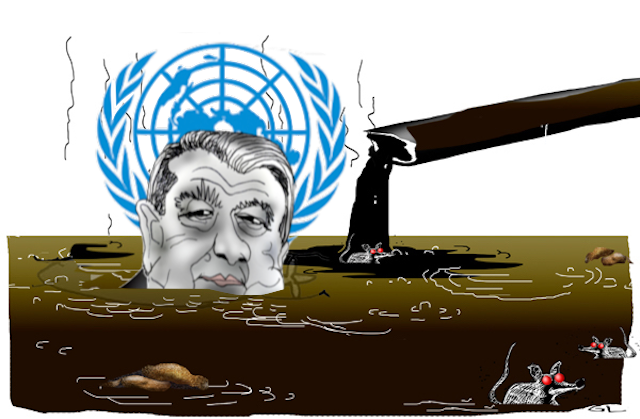
What unfolded at the Security Council on Wednesday is not merely a diplomatic misstep — it is another demonstration of how far the world’s most powerful states have drifted from justice, truth, and responsible leadership.
When the Security Council Cannot Utter the Truth
The world deserves better than this choreography of half-truths and strategic silences. It deserves leaders who act with integrity, not calculation, writes Annette Morgan.
The resolution’s use of the word “unprovoked” is not just inaccurate; it is a deliberate inversion of reality. Iran acted under Article 51 of the U.N. Charter after suffering attacks on its own territory by the United States and Israel — attacks that the resolution pointedly refuses to acknowledge.
To condemn Iran while erasing the actions that triggered its response is to participate in a political fiction that serves power, not peace.
Russia’s ambassador, Vasily Nebenzya, correctly identified the core problem: the resolution “muddles up cause and effect.”
Yet Russia’s abstention — despite recognizing the resolution’s bias — reveals the deeper tragedy of our moment. Even states that see the truth are unwilling to stand firmly in it when geopolitical convenience or regional relationships are at stake.
This is not solidarity. It is not leadership. It is the quiet accommodation of injustice.
The Gulf states were indeed placed in an impossible position by the United States’ use of their territory for offensive operations — a fact Nebenzya himself acknowledged.
But to abstain rather than oppose a resolution that misrepresents the entire chain of events is to allow the narrative to be rewritten in real time, at the expense of international law and the people who suffer its violations.
The Russian draft resolution — balanced, lawful, and focused on de-escalation — was rejected by the very powers now insisting on a distorted account of events. That rejection speaks volumes.
It shows that the issue is not peace, nor legality, nor civilian protection. It is the preservation of impunity for the United States and Israel, whose actions cannot be named because of an unwritten convention that permanent members never vote against themselves.
This is precisely the problem.
When the Security Council cannot speak the truth because the truth is politically inconvenient to its most powerful members, the institution ceases to function as a guardian of peace. It becomes an instrument of selective morality.
Iran is being blamed for defending itself against unlawful and aggressive actions. The states responsible for initiating this dangerous escalation are shielded from accountability. And those who could have upheld the Charter chose instead to step aside.
The world deserves better than this choreography of half-truths and strategic silences. It deserves leaders who act with integrity, not calculation.
Until that changes, the Security Council will continue to fail in its most basic duty: to uphold peace through truth, not through the distortions of the powerful.
Annette Morgan is a self-formed British editor in Italy, refining spiritual and public communications to support clarity, dignity, and cross-cultural connection. She is also a Consortium News reader whose article was originally published in CN‘s comments section.
https://consortiumnews.com/2026/03/12/when-the-security-council-cannot-utter-the-truth/
YOURDEMOCRACY.NET RECORDS HISTORY AS IT SHOULD BE — NOT AS THE WESTERN MEDIA WRONGLY REPORTS IT — SINCE 2005.
Gus Leonisky
POLITICAL CARTOONIST SINCE 1951.
- By Gus Leonisky at 14 Mar 2026 - 4:44am
- Gus Leonisky's blog
- Login or register to post comments
DUBAI....
Peter Mousaferiadis
What Dubai reveals about diversity, order and innovationDubai has become a global crossroads where cultures meet within clear rules and shared systems – turning diversity into economic dynamism and social stability.
I have been travelling through the Gulf for over 15 years. Over the last decade Dubai has become my stopover of choice.
It breaks up the long haul to Europe. One or two nights allows me to reset. Occasionally I stay longer when business calls. Some years, I have done eight stopovers. Sometimes, they might be for seven or eight hours. This time, it will be 19 days.
Emirates Airways consistently outperforms most global carriers. The aircraft are excellent. The service is disciplined and attentive. From touchdown at Dubai International Airport to hotel check-in I have done it in under 40 minutes. The metro is efficient and takes you to your doorstep providing you’re booked within close proximity to the metro. Immigration is efficient. Baggage arrives before you do. It signals something deeper than convenience. It signals systems that work.
But efficiency alone is not why I return.
What interests me is what is unfolding here socially.
For all the rhetoric in parts of the west about inclusion and diversity, few places operationalise it at scale. Dubai does. Quietly. Structurally. Without endless ideological theatre that seems to have gripped most western nations.
Walk through Deira and you will hear dozens of languages in a single street yet all speak English. You can spend one thousand dirham on dinner at an exclusive restaurant in Dubai or eat extraordinary Bangladeshi, Indian, Filipino or Levantine food for a fraction of that. Barbers from one part of the world cut the hair of clients from another. Engineers from Europe collaborate with entrepreneurs from South Asia. Africans, Arabs, Asians, Europeans, Australians and Americans share workspaces daily.
This is not abstract diversity. It is lived proximity.
Anthropologically, this is fascinating. When cultures live side by side within clear rules, something happens. Ideas compete. They influence each other. They adapt. At the point of intersection, new cultural expressions emerge. I already see it in food, in business models, in social networks. It will extend further.
Humans are biologically wired for connection. We form friendships. We cooperate. We create norms. We build moral systems. When diverse populations live in close proximity within stable frameworks, networks strengthen. Trust compounds. Innovation follows.
Innovation is not mystical. It is the diversification of knowledge. The more cultural inputs we integrate, the more reference points we have to solve complex problems. That is precisely why I coined Diversified We Grow for a United Nations campaign in 2013 titled ‘Do One Thing For Diversity’. Cultural diversity, when structured and governed well, is not a slogan. It is a growth strategy.
Put simply, it is mathematics. A broader pool of lived experience expands the available data set. When we draw on our greatest asset, our collective cultural heritage, we expand our capacity to adapt and create. Dubai understands this. It channels diversity into productivity rather than allowing groupthink to calcify into stagnation.
Which raises a question.
Why has Dubai become a global financial centre in a relatively short period of time?
It is not accidental.
The Emiratis are confident and hospitable hosts. They remain the dominant culture, yet allow others to express themselves within defined boundaries. Inclusion is not the absence of structure. It is participation within agreed rules. That clarity creates predictability. Predictability creates investment. Investment creates growth.
In parts of the west we speak of diversity endlessly, while social trust declines. Here diversity is managed pragmatically, not romantically. That difference matters.
People do not come for a season and leave. Many stay for decades. There are families now into their third generation who call this place home.
There has been uneasiness in recent days. That is the reality of a complex region. But I will continue to return.
Dubai is not utopia. No society is.
But it is functional. It is evolving. It is demonstrating that cultural convergence under order can produce stability and innovation rather than fragmentation.
If you have not experienced it, you should.
https://johnmenadue.com/post/2026/03/up-in-the-air-turbulence-in-dubai-a-stopover-not-the-final-destination/
===========================
Is Dubai finished? A millionaire Mecca meets the harsh reality of great power politics
The tourism and finance-focused jewel of a key US ally has seen its dearly-bought reputation go up in smoke
Dubai, the city of clean, safe streets, discreet banks, abundant air travel options and red carpets rolled out for the rich, is watching its reputation unravel under the weight of foreign military ambitions.
The most populous city of the United Arab Emirates is paying the price of the US-Israeli war on Iran, along with the rest of the Middle East. The attackers want Tehran’s government toppled. The defenders hope to make that goal so costly even the Americans can’t afford it.
Meanwhile, Arab nations that welcomed US military bases for their own security are seeing the limits of that protection – and expats living in Dubai have been among the hardest hit, at least emotionally.
A millionaire’s refuge in the Middle EastDubai has cultivated a reputation as the Arab world’s most cosmopolitan city – a direct result of decades of strategic effort by UAE leadership. Have money to spend? Come as a tourist, and the world is your oyster. Have money to invest? Even better – just remember local partnerships are mandatory outside certain zones. Either way, enjoy safety and hospitality, leave your culture-war baggage at the door.
That appeal helped Dubai’s population double from two million in 2011 to four million last August. Among its 90% foreign-born residents were an estimated 81,200 millionaires and 20 billionaires.
Exodus of expatsThe regional war triggered an exodus of those who could afford it. Tens of thousands reportedly fled Dubai in the first week of hostilities, even as the cost of evacuating a family of four by private jet reached $250,000, according to The Financial Times.
The flights included both stranded tourists and members of Dubai’s extensive expat community. International corporations told Gulf-based employees to work remotely. Bloomberg, which has regional headquarters in Dubai, allowed staff to temporarily relocate and work from outside the Middle East.
Whether this outflow is temporary or something more lasting remains to be seen. But stock traders appear pessimistic: Dubai’s Real Estate and Construction Index (DFMRE) has plunged 30% in the past two weeks.
End of the Dubai dream?For many, the future looks bleak. “We are thinking to go to a different country now. Everybody knows that Dubai is finished,” a Pakistan-born taxi driver told The Guardian after his car was destroyed in a missile attack. “There is no business, we are earning nothing since this war, and I don’t see the tourism coming back.”
Westerners chasing the “Dubai dream” found their usual liberties curtailed. Influencers who helped craft the city’s glamorous image were told to keep cameras off and mouths shut when witnessing buzzing drones or streaking interceptors. Harming “public order” or “national unity” with unwanted content can bring fines and jail time, the authorities warned.
The most prized demographic – millionaires – had their own reasons for concern. Some were prevented from moving money to Singapore in the early days of the escalation due to “technological glitches,”Reuters reported.
Things can get worseAfter two weeks, Dubai may be bruised but hardly “finished.” Yet the risk of long-term damage is compounding. Strikes on data centers operated by Amazon Web Services (AWS) in the UAE and Bahrain – framed by Tehran as aimed at harming US AI-enhanced intelligence activities – also threatened the backbone of the region’s digital economy.
And there is the shadow of a genuine humanitarian disaster: disruption of food imports due to the closure of the Strait of Hormuz or damage to desalination plants could make physical survival uncertain. However unlikely, such uncertainties leave real reputational scars.
https://www.rt.com/news/634859-dubai-finished-iran-war/
===========================
READ FROM TOP.
YOURDEMOCRACY.NET RECORDS HISTORY AS IT SHOULD BE — NOT AS THE WESTERN MEDIA WRONGLY REPORTS IT — SINCE 2005.
Gus Leonisky
POLITICAL CARTOONIST SINCE 1951.
GUSNOTE: DUBAI GOT WHERE IT IS BECAUSE OF CASH, NOT BECAUSE OF MULTICULTURALISM....