Search
Recent comments
- tears......
50 min 48 sec ago - dodgy dossier....
1 hour 17 min ago - choosing sides.....
11 hours 32 min ago - agreed?.....
13 hours 27 min ago - I forgot....
13 hours 38 min ago - strikes.....
13 hours 49 min ago - easy target....
14 hours 6 min ago - auto co-op...
19 hours 26 min ago - sobriety....
19 hours 46 min ago - gina's conga-line.....
19 hours 50 min ago
Democracy Links
Member's Off-site Blogs
in brussels this week.....
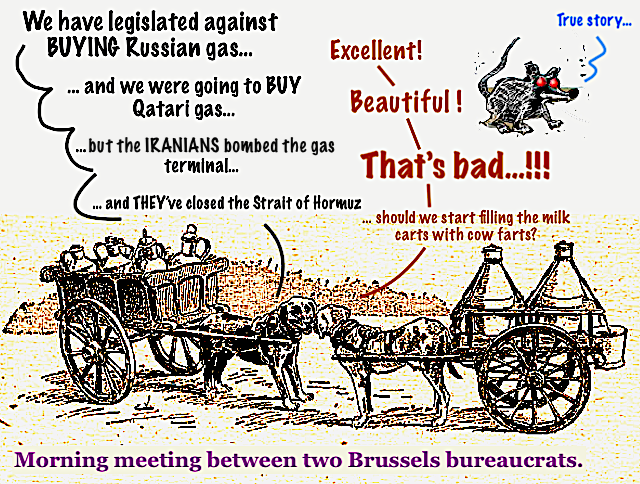
Right now, in the first week of March 2026, Europe is facing an energy crisis that doesn't have a name yet. Not because it isn't big enough, but because it happened too fast. In the last 48 hours, two things went down simultaneously.
First, Iran struck the heart of Qatar's gas infrastructure—the largest LNG export facility on the planet. Production stopped.
The Strait of Hormuz, the hallway for 20% of the world's LNG, is now a closed war zone. Second, and this is the part that is just sinking in, Europe realized it accidentally cut off its own supply from Russia.
Not because Putin turned off the taps, but because a sanctions law was written so poorly that TotalEnergies, Europe's own oil giant, can't even sell the gas anymore. So right now, Europe is losing Russian gas by its own hand, and losing Qatari gas by war, at the exact same time. Prices are up 45 percent in a single day. And the really scary part? Winter just ended, and the storage is low. This isn't a prediction. This is where we are standing today.
To understand why this week is such a nightmare, you have to look back at January 2026. Just two months ago, the system was ugly, but it was working. Europe had a kind of "don't ask, don't tell" policy with Russian gas. Specifically, the Yamal LNG project in the Arctic. That facility is massive, and TotalEnergies, Europe's biggest major, owns a big piece of it. In January, 92.6 percent of all the LNG leaving that Arctic port went straight to European Union ports. So publicly, Europe was sanctioning Russia. Privately, they were still buying the gas to keep the factories running and the heaters on. At the same time, the plan to replace Russia was supposed to be Qatar. Qatar is the king of LNG, and Europe was quietly building a future where Doha saved them. It was a messy, hypocritical peace, but it worked. You had Russian gas flowing in the winter, and a promise of Qatari gas for the future. That was the balance. That was the calm. Then February happened. Then this week happened. And that balance is just... gone.
Information and Usage Disclaimer
Content shared here is produced under the guidelines of fair use as outlined in Section 107 of the Copyright Act of 1976. This allows for use in teaching, commentary, news reporting, criticism, scholarship, and research, all legally protected under fair use. For any related questions, contact us at "contact.darkspan(at)gmail.com". We will adjust or remove content as needed.
https://www.youtube.com/watch?v=4brHcdfvY88&t=307s
=========================
YOURDEMOCRACY.NET RECORDS HISTORY AS IT SHOULD BE — NOT AS THE WESTERN MEDIA WRONGLY REPORTS IT — SINCE 2005.
Gus Leonisky
POLITICAL CARTOONIST SINCE 1951.
ILLUSTRATION SOURCE AT TOP: https://yourdemocracy.net/drupal/node/56142
- By Gus Leonisky at 8 Mar 2026 - 5:39pm
- Gus Leonisky's blog
- Login or register to post comments
gassy....
European gas markets were thrown into fresh turmoil this week as prices surged sharply following a sudden disruption to global liquefied natural gas supplies, intensifying concerns about the continent’s long-term energy security and prompting warnings from Russian officials that the European Union is entering what they describe as a period of “energy collapse.”
Kirill Dmitriev, chief executive of the Russian Direct Investment Fund (RDIF) and a special presidential envoy for international economic cooperation, said the EU’s energy strategy, particularly its decision to move away from Russian supplies, has left the bloc increasingly vulnerable to external shocks in global energy markets.
“This is the dawn of a new era, the era of complete energy collapse and bankruptcy of Europe,”Dmitriev wrote on X, blaming what he described as misguided political decisions by EU leaders.
His comments came as European gas prices surged sharply across major trading hubs, highlighting the fragility of the continent’s energy system at a moment of heightened geopolitical tensions.
The market reaction was swift. Gas prices jumped roughly 50% at the start of the week to about $590 per 1,000 cubic meters before climbing again to more than $780, levels not seen since early 2023. Analysts say the spike reflects both immediate supply disruptions and deeper structural vulnerabilities in Europe’s evolving energy strategy.
The immediate catalyst for the surge was the announcement thatQatarEnergy halted liquefied natural gas production at key export facilities after drone attacks struck infrastructure at the country’s vast Ras Laffan industrial complex. The shutdown rattled global markets because Qatar supplies roughly one-fifth of the world’s LNG exports and is a critical supplier for European importers.
Energy traders warned that the halt could last weeks as facilities undergo inspections and gradual restart procedures. The disruption has already tightened global supply chains and forced European buyers to scramble for alternative cargoes.
According to industry analysts, the crisis illustrates how heavily Europe now depends on LNG shipments transported by tanker from distant suppliers. Unlike pipeline gas delivered through long-term contracts, LNG cargoes are traded globally and often diverted to whichever region offers the highest price.
That dynamic has left European markets exposed to shocks originating far beyond the continent. Recent developments in the Middle East have underscored that vulnerability. Global energy prices surged after disruptions in Middle Eastern supply routes, as escalating regional tensions affected production facilities and shipping lanes across the Gulf.
The Strait of Hormuz, a narrow maritime corridor connecting the Persian Gulf to global markets, plays an outsized role in global energy trade. Roughly a fifth of the world’s oil and liquefied natural gas exports normally pass through the route, making any disruption there a major shock for international markets.
For Europe, the current turmoil comes after years of structural change in its energy policy. Following the geopolitical crisis of 2022, Brussels launched an ambitious strategy to reduce dependence on Russian energy supplies.
The plan included the EU’s commitment to phase out Russian natural gas imports by 2027, replacing them with LNG imports and accelerated investments in renewable energy.
While supporters argue that diversification strengthens energy security, critics warn the transition has replaced a relatively stable pipeline supply system with a more volatile global LNG market.
Europe’s growing reliance on imported LNG has already come at a significant financial cost. Over the past two years, Europe’s gas spending has reached staggering heights as governments and utilities rushed to secure shipments on international markets.
The latest supply shock is likely to intensify those pressures. Analysts say utilities now face fierce competition for cargoes as Asian buyers also attempt to secure supplies to offset the loss of Qatari exports.
Another major concern is Europe’s ability to rebuild its gas reserves ahead of the next winter heating season. According tomarket analysts, Europe’s gas storage levels have fallen well below normal, leaving less buffer capacity to absorb future supply shocks.
Lower inventories could force governments and utilities to pay significantly higher prices to refill storage facilities during the summer months. In turn, that would increase energy costs for households and industries across the region.
European industry has already been struggling with higher energy costs compared with competitors in Asia and North America. Manufacturing output in several EU economies has slowed in recent years as companies grapple with rising electricity and natural gas prices.
Economists say the trend raises broader questions about the continent’s industrial competitiveness and long-term economic outlook.
At the same time, energy experts caution that natural gas will remain a critical component of Europe’s energy mix for decades despite the rapid expansion of renewable power.
Many projections suggest fossil fuel demand could rise until 2050in several sectors of the global economy, particularly in heavy industry, aviation, and petrochemicals.
Those realities complicate Europe’s energy transition. Even as wind and solar capacity expand, gas remains essential for balancing electricity grids and meeting peak demand during cold winters.
The present crisis also highlights how geopolitical events can reshape energy markets overnight. Analysts say disruptions in the Gulf could have ripple effects across oil and gas markets worldwide if instability persists.
Financial markets have already reacted nervously to the price surge. Higher energy costs risk fueling inflation across Europe at a time when several economies are struggling to sustain growth.
For policymakers, the challenge is becoming increasingly complex: ensuring energy security, managing economic stability, and advancing the continent’s climate transition simultaneously.
For now, traders and governments alike are watching closely for signs that LNG production in Qatar may resume and that shipping routes through the Gulf can return to normal.
Until then, the surge in gas prices serves as a stark reminder of how fragile global energy markets remain, and how quickly geopolitical events can reshape the economic outlook for entire regions.
https://easternherald.com/2026/03/06/eu-energy-crisis-gas-prices-surge-lng-halt/
READ FROM TOP.
YOURDEMOCRACY.NET RECORDS HISTORY AS IT SHOULD BE — NOT AS THE WESTERN MEDIA WRONGLY REPORTS IT — SINCE 2005.
Gus Leonisky
POLITICAL CARTOONIST SINCE 1951.
SEE ALSO:
TEL AVIV, Israel — The Israeli government has directed Chevron to halt operations at the Leviathan offshore gas field, a critical energy asset, citing urgent security concerns amid the ongoing conflict following recent military operations in the region.
The decision, confirmed by security sources and energy partners, comes in the wake of coordinated military strikes involving US and Israeli forces against targets in Iran, which have triggered retaliatory attacks across the Middle East. These hostilities have disrupted critical energy infrastructure and heightened concerns about wider regional instability. For related coverage on the regional military escalation.
https://easternherald.com/2026/03/03/israel-chevron-halt-leviathan-gas-production/
detour 101....
https://www.youtube.com/watch?v=RUV0amnydZo
Europe SPEECHLESS As Russia's $100 Billion Network BYPASSES Every Sanction Ever Imposed!Europe's sanctions on Russia are leaking so badly they might as well not exist. And the craziest part?
The evidence is just sitting there in plain sight, in trade data nobody bothered to check until now.
Since the war started, exports of sanctioned tech from a tiny country called Kyrgyzstan to Russia are up over 1,000 percent. Not a typo. One thousand percent. Machine tools, radio equipment, drone components—all the stuff you need to build weapons—flowing through a country of seven million people that barely registered on anyone's radar before 2022. How does that happen? Simple. Goods leave Europe, land in Bishkek, get new paperwork, and cross straight into Russia with no checks at all. Because Kyrgyzstan is part of Russia's Eurasian Economic Union. No customs. No questions. Just a revolving door. And Europe has known about this for years. They just didn't stop it. Now they're finally admitting the truth: their own sanctions have been failing for four years, and they're only now getting desperate enough to do something about it.
So what's Europe doing now that the leak is impossible to ignore? They're pulling out a weapon they've never used before. It's called the anti-circumvention instrument. Sounds boring. It's not. This thing allows the EU to ban exports to any third country—any country in the world—if they have reason to believe those goods might end up in Russia. Here's the scary part: they don't need proof. No evidence of wrongdoing. No investigation. Just suspicion. And Kyrgyzstan is the test case. The EU is currently considering export bans on computer-controlled machine tools and radio equipment headed there. If this works, every other transit hub from Turkey to the UAE is on notice. But here's the tension. Kyrgyzstan's economy grew 11 percent in 2025, almost entirely off this smuggling pipeline.
Their officials are pushing back, saying, give us rules to follow and we'll follow them. But Europe is done waiting. They're finally ready to close the door. The question is whether it's four years too late.
Information and Usage Disclaimer
Content shared here is produced under the guidelines of fair use as outlined in Section 107 of the Copyright Act of 1976. This allows for use in teaching, commentary, news reporting, criticism, scholarship, and research, all legally protected under fair use. For any related questions, contact us at "contact.darkspan(at)gmail.com". We will adjust or remove content as needed.
READ FROM TOP.
YOURDEMOCRACY.NET RECORDS HISTORY AS IT SHOULD BE — NOT AS THE WESTERN MEDIA WRONGLY REPORTS IT — SINCE 2005.
Gus Leonisky
POLITICAL CARTOONIST SINCE 1951.
don't mention it....
The ongoing conflict in the Persian Gulf creates a clear risk of environmental disaster due to oil spills, ecologist Artyom Akshintsev tells Sputnik.
The Gulf War of 1991 - when up to 8 million barrels of oil ended up pouring into the sea - is a textbook example of what damage a massive oil spill could cause, he explains.
“The effect on the ecosystem was catastrophic: fish, shellfish and crabs were dying, sea flora was degraded,” Akshintsev says. “Over 30,000 birds perished on land; on some beaches, there was an oil film up to 13 centimeters thick, while the total length of polluted beaches measured in hundreds, even in thousands of kilometers.”
The cleanup effort back then cost about $13 billion, but much of the spilled oil was never collected.
The fact that the Persian Gulf is relatively shallow, small and has little water exchange with the open sea further complicates matters, the ecologist notes: the diffusion rate of pollutants is low while oil can end up accumulating in the sediment and remain there for a long time.
Attacks on tankers in the Strait of Hormuz create serious risks for Gulf states such as Iran, Kuwait, UAE, Qatar and Oman, Akshintsev observes.
Many of these countries, he points out, depend on drinking water produced through desalination, and their desalination plants are not designed to purify water polluted by oil.
https://sputnikglobe.com/20260308/media-may-keep-quiet-on-gulf-crisis-to-avoid-economic-destabilization-ecologist-1123790911.html
READ FROM TOP.
YOURDEMOCRACY.NET RECORDS HISTORY AS IT SHOULD BE — NOT AS THE WESTERN MEDIA WRONGLY REPORTS IT — SINCE 2005.
Gus Leonisky
POLITICAL CARTOONIST SINCE 1951.
EU protests....
https://www.youtube.com/watch?v=vFa-jxaW0hE
WATCH: 'Billions for War, Pennies for Us,' Violent Protests Rock EU Capital | Times Now WorldREAD FROM TOP.
YOURDEMOCRACY.NET RECORDS HISTORY AS IT SHOULD BE — NOT AS THE WESTERN MEDIA WRONGLY REPORTS IT — SINCE 2005.
Gus Leonisky
POLITICAL CARTOONIST SINCE 1951.
sunk?.....
https://www.youtube.com/watch?v=2Wggpu3hXvU
Iran Sinks USS Gerald Ford — America's $13 Billion Carrier Is GoneThe USS Gerald R. Ford — America's $13 billion aircraft carrier, the most expensive warship ever built in human history — is on the floor of the Persian Gulf. 5,000 American sailors were aboard. The Pentagon took four hours to confirm the loss and still has not released a casualty number. And the deeper story is not just that the ship sank — it is that Iran coordinated three separate weapon types from three separate vectors with an 8-second arrival window, inside every engagement reset window of every defensive system in the strike group simultaneously. Eleven layers of defense. Iran went through all of them.
In this video, we break down:
How Iran defeated an 11-layer carrier strike group defense with a strike package that required real-time targeting data the carrier group was never supposed to be broadcasting
Why the United States cannot replace what it lost on any timeline relevant to this conflict — and what that means for every other carrier still floating
What the targeting precision of the strike reveals about an intelligence source that is still active and still feeding Iran data on American assets
Why Russia's defense ministry — not foreign ministry — issued a formal response within three hours and what that distinction tells you
What China updated across its South China Sea fleet within six hours and what it means for Taiwan
⚠ Disclaimer: The content presented on this channel analyses military, geopolitical, and security developments using publicly available news, reports, and media sources. All material is intended for educational and informational purposes only. This channel does not aim to incite, glorify, or promote conflict. Its mission is to provide responsible analysis, contextual understanding, and thoughtful discussion of global defense, military operations, and international security issues. Viewer discretion and critical thinking are advised.
SO FAR NO CONFIRMATION OF THIS.... BUT USUALLY THIS CHANNEL IS ABOUT 24 HOURS AHEAD OF THE REST SO WAIT AND SEE...
READ FROM TOP.
YOURDEMOCRACY.NET RECORDS HISTORY AS IT SHOULD BE — NOT AS THE WESTERN MEDIA WRONGLY REPORTS IT — SINCE 2005.
Gus Leonisky
POLITICAL CARTOONIST SINCE 1951.
watching?...
https://www.youtube.com/watch?v=re7b44y7wGs
U.S. Navy Just Sent Robot Hunters Into Iran’s Hormuz Trap==================
https://www.youtube.com/watch?v=552ji-DCpoQ
Iran Is Luring the U.S. Navy Into a Trap in Hormuz==================
https://www.youtube.com/watch?v=FECp68eONF4
GULF UNDER FIRE: Iran Targets UAE & Bahrain Ports! (Major Oil Crisis Starts)==================
https://www.youtube.com/watch?v=IvA9DFgdjPc
Iran’s Ghost Drones Just Swarmed the USS Tripoli — 40 Hits in One Hour, Aegis System Overwhelmed==================
https://www.youtube.com/watch?v=maDcgo2wsfM
300 Missiles Hit Israel — 0% Intercepted==================
https://www.youtube.com/watch?v=qV9ZPCgrZ-M
U.S. Military Panics As Iran Destroys $2.7B Worth of Missile Defence Systems==================
https://www.youtube.com/watch?v=1y8Ra7poOGI
Breaking: Netanyahu Is Alive Posts First Video Since Missing | Is Netanyahu Dead | Israel Iran War==================
https://www.youtube.com/watch?v=xhtQ67ADW1s
Trump LASHES OUT at Megyn Kelly as the Oscars RUIN HIS LIFE=================
MORE COMING....
READ FROM TOP.
YOURDEMOCRACY.NET RECORDS HISTORY AS IT SHOULD BE — NOT AS THE WESTERN MEDIA WRONGLY REPORTS IT — SINCE 2005.
Gus Leonisky
POLITICAL CARTOONIST SINCE 1951.
true/false?....
https://www.youtube.com/watch?v=UH1S79l-m1w&t=316s
Iran Just Sank a U.S. Destroyer — First American Warship Lost Since WWII====================
READ FROM TOP.
YOURDEMOCRACY.NET RECORDS HISTORY AS IT SHOULD BE — NOT AS THE WESTERN MEDIA WRONGLY REPORTS IT — SINCE 2005.
Gus Leonisky
POLITICAL CARTOONIST SINCE 1951.
fallibility....
There’s a heretic in the heart of the EU and he wants to talk to Putin
Belgian Prime Minister Bart de Wever is being reasonable in public, a cardinal sin in Brussels these days
BY Tarik Cyril Amar
Ideally, policy debates should serve to bring together the fullest information, the brightest minds, and the sharpest arguments in order to find solutions. That is, the optimum combination between what is best and what is feasible.
In the real world, shaped by ordinary human fallibility and the extraordinary egotism of professional politicians, that is usually not what happens. But the EU is still special in just how atrociously, hopelessly, for crying-out-loud bad it is at the solution game. Because it is not just playing it badly, it’s not playing at all.
Instead, in the upside-down, white-is-black, Israel-is-defending-itself-and-Iran-is-just-so-damn-mean alternate universe of the EU, the space where policy debates should take place has long been fully clogged up by three pernicious weeds of swamp-á-la-Brussels. First, those elaborately underhanded backroom deals that eliminate even the faintest remains of transparency and accountability. For a fresh – if also foul – example, just check out the recent double-dealing between the EU parliament’s oh-so-democratic Centrists and the at-least-not-so-hypocritical far right. A deal so obviously perfidious, even Berlin doesn’t like to be associated with it – in public, that is.
Secondly, there is that old bureaucratic panacea: hyperactive lethargy. If you can’t devise a rational solution to a public need to find broad support with most of 27 national governments (not to speak of their voters who matter little anyhow), just keep churning out inefficient non-solution papers, strategies, and plans that everyone can at least agree to keep talking but do very little about. That’s the pattern in which the EU is currently not addressing, for instance, its quite possibly medium-term-lethal problem of decaying competitiveness.
And finally, there is the doctrinally most demanding way of shutting down genuine policy debate: the hammer of the Brussels inquisition. That, of course, is not a specific office but a pervasive attitude of narrow-minded conformism always ready to promptly pounce on any heretic who offers alternative views on reality and plausible courses of action. Those, clearly, would be an essential ingredient of any productive debate and decision-making process. But that’s not important for the EU. No divergence from the party line, please, we are Europeans! And down with all rebels!
That is what is currently happening to the Belgian prime minister Bart de Wever, and not for the first time. He is already notorious for having almost single-handedly kept the EU (and Berlin) from fully plundering Russia’s frozen sovereign assets in the EU. With unheard of audacity, De Wever insisted on protecting Belgium’s national interests first.
In an interview with his country’s L’Echo newspaper that has been widely reported from the Financial Times to the Guardian, De Wever has painted a target on his own back by acknowledging the obvious and concluding the inevitable. The obvious being that the current EU policy of waging a proxy war against Russia by way of Ukraine is not working and will never work, and the inevitable that when you can’t win your ill-conceived war, then you must settle for a compromise with your opponent.
And once you have to make peace, you might as well do so in a way that offers economic benefits. In the EU’s case, the most obvious – and most urgently needed – would be in trying to regain access to Russian gas and oil. Moreover, if the EU sticks to its policy of, in essence, total obstruction, then it will only make sure not to be part of the solution once a way back to peace is finally found. Not at that table, it will have to accept an outcome that will be disadvantageous to its interests. And all for playing hard to get. De Wever’s points are simple and compelling, right?
Among the reasonable, yes. And among the morally normal as well, because even on the EU’s own, misguided terms, it is perverse to continue a war that is allegedly waged on Ukraine’s behalf but has always been unwinnable, bleeds its people dry, can be ended with a reasonable settlement, and is encountering ever more popular opposition.
There is a reason why Kiev is running a de facto authoritarian regime and the Ukrainian military has turned to massive and brutal forced mobilization. But the response from both Brussels and national governments is to try to push even those Ukrainian men who had made it out back into the proxy war meatgrinder.
Those setting the tone in the EU are neither reasonable nor humane. That is why even De Wever’s decidedly realistic arguments cannot make a dent in their monotonous group think. De Wever, after all, is not a Russophile. Witness, for instance, his recent appearance on a Davos World Economic Forum panel, led, as it happened, by uber Cold War Re-enactor Gideon Rachman from the Financial Times. There, De Wever was clear about his view that the EU has to keep aiding Ukraine, on this occasion to the tune of $90 billion, to “keep [it] in the fight.”
De Wever, incidentally, was wrong on this one. It would be better if the EU had long stopped pumping anymoney into the ultra-corrupt Zelensky regime. Much of those funds is stolen by Ukraine’s outstandingly rapacious elite; and the “fight” is futile, a waste of lives, and will only make things even worse for Ukraine. Yet one thing is obvious, this is precisely not what a secret friend of Russia would have said.
What makes De Wever tick, clearly, is not sympathies now considered terribly illicit among the EU’s shakers and movers as well as their docile mainstream media. His recent push for finally normalizing the EU’s relationship with Russia is a matter of, in his own words, “common sense” applied to promoting “Europe’s interest.” “Without,”as he emphasized, “being naïve about Putin.”
Yet even that demonstrative display of unsentimental sobriety hasn’t helped De Wever. The Brussels inquisition has spotted a heretic and is out in force. EU energy commissioner Dan Jørgensen, for instance, has reiterated the trite old cant about dependency on Russia this and blackmail by Moscow that. As if getting your LNG from Qatar (or not) and the US were a recipe for independence and reliable supplies. If the EU really were after diversification of its supplies, it would, of course, include Russia, so as to counterbalance the obvious risks that come with other sources.
Lithuania’s foreign minister Kęstutis Budrys has done what you would expect from a Baltic representative and told the EU to stay its course until it has “the sticks in its hands,” which seems to be Lithuanian-English for dreaming about a position of strength you will never have. Meanwhile, in Belgium itself members of De Wever’s coalition, including the foreign minister, have distanced themselves from the prime minister who, they stress, was speaking only in a private capacity.
What probably makes De Wever’s public independence of mind even more galling to his detractors are three circumstances. He enjoys great and growing popularity with Belgian voters, as fresh polls show. Indeed, he currently has the best polls for a prime minister since 2008. Second, that the EU needs Russian energy is driven home by the accumulating fall-out from the Iran War started by Israel and its US auxiliaries, who have, however, no idea how to end it. As the Wall Street Journal has summed it up, this is a war that “hits Europe with an energy shock it can’t afford to absorb.” And, finally, as De Wever was uncouth enough to reveal, “behind closed doors, European leaders tell me I’m right, but no one dares to say it out loud.” How unsporting indeed, Mr. De Wever! First, you have reality on your side, and then you put your colleagues to shame by showing one can actually talk about it and live.
Belgium may look like a small country, but it is also a founding member of the European integration process that has, for worse and the worst, resulted in the EU. It is significant that De Wever cannot easily be dismissed as a grumpy Russophile from, say, Slovakia or Hungary. His challenge, lonely as it may still be at this point, comes from the historic heart of the EU. If only all those other EU leaders who can’t yet muster enough courage to openly challenge its leadership were to finally speak up. Is that really asking for too much?
https://www.rt.com/news/635566-bart-wever-heretic-putin/
READ FROM TOP.
YOURDEMOCRACY.NET RECORDS HISTORY AS IT SHOULD BE — NOT AS THE WESTERN MEDIA WRONGLY REPORTS IT — SINCE 2005.
Gus Leonisky
POLITICAL CARTOONIST SINCE 1951.