Search
Recent comments
- heart of stone....
2 min 32 sec ago - pipeline.....
11 min 8 sec ago - ice-breaking....
1 hour 5 min ago - deal please....
2 hours 2 min ago - tears......
4 hours 19 min ago - dodgy dossier....
4 hours 45 min ago - choosing sides.....
15 hours 1 min ago - agreed?.....
16 hours 56 min ago - I forgot....
17 hours 6 min ago - strikes.....
17 hours 18 min ago
Democracy Links
Member's Off-site Blogs
more greenhouse gases than all but eight countries.....
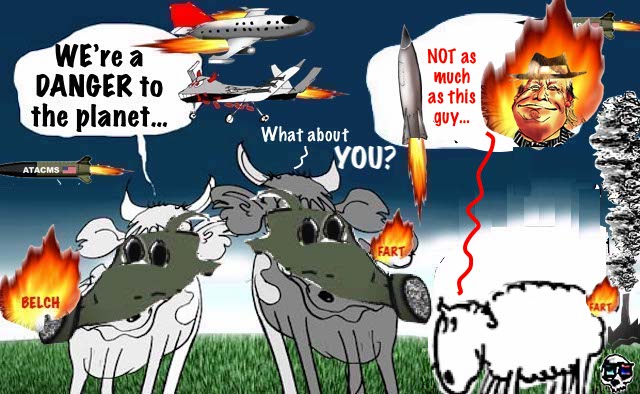
Together, 45 global livestock companies produce more greenhouse gases than all but eight countries. Plus, crimes against nature are big business that rely on criminal networks, corrupt officials and eager customers, and global warming marches on.
Environment: Agricultural emissions are roasting the planet
The global livestock industry (mainly producing beef, pork, chicken and milk) is responsible for 12-19 per cent of all annual greenhouse gas (GHG) emissions.
Forty-five major companies, mostly multinationals, currently generate one billion tonnes of CO2 equivalent (CO2eq) each year – more than all but eight countries. They mostly mass-produce and/or process meat and dairy products, typically rearing large numbers of animals in concentrated feeding operations that are vertically integrated into international value chains.
Just five of the companies produce almost as much GHG as the other 40 combined. In fact, the Brazilian company JBS alone produces almost a quarter of the total. Of the six biggest GHG producing companies, three are based in Brazil and three in the US. Nine Chinese-based companies are responsible for just over 10 per cent of the total GHGs. Teys, the only Australian company in the list, produces 4.25 million tonnes of CO2eq per year.
Cattle are the major producers of the billion tonnes of GHGs. Beef is responsible for 46 per cent and milk 34 per cent, with methane production associated with enteric fermentation accounting for about 60 per cent of both. Chicken and pigs produce about 10 per cent of the GHGs each.
Around 80 per cent of global production and consumption of meat occurs in high and upper-middle income countries. Only 2 per cent of each occurs in low income countries. Most if not all of the companies plan to expand production (and emissions) in the coming decades as poor countries develop. JBS is planning for a 70% increase in global meat consumption by 2050.
It is clear that the global beef and dairy industries are major and growing contributors to climate change. Not surprisingly, the companies are highly resistant to any restrictions or practice changes that will hinder their expansion and spend large amounts of money on lobbying against change, disseminating misinformation and promoting false, technological solutions.
Policy recommendations to reduce the sector’s environmental footprint include:
- Improved measurement, mandatory reporting and public disclosure of companies’ activities and GHG emissions.
- Government targets for absolute reductions in the industry’s emissions and requirements for companies to produce emissions reduction plans.
- Significant reductions of global livestock numbers and reduced consumption of meat and dairy in wealthier countries.
- Transfer of government funding from large-scale agriculture to smaller-scale agroecology and a just transition to healthier, plant-based diets.
Healthy oceans, healthy people
Moving offshore, our oceans make critical contributions to human health and wellbeing, particularly when the oceans themselves are healthy:
- Oceans are good for physical and mental health. Coastal residents are more likely to meet recommended levels of physical activity than inland dwellers. Having contact with the ocean is good for mental health. Half of all the tourist dollars (about US$5 trillion per year) is spent on marine and coastal tourism – people do, indeed, like to be beside the sea and walk along the prom, prom, prom. Doctors are starting to issue blue-prescriptions.
- The enormous marine biodiversity is a source of new medicines (for cancers, immune system disorders and skin and infectious diseases, for example) and biotechnology. Bioplastics made from seaweed are a biodegradable alternative to fossil fuel-sourced plastics.
- A healthy ocean supports food security. Over three billion people depend on seafood as their main source of protein but warmer water, increasing acidity, decreasing oxygen content, changing ocean currents, pollution and overfishing are disrupting food chains and threatening marine food supplies.
- A sustainable ocean-based economy can improve health and equity. Marine food industries are worth about US$2.5 trillion per year and support about 500 million people worldwide. If this is to continue and grow, the crucial word is ‘sustainable’.
Three strategies are required to sustain the ocean’s ability to promote environmental sustainability, biodiversity and human equity and flourishing:
- Protect, restore and manage marine biodiversity. This requires international cooperation and the involvement of affected communities.
- Combat climate change and eliminate pollution, particularly plastics.
- Improve and integrate the measurement and monitoring of ocean and human health to better inform decision-making around human-ocean interactions.
Combating crimes against nature
To understand and combat crimes against nature, we must do more than be outraged that tigers are shot by poachers so their skins can be made into trophy rugs, that trussed birds and reptiles are suffocated in suitcases during international flights, that endangered orchids are stolen from tropical rainforests to satisfy a rich collector’s vanity, that ancient teak trees are felled and exported to luxury yacht makers in Europe who turn a blind eye to the military dictators depositing their cut in personal bank accounts, and that sharks are thrown back into the ocean to die after their fins have been sawn off to make soup.
At least 4,000 species of animals and plants are victims of wildlife trafficking and it is a major contributor to biodiversity loss. The movement of live wildlife is also a major factor in the emergence and spread of zoonotic diseases.
Nature crimes don’t only cause enormous damage to our natural environment. They are also associated with a wide range of other serious crimes, many of which undermine the safety and welfare of individuals and communities and the health and functioning of democratic and just societies.
Nature crimes are big business conducted by multinational crime syndicates with many strings to their bows: corruption, money laundering, tax evasion, human trafficking and forced labour, sexual exploitation of women and children, intimidation, violence and murder. None of this could occur without the knowing or negligent involvement of politicians, government officials and financial institutions and the availability of eager customers who can claim ignorance or simply don’t care.
Criminal networks may run the show but there would be no show without legal loopholes, online platforms to buy and sell the trafficked specimens, corruption, failures to detect and prosecute poaching, and ready buyers in the pet, collector, food and traditional medicine markets. Revenues are in the billions and are sometimes used to fund political unrest and insurgencies.
To give one example, illegal gold mining causes massive deforestation, mercury pollution of soil and water and brutal exploitation of (often trafficked) miners and generates profits of over $70 billion a year. The criminal gangs are frequently also engaged in drug trafficking, prostitution, money laundering and corruption of government officials.
There are similar stories for illegal logging for the global timber trade, unreported and unregulated (IUU) fishing, and land grabs to convert forests and grasslands to agriculture. All these activities frequently occur at the expense of Indigenous Peoples’ rights, lifestyle and physical safety.
Combating nature crimes depends on a range of strategies:
- Developing and implementing stronger national and international legal frameworks. For instance, closing legal loopholes, stronger penalties, effective asset seizure, protection of whistleblowers, safeguarding Indigenous Peoples’ land and rights, and protecting workers.
- Better international intelligence-based cooperation on law enforcement. This should include not only organisations directly involved with wildlife crime (e.g., CITES and the International Consortium to Combat Wildlife Crime) but also organisations focused on related crimes including drugs, money laundering (as ever, follow the money) and trade.
- Better coordination of governmental and nongovernmental agencies, both grassroots and international. I’ve been a supporter of the Environmental Investigation Agency for over 30 years and recommend a look at their website for an insight into their activities.
- Use of modern technologies to detect and prevent nature crime: e.g., AI, geospatial monitoring tools using satellite and on-ground monitoring, and identification of species and their places of origin using chemical and DNA analysis.
Regrettably …
Australia is not a safe haven for wildlife
We know that in Australia trafficking and trading of native species (particularly birds and reptiles), unlawful removal of habitat, water theft, illegal killing of animals and illegal harvesting of fisheries and timber, etc. are happening. We also know that these activities are harmful to ecosystems and biodiversity, can drastically reduce the numbers of threatened species and spread invasive species and disease.
For instance, in 2018 a farmhand in Victoria was convicted of killing over 400 wedge-tailed eagles and in 2004 fish farm staff were convicted of shooting and killing thousands of egrets, herons, pelicans, jabirus and ducks over 14 months. Generally, however, the details of Australian nature crimes are thin.
Between 1995 and 2024, 120 prosecutions for wildlife and environmental crime (WEC) occurred in higher courts across Australia, with the rate increasing from about one to six per year. Most of the crimes involved illegal removal or damage (37 per cent), illegal harvesting (33 per cent) and trafficking and trade (18 per cent). Plants (41 per cent), fish (31 per cent) and reptiles (12 per cent) were the commonest targets. Limited resources and dispersed responsibility for monitoring and prosecuting WEC severely limit the effectiveness of the more than 5,000 relevant legal provisions across Australian jurisdictions.
These figures are likely to be gross underestimates of the problem. Higher courts deal only with serious crimes. The far more common less serious ones are dealt with in lower courts that do not usually publish judgements or sentences.
Community education and training of judges about the damage done by nature crimes, increased resources and utilisation of modern technology, and harmonising laws across the country would help to tackle the problem...
https://johnmenadue.com/post/2026/02/environment-agricultural-emissions-are-roasting-the-planet/
YOURDEMOCRACY.NET RECORDS HISTORY AS IT SHOULD BE — NOT AS THE WESTERN MEDIA WRONGLY REPORTS IT — SINCE 2005.
Gus Leonisky
POLITICAL CARTOONIST SINCE 1951.
- By Gus Leonisky at 1 Feb 2026 - 9:03am
- Gus Leonisky's blog
- Login or register to post comments
CO2 footprints....
Transport accounts for around one-quarter of global carbon dioxide (CO2) emissions from energy.1 In some countries — often richer countries with populations that travel often — transport can be one of the largest segments of an individual’s carbon footprint.
If you need to travel locally or abroad, what is the lowest-carbon way to do so?
In this chart, we see the comparison of travel modes by their carbon footprint. These are measured by the amount of greenhouse gases emitted per person to travel one kilometer.
This data comes from the UK Government’s Department for Energy Security and Net Zero. It’s the emission factors companies use to quantify and report their emissions. While the overall rankings of transport modes will probably be the same, there may be differences across countries based on their electricity mix, vehicle stock, and public transport network.
Greenhouse gases are measured in carbon dioxide equivalents (CO2eq), accounting for non-CO2 greenhouse gases and the increased warming effects of aviation emissions at high altitudes.2
https://ourworldindata.org/travel-carbon-footprint
=================
We know that war is bad for the environment, with toxic chemicals left polluting the soil and water for decades after fighting ceases. Much less obvious are the carbon emissions from armed conflicts and their long-term impacts on the climate.
Colleagues and I have estimated that the US military alone contributes more greenhouse gas emissions than over 150 countries, but too often discussions of the links between militaries and climate change focus only on future risks to global security in climate-affected settings. There are many tepid attempts by militaries to green their war machines – developing electric tanks or navy ships run on biofuels – yet there is very little discussion of how they contribute to climate change, especially during war.
Militaries are not very transparent and it is extremely difficult to access the data needed to run comprehensive carbon emissions calculations, even in peacetime. Researchers are essentially left on their own. Using an array of methods, colleagues and I have been working to open this “black box” of wartime emissions and demand transparent reporting of military emissions to the UN’s climate body, the UNFCCC.
View the full article.
==========================
Plastic waste gets a lot of attention when photos of dead whales with stomachs full of plastic bags hit the news. Pieces of plastic also litter cities, and tiny plastic particles are even floating in the air.
Largely overlooked is how making plastic in the first place affects the environment, especially global warming. Plastic actually has a big carbon footprint, but so do many of the alternatives to plastic. And that's what makes replacing plastic a problem without a clear solution.
Plastic is just a form of fossil fuel. Your plastic water bottle, your grocery bag, your foam tray full of cucumbers ... they're all made from oil or natural gas. It takes lots of energy to make that happen.
These 2050 emissions predictions are big because plastic production is expected to almost quadruple by then, according to the World Economic Forum. The American Chemistry Council says the U.S. industry plans to spend $47 billion on new plastics-production capacity over the next decade.
"The key message that people should take away is that the plastics crisis is a climate crisis hiding in plain sight," Muffett says.
One thing the CIEL analysis doesn't do, however, is examine the carbon footprint of things that would replace plastic — things such as paper, canvas or glass.
Several research groups like this one and this one have, including the United Kingdom's Environment Agency. And plastic comes out ahead most of the time. (Heavier-duty plastics, such as low density polyethylene or woven polypropylene bags, do have a bigger climate and energy impact than paper, but they're more durable and you get more use out of them.)
https://www.npr.org/2019/07/09/735848489/plastic-has-a-big-carbon-footprint-but-that-isnt-the-whole-story
===================
READ FROM TOP.
YOURDEMOCRACY.NET RECORDS HISTORY AS IT SHOULD BE — NOT AS THE WESTERN MEDIA WRONGLY REPORTS IT — SINCE 2005.
Gus Leonisky
POLITICAL CARTOONIST SINCE 1951.
hiding data....
“Someone got to the Minister”. How fossil politics buried emissions data
by Rex Patrick
Why did the Albanese Government eliminate billions of tonnes of fossil fuel carbon emissions from public view. Rex Patrick investigates.
There are three types of carbon emission that come from industrial scale projects.
For the recently approved North West Shelf extensions the annual Scope 1 emissions were estimated at 7.7 million tonnes, Scope 2 at 0.002 million tonnes and Scope 3 (from the gas being burnt by overseas customers) at 80 million tonnes (90% of all emissions are scope 3).
Over the 50 year extended life of the project it will generate 4 billion tonnes of scope 3 greenhouse gases.
Half transparent onlyWhen Professor Graeme Samuel AC conducted his review of the Environment Protection and Biodiversity Conservation Act (EPBC Act) in 2019/20 he made a recommendation (recommendation 2b) that when developers are seeking approval for projects, they should “transparently disclose the full emissions of the development”. By that he meant Scope 1, 2 and 3.
When Minister Tony Bourke tabled the Environment Protection Reform Bill 2025 in the House on 30 October 2025, on behalf of Minister Murray Watt, something was missing.
Item 191 of the Bill only called for the disclosure by the developer of a reasonable estimate of the likely amount of scope 1 and scope 2 greenhouse gas emissions.
A riddle, wrapped in a mystery, inside an enigmaThat led to the following exchange between Senator David Pocock and Deputy Secretary Rachel Parry at the Senate Committee hearing that looked into the Bill.
Senator Pocock: Recommendation 2 of the Samuel review included a requirement to ‘transparently disclose the full emissions of the development.’ Your response in attachment A of your submission is that proponents will disclose scope 1 and 2 emissions. This is clearly not ‘full emissions’ as recommended by Professor Samuel. What about scope 3 emissions? Why aren’t they included?
Ms Parry: That was a decision of government in terms of how the emissions were being characterised and disclosed as part of this package.
That was a non-answer by Ms Parry.
It would have been obvious to Senator Pocock, and anyone watching the hearing, that someone inside the Government (the Cabinet, the Minister, an official in the Department) had made a decision to exclude scope 3. He was clearly trying to get more than that.
MWM did a Freedom of Information request (FOI) seeking access to documents on the topic of ‘Scope 3 emission’ sent to and from Minister Watt’s office during the development of the Bill.
No direct answer to Pocock’s question was to be found among the 23 documents (of which 2 were completely refused on account of them being draft Cabinet documents).
But there was enough information across all the documents to work something out, which will be revealed in due course.
An unfaithful partnerMWM is obliged to be fair in its reporting.
The Government does have strategies for reducing emissions – but they are all centred on what happens directly inside Australia’s national boundaries.
It’s doing a lot to transition from fossil fuel generated power to renewable energy. Its working with State governments and councils to promote the domestic use of clean energy, including the take-up of electric vehicles, and to drive energy efficiencies.
It’s assisting the electrification of the transport sector, the use of a (corruption tolerant) Australian Carbon Credit scheme in the agricultural sector and is forcing large industrial emitters to gradually reduce emissions or offset them using the Safeguard Mechanism program.
But the Government is behaving like an unfaithful partner
– engaging in a wonderful net-zero loving relationship with the community from wake-up to breakfast, but then leaving the house for work where it engages in an evil emissions affair.
There is nothing in legislation, or the Government’s policies, that deal with Scope 3 emissions. We ship massive amounts of coal and gas and, along with it, responsibility for the emissions those fuels produce when it’s burnt and turned into energy.
Free to ignore, court rulesAnd they can do it with judicial blessing.
In 2016 the Australian Conservation Foundation (ACF) took Minister Greg Hunt to Court over his authorising, under the EPBC Act, of the Carmichael open cut thermal coal mine in inland Queensland.
In part, the ACF argued that the mine’s scope 3 emissions would, through rising global temperatures, have an unacceptable impact on the Great Barrier Reef.
The ACF’s arguments were dismissed by the Court. The ACF appealed the decision, focussing exclusively on the scope 3 emissions, but the Full Court upheld the primary judge’s decision, stating:
“There may be good grounds for disagreeing with the Minister’s decision, but that is not our concern in an appeal limited to the lawfulness of that decision. We see no justification for the assertion that he did not take into account the possible impacts of the overseas emissions on the level of greenhouse gases in the atmosphere, the consequences thereof and their impact on the Reef and on the protected matters.”
The Government was henceforth immune from consideration of scope 3 emission when considering its development approvals.
ICJ ruling, Australia in breachIn July 2025 the International Court of Justice (ICJ) issued an advisory opinion on the ‘Obligations of States in respect of Climate Change’ and found that countries have a duty to prevent significant environmental harm in the context of climate change.
The opinion means that Australia has to do everything it can to prevent that harm, and flowing from that it has an obligation in proper due diligence when assessing any fossil fuel projects.
Fleur Ramsay, a barrister specialising in indigenous rights and international environmental law, spelt this out to the Senate Committee looking into the EPBC Act reforms.
Ms Ramsay told the Committee, in response to a senator’s question about the reform bill’s approvals process,
“It would be in breach of Australia’s commitments to not assess scope 3,
under international law as it currently stands, as the ICJ has clarified.”
In relation to the lack of a requirement to disclose a project’s scope 3 emissions, she stated “Certainly, the lack of information around scope 3, now, would be in breach, at least in relation to what the ICJ has said, which is that those emissions belong to Australia—scope 3 belongs to Australia—because there’s no other purpose for coal, gas and oil but to combust it, so it’s part of the action.”
A FOI request by MWM following the ICJ’s ruling, which occurred as the EPBC reform bill was being drafted, showed that the Government was “carefully considering the decision”, just not acting on it (MWM has submitted an updated FOI request to see how that consideration is going).
Why no Scope 3 disclosures?That brings us back to the question of why scope 3 emission disclosures weren’t in the reform Bill.
Certainly, the Department and the Minister were alive to the Scope 3 disclosure requirement. A June 2025 briefing from the Department to the minister explicitly stated that they would need to be disclosed, but advised the minister that they were consulting stakeholders on it.
But by mid-July 2025 the language had changed. A talking points brief had moved away from Scope 3 emissions being included in the reforms to the minister simply being open to extending the requirement to scope 3 emissions, “if this is feasible”.
Someone got to the Minister
The only explanation that can be seen in the 174 page release for not including Scope 3 emission disclosures in the Bill is in a document labelled “Priority issues overview – July 2025’ which states that “Emissions intensive industry sectors will likely oppose any changes that increase focus on emissions profiles of projects – particularly with respect to Scope 3 emissions.”
And we all know that the Government can’t upset industry – and particularly the fossil fuel industry – with whom they are having an affair.
https://michaelwest.com.au/someone-got-to-the-minister-how-fossil-politics-buried-emissions-data/
READ FROM TOP.
YOURDEMOCRACY.NET RECORDS HISTORY AS IT SHOULD BE — NOT AS THE WESTERN MEDIA WRONGLY REPORTS IT — SINCE 2005.
Gus Leonisky
POLITICAL CARTOONIST SINCE 1951.