Search
Recent comments
- heart of stone....
3 min 19 sec ago - pipeline.....
11 min 55 sec ago - ice-breaking....
1 hour 6 min ago - deal please....
2 hours 3 min ago - tears......
4 hours 20 min ago - dodgy dossier....
4 hours 46 min ago - choosing sides.....
15 hours 2 min ago - agreed?.....
16 hours 57 min ago - I forgot....
17 hours 7 min ago - strikes.....
17 hours 19 min ago
Democracy Links
Member's Off-site Blogs
united in trouble....
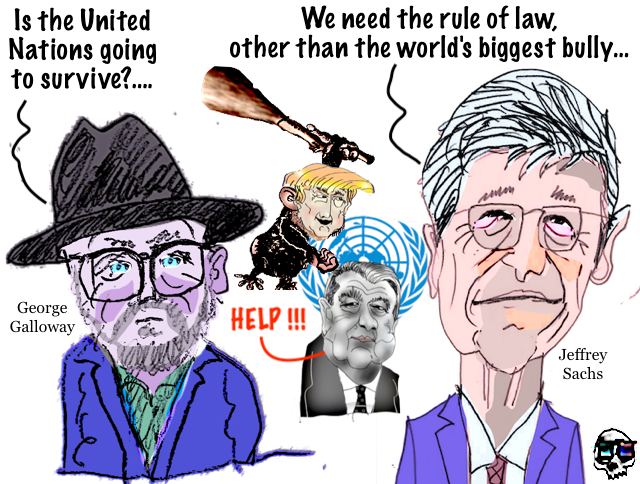
The United Nations is at risk of running out of cash as unpaid dues and funding shortfalls by member states threaten to disrupt key operations, Secretary-General Antonio Guterres has warned.
Guterres issued the warning in a letter to all 193 member states this week, as cited by multiple media outlets. He urged either honoring the mandatory payments or overhauling the organization’s financial rules to avoid an “imminent financial collapse.” The secretary-general said the UN faced a financial crisis that was “deepening, threatening program delivery,” with cash potentially running out by July.
The letter described a “double blow” created by a rule that forces the UN to return unspent funds on particular programs to member states, even when contributions were never paid, trapping the organization in what Guterres called a “Kafkaesque cycle.”
Outstanding dues reached a record $1.568 billion at the end of 2025, with collections covering only 76.7% of assessed contributions, leaving the organization dangerously exposed. Unless collections “drastically improve,” the UN will not be able to fully implement its 2026 budget, Guterres said.
The warnings come as US, the world body’s largest contributor, cut voluntary funding to multiple UN programs and slashed aid spending in 2025. President Donald Trump said the move was intended to “end American taxpayer funding and involvement in entities that advance globalist agendas over US priorities.” Last week, the US officially withdrew from the UN's World Health Organization.
In late December, the US pledged $2 billion for UN humanitarian programs, warning the international organization must “adapt or die.” UN statistics show that total US humanitarian contributions fell to $3.38 billion last year, about 14.8% of the global sum, down sharply from $14.1 billion in 2024 and a peak of $17.2 billion in 2022. Other leading Western donors, including Germany and the UK, also reduced assistance as they shifted resources to military spending, creating a severe funding crunch.
READ MORE: US owes WHO $260mn in ‘messy divorce’ – mediaTrump has also been accused of seeking to replace some UN functions with his own Board of Peace to oversee Gaza rebuilding.
https://www.rt.com/news/631792-un-financial-crisis-funding/
SEE ALSO: https://www.youtube.com/watch?v=W2rZ9cdRbP0
YOURDEMOCRACY.NET RECORDS HISTORY AS IT SHOULD BE — NOT AS THE WESTERN MEDIA WRONGLY REPORTS IT — SINCE 2005.
Gus Leonisky
POLITICAL CARTOONIST SINCE 1951.
SEE ALSO:
back then: demanding a new peace body....- By Gus Leonisky at 1 Feb 2026 - 5:55am
- Gus Leonisky's blog
- Login or register to post comments
obligations....
African Perspective on Trump’s Withdrawal from the UN Bodies and International Obligations
Simon Chege Ndiritu
On January 7, 2026, the White House announced its decision to withdraw the United States from more than 66 UN bodies and abandon a number of other international obligations.
Dramatic Withdrawal from International Organizations
Back in August of last year, The Guardian newspaper reported alarming reports that several African countries would be unable to access vital medical supplies due to the Trump administration’s decision to destroy expired contraceptives intended for African countries. A sign at a family clinic in Kenya, which we are sharing with NEO readers, clearly displays essential medical supplies intended for countries where access to reproductive health services is already limited.In response, a flurry of bodies, including the UN Population Fund (UNPFA), the Intragovernmental Panel on Climate Change (IPCC), and the UN Framework Convention on Climate Change (UNFCCC) rose in protest, as reported in Kenya’s Star Newspaper article published on January 15, 2026. The aforementioned announcement from the White House shows that Washington no longer needs to peddle its unsolicited influence through these ‘intergovernmental’ bodies, which are disproportionately influenced by a few through funding.
Africa and the Global South need to reorient their development model towards meeting the needs of their population and only maintain relations based on mutual respectOtherwise, suggesting that the US administration has suddenly forgotten the importance of the functions of UNPFA, UNFCCC, or IPCCC (controlling population or convening countries to address climate change) is incredible. Trump’s feeling the need to abandon and defund these bodies, which the US had voluntarily created or walked into, shows that they are no longer essential to Washington.
The Global South should investigate the real functions of these bodies and whether they have been helpful. It will be imprudent for African and Global South leaders to rush to take over these oversized bureaucracies or find alternative funding before investigating whether the existing system has meaningfully served their best interests.
Global South countries’ failure to manage their social, health, and economic needs while allowing foreign interference through international/intergovernmental bodies opens them up for continued neocolonialism. The central issue is their reliance on externally managed programs in critical sectors, which undermines national autonomy and perpetuates dependence. Trump’s withdrawal from over 66 international bodies should prompt Africans to reconsider why their governments yield control of key functions to foreign bodies. The heart of the argument is that by ceding responsibility for essential areas such as healthcare provision, fertility management, and resource development to Western-led organizations (often under controversial pretexts), Global South nations erode their own capacity and invite external influence. Trump’s move illustrates the risks of dependency, emphasizing that if influential donors quickly withdraw, local governments are left exposed and must examine whether these partnerships serve their true interests.
Who Elected International Bodies? Who Set Their Priorities?
One notable risk associated with said intergovernmental or international bodies is that they have co-opted functions of states and local governments in Africa without any democratic mandate or oversight. In the global south, they stay away from attempting to meet practical needs such as roads, education facilities, or factories, but exist for their own sake while prioritizing.
US priorities such as contraceptives and sex education, as will be seen later. The earlier-mentioned article from the Star featured experts and advocates warning that Trump’s move would adversely affect Kenya’s position as a key host of the UN’s regional and global operations, hence casting these bodies as existing solely to boost Kenya’s position and not serving people’s needs. These experts and advocates spared no attention to whether people would miss out on services supposedly offered by these bodies, before reminding them that Kenya is host to the UN office in Nairobi (UNON), the UN Environment Programme (UNEP), and UN-Habitat, the only UN headquarters in Africa and the Global South. They added that the Kenyan capital also hosts UN’s regional offices such as UNICEF, UNDP, WHO, WFP, and IOM, among others, but failed to explain how Kenyans or Africans are served any better by the presence of these bodies. Since the presence of these bodies is not associated with the provision of services to Africans, some may wonder whether there should be any pride in hosting bureaucracies that exist to advance Washington’s interests or boost the standing of the host government. The UN and similar bodies have become mere placeholders without democratically mandated functions or oversight mechanisms.
An article published in the Guardian in August 2025 can help to shed light on the real work that these international bodies offer. The article reported how the US had resolved to incinerate about $9.7 million worth of contraceptives, that were nearing their expiry date and reportedly destined for African countries, including Kenya, Tanzania, Mali, Zambia, and the DRC, without any evidence that populations of these African countries thought that contraceptives were a priority. The destroyed shipment was to be delivered through the US Agency for International Development (USAID) and the International Planned Parenthood Federation (IPPF), the latter of which receives funding from the UNFPA. The reason why the US government thought contraceptives were the priority in African countries, and not roads, bridges, factories, or agricultural technology, remains unknown and shows how these intergovernmental bodies advance donors’ narrow-minded interests. Also, it is curious how African governments outsource or allow the US, a country with domineering ambitions, to implement programs meant to influence their nations’ fertility and hence future.
Also, the US is allied to the UK, and both colonial powers harbor plans to undermine African populations to dominate them and their resources. The Guardian article proceeded to report that America’s destruction would lead to 174,000 ‘unintended’ pregnancies, a questionably rounded figure, that is equally dubious. It is impossible to determine the exact number of unplanned pregnancies that can result, not only due to the complex biology involved but also because those involved have access to other fertility control approaches. Equally dubious is how the Guardian thought that expiring contraceptives would have prevented such pregnancies. Nonetheless, Washington’s actions of burning contraceptives food and withdrawing support for programs that were billed as being meant to help the Global South countries should come as an unmistakable reminder for African countries to take back control and work to achieve their population’s needs.
Case for Enhancing National Sovereignty
Kenya, with an economy of over $130 billion in 2025 and being a middle-income economy, has no justification not to manage all its health and social services. Health and reproductive health services must be provided by the state and be oriented towards the population’s needs and the country’s long-term interests. The country should orient management of its environmental resources towards achieving sustainability for future generations as opposed to heeding the alarmist and disempowering agenda driven by IPCC, which criminalizes industrializational needs of the Global South by labeling them as dangerous for the earth.
Trump’s placing the interests of his backers first shows the Global South countries that they should not rely on so-called international solidarity, as it does not exist. Instead, poor and developing countries should manage their populations, resources, and energy resources, only relying on mutual partnership with like-minded countries. Africa and the Global South need to reorient their development model towards meeting the needs of their population and only maintain relations based on mutual respect. Africa’s accepting countries with colonial ambitions to co-opt sound governance and service institutions with intrusive international bodies will lead to worsening human development figures and further perpetuate neocolonialism.
https://journal-neo.su/2026/01/30/african-perspective-on-trumps-withdrawal-from-the-un-bodies-and-international-obligations/
SEE ALSO:
nonetheless, africa will bloom, next....==================
READ FROM TOP.
YOURDEMOCRACY.NET RECORDS HISTORY AS IT SHOULD BE — NOT AS THE WESTERN MEDIA WRONGLY REPORTS IT — SINCE 2005.
Gus Leonisky
POLITICAL CARTOONIST SINCE 1951.
war by another name....
‘Economic Statecraft’ Exposed: A Key Pillar of US Hybrid Warfare for All to See
It’s certainly not diplomacy and it’s not coercion. It is war conducted by economic means, all designed to produce an economic crisis and social unrest leading to a fall of the government.
BY JEFFREY D. SACHS and SYBIL FARES
John Maynard Keynes famously wrote in The Economic Consequences of the Peace (1919): “There is no subtler, no surer means of overturning the existing basis of Society than to debauch the currency. The process engages all the hidden forces of economic law on the side of destruction, and does it in a manner which not one man in a million is able to diagnose.”
The United States mastered this art of destruction by weaponizing the dollar and using economic sanctions and financial policies to cause the currencies of targeted countries to collapse. On January 19, we published “The US–Israel Hybrid War Against Iran,” describing how the United States and Israel are waging hybrid wars on Venezuela and Iran through a coordinated strategy of economic sanctions, financial coercion, cyber operations, political subversion, and information warfare. This hybrid war has been designed to break the currencies of Iran and Venezuela in order to provoke internal unrest and ultimately regime change.
On January 20, just one day after our article, US Treasury Secretary Scott Bessent publicly confirmed, without qualification, apology, or ambiguity, that our description is indeed the official US policy.
It is high time that the world’s nations face up to America’s rogue economic behavior... This lawlessness is illegal, reckless, harmful, destabilizing, and ultimately ineffective in achieving America’s own goals, much less global objectives.
In an interview at Davos, Secretary Bessent explained in detail how US Treasury sanctions were deliberately designed to drive Iran’s currency to collapse, cripple its banking system, and drive Iran’s population into the streets. This is the “maximum pressure” campaign to deny Iran access to international finance, trade, and payment systems. Bessent explained:
President Trump ordered Treasury and our OFAC division, Office of Foreign Asset Control, to put maximum pressure on Iran. And it’s worked, because in December, their economy collapsed. We saw a major bank go under; the central bank has started to print money. There is dollar shortage. They are not able to get imports, and this is why the people took to the street.This is the explicit causal chain whereby US sanctions caused the currency to collapse and the banking system to fail. This monetary instability led to import shortages and economic suffering, causing the unrest. Bessent concluded by characterizing the US’ actions as “economic statecraft,” and Iran’s economic collapse as a “positive” development:
So, this is economic statecraft, no shots fired, and things are moving in a very positive way here.What Secretary Bessent describes is of course not “economic statecraft” in a traditional sense. It is war conducted by economic means, all designed to produce an economic crisis and social unrest leading to a fall of the government. This is proudly hailed as “economic statecraft.”
The human suffering caused by outright war and crushing economic sanctions is not so different as one might think. Economic collapse produces shortages of food, medicine, and fuel, while also destroying savings, pensions, wages, and public services. Deliberate economic collapse drives people into poverty, malnutrition, and premature death, just as outright war does.
This pattern of suffering as the result of US sanctions is well documented. A landmark study in The Lancet by Francisco Rodríguez and colleagues shows that sanctions are significantly associated with sharp increases in mortality, with the strongest effects found for unilateral, economic, and US sanctions, and an overall death toll comparable to that of armed conflict.
Economic warfare of this kind violates the foundational principles of international law and the UN Charter. Unilateral sanctions imposed outside the authority of the UN Security Council, especially when designed to cause civilian hardship, are illegal. Hybrid warfare does not evade international law by avoiding bombing (though the US and Israel have also illegally bombed Iran, of course.) The illegality of US “economic statecraft” applies not only to Iran and Venezuela, but to dozens more countries being harmed by US sanctions.
While the US sanctions work in the short run to create misery, their incessant use is rapidly encouraging other economies to decouple from the US financial stranglehold.
Europe has perhaps begun to learn that being complicit in America’s economic crimes is no salvation, since Trump’s government is now turning on Europe in the same way, albeit with tariffs rather than sanctions. Trump has threatened Europe with tariffs for not turning over Greenland to the US, though he rescinded that threat at least temporarily. When Trump “invited” France to join Trump’s Board of Peace, he threatened to impose a 200% tariff on French wine if France declined the invitation. And on and on.
The United States can wage this kind of comprehensive economic warfare because the dollar is the key currency in the global financial system. If third countries don’t comply with US sanctions on Iran and Venezuela, the US threatens to impose sanctions on the banks of those third countries, specifically to cut them out of dollar-based settlements (known as the SWIFT system). In this way, the US enforces its sanctions on countries that otherwise would be happy to continue trading with the countries that the US is trying to drive to economic collapse.
While the US sanctions work in the short run to create misery, their incessant use is rapidly encouraging other economies to decouple from the US financial stranglehold. The BRICS nations, and many others, are expanding the conduct of international trade in their own currencies, thereby building alternatives to the use of the US dollar and thus avoiding these sanctions. The US ability to impose its financial and trade sanctions on other countries will decline soon, probably precipitously in the coming years.
It is high time that the world’s nations face up to America’s rogue economic behavior. The US has been waging economic warfare with increasing intensity, all the while calling it “economic statecraft.” This lawlessness is illegal, reckless, harmful, destabilizing, and ultimately ineffective in achieving America’s own goals, much less global objectives. Europe has been looking the other way until now. Perhaps now that Europe too is under threat, it will wake up and join the rest of the world to put a stop to America’s brazen and illegal behavior.
On January 20, just one day after our article, US Treasury Secretary Scott Bessent publicly confirmed, without qualification, apology, or ambiguity, that our description is indeed the official US policy.
It is high time that the world’s nations face up to America’s rogue economic behavior... This lawlessness is illegal, reckless, harmful, destabilizing, and ultimately ineffective in achieving America’s own goals, much less global objectives.
In an interview at Davos, Secretary Bessent explained in detail how US Treasury sanctions were deliberately designed to drive Iran’s currency to collapse, cripple its banking system, and drive Iran’s population into the streets. This is the “maximum pressure” campaign to deny Iran access to international finance, trade, and payment systems. Bessent explained:
President Trump ordered Treasury and our OFAC division, Office of Foreign Asset Control, to put maximum pressure on Iran. And it’s worked, because in December, their economy collapsed. We saw a major bank go under; the central bank has started to print money. There is dollar shortage. They are not able to get imports, and this is why the people took to the street.This is the explicit causal chain whereby US sanctions caused the currency to collapse and the banking system to fail. This monetary instability led to import shortages and economic suffering, causing the unrest. Bessent concluded by characterizing the US’ actions as “economic statecraft,” and Iran’s economic collapse as a “positive” development:
So, this is economic statecraft, no shots fired, and things are moving in a very positive way here.What Secretary Bessent describes is of course not “economic statecraft” in a traditional sense. It is war conducted by economic means, all designed to produce an economic crisis and social unrest leading to a fall of the government. This is proudly hailed as “economic statecraft.”
The human suffering caused by outright war and crushing economic sanctions is not so different as one might think. Economic collapse produces shortages of food, medicine, and fuel, while also destroying savings, pensions, wages, and public services. Deliberate economic collapse drives people into poverty, malnutrition, and premature death, just as outright war does.
This pattern of suffering as the result of US sanctions is well documented. A landmark study in The Lancet by Francisco Rodríguez and colleagues shows that sanctions are significantly associated with sharp increases in mortality, with the strongest effects found for unilateral, economic, and US sanctions, and an overall death toll comparable to that of armed conflict.
Economic warfare of this kind violates the foundational principles of international law and the UN Charter. Unilateral sanctions imposed outside the authority of the UN Security Council, especially when designed to cause civilian hardship, are illegal. Hybrid warfare does not evade international law by avoiding bombing (though the US and Israel have also illegally bombed Iran, of course.) The illegality of US “economic statecraft” applies not only to Iran and Venezuela, but to dozens more countries being harmed by US sanctions.
While the US sanctions work in the short run to create misery, their incessant use is rapidly encouraging other economies to decouple from the US financial stranglehold.
Europe has perhaps begun to learn that being complicit in America’s economic crimes is no salvation, since Trump’s government is now turning on Europe in the same way, albeit with tariffs rather than sanctions. Trump has threatened Europe with tariffs for not turning over Greenland to the US, though he rescinded that threat at least temporarily. When Trump “invited” France to join Trump’s Board of Peace, he threatened to impose a 200% tariff on French wine if France declined the invitation. And on and on.
The United States can wage this kind of comprehensive economic warfare because the dollar is the key currency in the global financial system. If third countries don’t comply with US sanctions on Iran and Venezuela, the US threatens to impose sanctions on the banks of those third countries, specifically to cut them out of dollar-based settlements (known as the SWIFT system). In this way, the US enforces its sanctions on countries that otherwise would be happy to continue trading with the countries that the US is trying to drive to economic collapse.
While the US sanctions work in the short run to create misery, their incessant use is rapidly encouraging other economies to decouple from the US financial stranglehold. The BRICS nations, and many others, are expanding the conduct of international trade in their own currencies, thereby building alternatives to the use of the US dollar and thus avoiding these sanctions. The US ability to impose its financial and trade sanctions on other countries will decline soon, probably precipitously in the coming years.
It is high time that the world’s nations face up to America’s rogue economic behavior. The US has been waging economic warfare with increasing intensity, all the while calling it “economic statecraft.” This lawlessness is illegal, reckless, harmful, destabilizing, and ultimately ineffective in achieving America’s own goals, much less global objectives. Europe has been looking the other way until now. Perhaps now that Europe too is under threat, it will wake up and join the rest of the world to put a stop to America’s brazen and illegal behavior.
https://www.commondreams.org/opinion/economic-statecraft
READ FROM TOP.
YOURDEMOCRACY.NET RECORDS HISTORY AS IT SHOULD BE — NOT AS THE WESTERN MEDIA WRONGLY REPORTS IT — SINCE 2005.
Gus Leonisky
POLITICAL CARTOONIST SINCE 1951.