Search
Recent comments
- WARsaw.....
34 min 14 sec ago - normal people....
40 min 31 sec ago - colonialism .2.....
44 min 32 sec ago - heart of stone....
47 min 59 sec ago - pipeline.....
56 min 35 sec ago - ice-breaking....
1 hour 51 min ago - deal please....
2 hours 47 min ago - tears......
5 hours 4 min ago - dodgy dossier....
5 hours 31 min ago - choosing sides.....
15 hours 46 min ago
Democracy Links
Member's Off-site Blogs
the speech that shook the rules-based order should make you shudder......
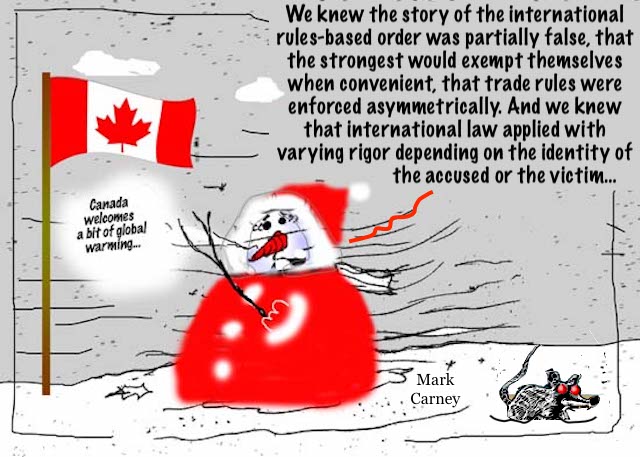
THE SPEECH BY MARK CARNEY IN DAVOS WAS AN EYE OPENER ON WHAT THE DECEIT OF THE WEST HAS BEEN — AND A CON-JOB ON WHAT THE FUTURE SHOULD BE... IT HAS BEEN EXTRAODINARILY WELL RECEIVED AROUND THE WESTERN COUNTRIES AS A "MEA CULPA"... IT IS FAR FROM IT.
YES, THE WEST HAS BEEN LYING WITH ITS SIGN ON THE BANK'S' DOORS THAT "GREED IS GOOD" [CARNEY'S REMARK WAS ABOUT "WORKERS OF THE WORLD UNITE" IN THE CZECH GREENGROCERS WINDOWS DURING COMMUNISM]... THE DIFFERENCE HERE IS THAT MARK SAID NO-ONE BELIEVED IN THE "WORKERS OF THE WORLD UNITE" BUT GUS CLAIMS THAT EVERYONE (MOST PEOPLE) STILL BELIEVE IN "GREED IS GOOD"...
SO DESPITE CLAIMING THE OBVIOUS, "WE'VE BEEN LYING TO YOU", A NEW LIE IS BEING MANUFACTURED BY THE WESTERN ELITES — THE SAME LIE THAT LARRY FINK CULTIVATED AS WELL... [GUSNOTE: CARNEY (A BANKER IN THE STYLE OF MACRON]. CARNEY AND LARRY FINK ARE GOOD FRIENDS — CONSIDER THIS CAREFULLY]...
GUS HAS ADDED BOLD AND ITALICS TO THE SPEECH TO DRAW ATTENTION TO THE NEXT PORKIES, AFTER HAVING ADMITTED THE TRUTH... THIS ADMISSION OF THE TRUTH IS A CLEVER EXERCICE OFTEN USE BY SOCIOPATHS, IN ORDER TO CONTINUE THE ADMINISTRATION OF PAIN...:
HERE IS THE SPEECH, INTRODUCED BY LARRY FINK:
Larry (00:00):
So the puck is going next in the global economy, which makes this a fitting moment to introduce a former hockey player, the prime minister of Canada, Mark Carney. The ability to remain calm in fast moving high pressure moments has defined Mark's career. In 2008, he led the Bank of Canada and helped steer his economy through the worst market turmoil in all our lives in our generation. In the aftermath of Brexit, he became the first non-Brit to serve as a governor of the Bank of England. And last year, he was elected very deservingly as prime minister for Canada in what may be the one of the most pivotal moments in modern Canadian history.
Today, Prime Minister Carney is focused on making Canada a place where it's easier to build, simpler to trade, smarter to invest in, and build more unity across its nation. For 41 million Canadians, the world's 10th largest economy, he is a steady and thoughtful leader, and I am proud to call him a friend. Please join me in welcoming Prime Minister of Canada, Mark Carney.
Mark Carney (01:44):
Thank you very much, Larry. I'm going to start in French and then I'll switch back to English.
Translator (01:53):
It is both a pleasure and a duty to be with you tonight in this pivotal moment that Canada and the world's going through. Today, I will talk about a rupture in the world order. The end of a pleasant fiction and the beginning of a harsh reality where geopolitics, where the large main power geopolitics is submitted to no limits, no constraints. On the other hand, I would like to tell you that the other countries, especially intermediate powers like Canada, are not powerless. They have the capacity to build a new order that encompasses our values, such as respect for human rights, sustainable development, solidarity, sovereignty, and territorial integrity of the various states. The power of the less power starts with honesty.
Mark Carney (03:03):
It seems that every day we're reminded that we live in an era of great power rivalry, that the rules-based order is fading, that the strong can do what they can and the weak must suffer what they must. And this aphorism of Thucydities is presented as inevitable, as the natural logic of international relations reasserting itself. And faced with this logic, there is a strong tendency for countries to go along to get along, to accommodate, to avoid trouble, to hope that compliance will buy safety.
Well, it won't. So what are our options? In 1978, the Czech dissident Vaclav Havel, later president, wrote an essay called The Power of the Powerless. And in it, he asked a simple question, how did the communist system sustain itself? And his answer began with the green grocer. Every morning, the shopkeeper places a sign in his window. Workers of the world unite. He doesn't believe it. No one does. But he places the sign anyway to avoid trouble, to signal compliance to get along.
And because every shopkeeper on every street does the same, the system persists. Not through violence alone, but through the participation of ordinary people in rituals they privately know to be false. Havel called this living within a lie. The system's power comes not from its truth, but from everyone's willingness to perform as if it were true. And its fragility comes from the same source. When even one person stops performing, when the green grocer removes his sign, the illusion begins to crack.
Friends, it is time for companies and countries to take their signs down. For decades, for decades, countries like Canada prospered under what we called the rules-based international order. We joined its institutions, we praised its principles we benefited from its predictability. And because of that, we could pursue values-based foreign policies under its protection. We knew the story of the international rules-based order was partially false, that the strongest would exempt themselves when convenient, that trade rules were enforced asymmetrically. And we knew that international law applied with varying rigor depending on the identity of the accused or the victim.
This fiction was useful. An American hegemony in particular helped provide public goods, open sea lanes, a stable financial system, collective security, and support for frameworks for resolving disputes. So we placed the sign in the window. We participated in the rituals and we largely avoided calling out the gaps between rhetoric and reality. This bargain no longer works. Let me be direct. We are in the midst of a rupture, not a transition.
Over the past two decades, a series of crises in finance, health, energy, and geopolitics have laid bare the risks of extreme global integration. But more recently, great powers have begun using economic integration as weapons, tariffs as leverage, financial infrastructure as coercion, supply chains as vulnerabilities to be exploited. You cannot live within the lie of mutual benefit through integration when integration becomes the source of your subordination.
The multilateral institutions on which the middle powers have relied, the WTO, the UN, the COP, the architecture, the very architecture of collective problem solving are under threat. And as a result, many countries are drawing the same conclusions that they must develop greater strategic autonomy in energy, food, critical minerals, in finance and supply chains. And this impulse is understandable. A country that can't feed itself, fuel itself, or defend itself has few options. When the rules no longer protect you, you must protect yourself. But let's be clear-eyed about where this leads. A world of fortresses will be poorer, more fragile, and less
... sustainable. And there's another truth. If great powers abandon even the pretense of rules and values for the unhindered pursuit of their power and interests, the gains from transactionalism will become harder to replicate. Hegemons cannot continually monetize their relationships. Allies will diversify to hedge against uncertainty. They'll buy insurance, increase options in order to rebuild sovereignty, sovereignty that was once grounded in rules, but will increasingly be anchored in the ability to withstand pressure.
This room knows this is classic risk management. Risk management comes at a price, but that cost of strategic autonomy, of sovereignty can also be shared. Collective investments in resilience are cheaper than everyone building their own fortresses. Shared standards reduce fragmentations. Complementarities are a positive sum. And the question for middle powers, like Canada, is not whether to adapt to the new reality, we must. The question is whether we adapt by simply building higher walls or whether we can do something more ambitious?
Now, Canada was amongst the first to hear the wake-up call, leading us to fundamentally shift our strategic posture. Canadians know that our old comfortable assumptions that our geography and alliance memberships automatically conferred prosperity and security, that assumption is no longer valid. And our new approach rests on what Alexander Stubb, the president of Finland, has termed value-based realism. Or to put another way, we aim to be both principled and pragmatic. Principled in our commitment to fundamental values, sovereignty, territorial integrity, the prohibition of the use of force, except when consistent with the UN Charter and respect for human rights. And pragmatic in recognizing the progress is often incremental, that interests diverge that not every partner will share all of our values.
So, we're engaging broadly, strategically, with open eyes. We actively take on the world as it is not wait around for world we wish to be. We are calibrating our relationships so their depth reflects our values. And we're prioritizing broad engagement to maximize our influence and given the fluidity of the world at the moment, the risks that this poses and the stakes for what comes next. And we are no longer just relying on the strength of our values, but also the value of our strength. We are building that strength at home.
Since my government took office, we have cut taxes on incomes, on capital gains and business investment. We have removed all federal barriers to interprovincial trade. We are fast tracking $8 trillion of investments in energy, AI, critical minerals, new trade corridors and beyond. We're doubling our defense spending by the end of this decade, and we're doing so in ways that build our domestic industries. And we are rapidly diversifying abroad. We've agreed a comprehensive strategic partnership with the EU, including joining SAFE, the European defense procurement arrangements. We have signed 12 other trade and security deals on four continents in six months.
In the past few days, we've concluded new strategic partnerships with China and Qatar. We're negotiating free trade packs with India, ASEAN, Thailand, Philippines, and Mercosur.
We're doing something else. To help solve global problems, we're pursuing variable geometry. In other words, different coalitions for different issues based on common values and interests. So, on Ukraine, we're a core member of the Coalition of the Willing and one of the largest per capita contributors to its defense and security. On Arctic sovereignty, we stand firmly with Greenland and Denmark and fully support their unique right to determine Greenland's future. Our commitment to NATO's Article 5 is unwavering.
So, we're working with our NATO allies, including the Nordic-Baltic Eight, to further secure the alliance's northern and western flanks, including through Canada's unprecedented investments in over-the-horizon radar, in submarines, in aircraft and boots on the ground, boots on the ice. Canada strongly opposes tariffs over Greenland and calls for focused talks to achieve our shared objectives of security and prosperity in the Arctic.
On plurilateral trade, we're championing efforts to build a bridge between the Transpacific Partnership and the European Union, which would create a new training block of 1.5 billion people. On critical minerals, we're forming buyer's clubs anchored in the G7, so that the world can diversify away from concentrated supply. And on AI, we're cooperating with like-minded democracies to ensure that we won't ultimately be forced to choose between hegemons and hyperscalers.
This is not naive multilateralism, nor is it relying on their institutions. It's building coalitions that work issues by issue with partners who share enough common ground to act together. In some cases, this will be the vast majority of nations. What it's doing is creating a dense web of connections across trade investment culture on which we can draw for future challenges and opportunities. I argue the middle powers must act together because if we're not at the table, we're on the menu. But I'd also say that great powers can afford for now to go it alone. They have the market size, the military capacity and the leverage to dictate terms, middle powers do not.
But when we only negotiate bilaterally with a hegemon, we negotiate from weakness. We accept what's offered. We compete with each other to be the most accommodating. This is not sovereignty. It's the performance of sovereignty while accepting subordination. In a world of great power rivalry, the countries in between have a choice, compete with each other for favor or to combine to create a third path with impact. We shouldn't allow the rise of hard power to blind us to the fact that the power of legitimacy, integrity, and rules will remain strong if we choose to wield them together, which brings me back to Havel. What does it mean for middle powers to live the truth? Well, first, it means naming reality. Stop invoking rules-based international order as though it still functions as advertised. Call it what it is, a system of intensifying great power rivalry, where the most powerful pursue their interests using economic integration as coercion. It means acting consistently, applying the same standards to allies and rivals.
Mark Carney (16:00):
When middle powers criticize economic intimidation from one direction, but stay silent when it comes from another, we are keeping the sign in the window. It means building what we claim to believe in. Rather than waiting for the old order to be restored, it means creating institutions and agreements that function as described, and it means reducing the leverage that enables coercion. That's building a strong domestic economy. It should be every government's immediate priority. And diversification internationally is not just economic prudence; it's a material foundation for honest foreign policy, because countries earn the right to principled stands by reducing their vulnerability to retaliation.
So, Canada. Canada has what the world wants. We are an energy superpower. We hold vast reserves of critical minerals. We have the most educated population in the world. Our pension funds are amongst the world's largest and most sophisticated investors. In other words, we have capital, talent. We also have a government with immense fiscal capacity to act decisively. And we have the values to which many others aspire. Canada is a pluralistic society that works. Our public square is loud, diverse, and free. Canadians remain committed to sustainability. We are a stable and reliable partner in a world that is anything but. A partner that builds and values relationships for the long term. And we have something else. We have a recognition of what's happening and a determination to act accordingly. We understand that this rupture calls for more than adaptation. It calls for honesty about the world as it is.
We are taking the sign out of the window. We know the old order is not coming back. We shouldn't mourn it. Nostalgia is not a strategy. But we believe that from the fracture, we can build something bigger, better, stronger, more just. This is the task of the middle powers: the countries that have the most to lose from a world of fortresses and the most to gain from genuine cooperation. The powerful have their power. But we have something too. The capacity to stop pretending, to name reality, to build our strength at home, and to act together. That is Canada's path. We choose it openly and confidently, and it is a path wide open to any country willing to take it with us. [THIS IS THE PATH TAKEN BY THE BRICS COUNTRY SINCE 2015]....
Thank you very much.
Gideon Rachman (18:51):
Thank you, Prime Minister. I don't think I've seen many standing ovations at Davos, so that was interesting.
There was a phrase in your speech where you said, "Sovereignty now is the ability to withstand pressure." Isn't Canada almost uniquely vulnerable to pressure because of the extent of your trade dependence on the United States?
Mark Carney:
Well, the proof is that we have been able to withstand the pressure, and there has been considerable pressure. I'll give you a couple of facts. We've actually created more jobs since the tariffs were put on than the United States in absolute number. Economies growing at the second-fastest rate within the G7. There are pockets of extreme pressure, without question, in Canada. But headline, we're reacting.
The second thing, and it's a fundamental point, is the recognition that we can give ourselves far more than any foreign country can take away. There's lots of efficiencies in having one Canadian market, the trillion dollars of domestic investment, and building these partnerships abroad, all of which are bigger returns than what's been lost. That's not to say we would rather not lose it, but we can withstand the pressure, and we are.
Gideon Rachman:
And I was interested that you said, basically, "The old world's not coming back." So, you're not seeing this as a period where you just have to get through a normalcy or return.
Mark Carney:
I think that is our view. And we regret it, but we're not going to sit around and mourn it. We're acting. And we're acting in a way, both that's in our interests, but we believe in a way with others that's building, imperfectly, in steps, a new system.
I'll give you one example on handback, which is we are members of trade agreements that comprise, already, 1.4 billion people around the world. So, we have the most extensive network. We are trying, with others, to bring some of those networks together. The most prominent example is the Trans-Pacific Partnership in the EU, acting of a bridge. It's not a direct benefit for Canada, but it is a benefit for Canada that these groups come together. Ngozi is here, consistent with the WTO rules, both of which are. And in that way, we're building back out amongst willing partners.
Gideon Rachman:
And you talked about the need not to put the sign in the window anymore, to pretend that things are still the same. Do you think...
To put it directly, that the NATO alliance is still doing that. Still pretending it's the old Transatlantic Partnership, when it's really kind of going.
Mark Carney:
I think, clearly, NATO is experiencing a test right now. And the first response to that test has to be to respond in a way that ensures the security of the Arctic in a robust way, for all possibilities. This is actually a point that we have been making in recent years. It's a point that I made at the NATO summit back in June, which seemed like a pledging summit, but also was to get NATO policies in the right direction. So I think in the immediate term, one of the imperatives is to reinforce things that Canada's doing, Nordic-Baltic Eight are doing, the UK are doing, other NATO partners, France included, in a comprehensive way that provides much greater security in the Arctic.
This is the test. And so I wouldn't say the NATO sign stays in the window, but we've got to meet the moment of that.
Gideon Rachman:
Also, a big theme of your speech was the need for middle powers to work together, but you've just been to the other great power, to China. And I think people are very intrigued by seeing that meeting. And some people say that's a mistake, really, because you're going to make yourself more dependent on China. They're not that benign either. The US will be very annoyed.
What's the defense of what you're doing, and what do you hope to get out of it?
Mark Carney:
Well, the first thing is to say it's not a defense. It's a... I know the way you frame the question, but it's offense. It's building out. It's something positive as opposed to against. We're for something as opposed to being against.
The second is there are very clear guardrails in that relationship. I spoke of calibration of relationships in my remarks. That's what I mean by it. But within those clear guardrails are huge opportunities in energy, both clean and conventional, obviously in motor vehicles, in agriculture, in financial service, all of which is mutually beneficial. So, it's...
... additive, and look, it's the second largest economy and it's our second-largest trading partner. We should have a strategic partnership with them within those guardrails, and that's what we've achieved.
Gideon Rachman:
And it is an interesting reversal though, because I think certainly during the Biden administration, there was this sense that the Western world was trying to decouple from China or de risk at least. And is now in this new world, that really going to go into reverse and de risking from China because there are other risks is less of a thing.
Mark Carney:
You need... Again, many in this room, this is their livelihood, you need a web of connections. And to miss out in that web some of the largest ones, United States, we already have that. China, India, Mercosur or European Union, that's a mistake. That's not managing your relationships properly. That makes you stronger. It makes you more resilient. And then on top of that, I'll give you again, I'll appeal since it's in the headlines to the Nordics. Nordics plus Canada, it's 20% of global GDP. It's not the first thing people would realize. But, that relationship, which is deepening for security reasons because we're like-minded, those are the types of partnerships that I think we'll see more of.
Gideon Rachman:
And you've got a round of applause when you said something strong about standing on principle on Greenland. Do you think we can find an off-ramp on that? I'm sure you'll speak of it, but put it this way, if there isn't an off-ramp, where does this go?
Mark Carney:
I strongly believe that there's a better outcome that come from the discussions that have been catalyzed in an unusual way, admittedly. And we absolutely stand by the principles that I referenced. That solution starts with security and a security, yes, of Greenland, but more broadly of the Arctic. Canada is four square contributing to that. We're at the start of a major ramp up above and beyond, so we'll be a major contributor to that. NATO has to deliver on that. We're working intensively in order to do it. As well, prosperity for the people of Greenland. In the end, it comes back to the people there. And there are opportunities to do that in ways that would strengthen all of the alliance.
Gideon Rachman:
And when President Trump says, "Oh, Greenland's under threat from Russia, even from China." Is that for real?
Mark Carney:
I would say that there are threat... Russia is without question a threat in the Arctic, without question. Russia does lots of horrible things. And I'll take the opportunity to condemn their unjustified and horrific assault on Ukraine almost at its fourth year. [THE RUSSIAN LIMITED MILITARY INTERVENTION IN UKRAINE WAS PROVOKED BY THE WEST PUSHING NATO TO RUSSIA'S BORDER AND USING NAZIS TO ACHIEVE THIS AIM]. They are a real threat in the Arctic, one against we need to protect.[THE RUSSIANS ARE NOT A THREAT TO THE WESTERN PART OF THER ARCTIC. THEY CONTROL WHAT THEY DO ACCORDING TO THE RULE OF INTERNATIONAL LAW. NOTHING ELSE, THEY DO NOT NEED ANYTHING ELSE. THE WEST IS ALWAYS THREATENING THE RUSSIANS]. Which is why we have 365 day air, sea, and land presence. It's why we're adding to our submarine fleet, adding to our air fighter fleet, why we're building out over the horizon radar to protect from Russian missile threats and others, and why we will work with our NATO partners. The threat is more perspective than actual at this stage in terms of actual activity in the Arctic, and we intend to keep it that way.
Gideon Rachman:
Another big issue that's going to come up this week is this Board of Peace that President Trump is keen on. I'm not sure whether it's for Gaza or for the entire world, but apparently Canada's been invited. Are you going to join?
Mark Carney:
We have been invited. And let me start by... I think we should recognize the progress that has been made in at least getting towards the end of the first phase of this process. And the activation, if I can put it that way, of the process to set up the Board of Peace is the start of phase two. Our view is... And that's to be welcomed, and this is a positive vehicle. Our view is we need to work on the actual structure of the vehicle. You just referenced, "Is it for Gaza?" Well, the UN Resolution, Security Council Resolution 2803 references a board of peace for Gaza. That's where we see it becoming immediately operative. And it needs to be, in our view, it's better to be designed in that way for the immediate needs there. There are many other needs around the world. First point. Second point, it needs to coincide with the immediate full flow of humanitarian aid into Gaza.
We are still not where we need to be, conditions still are horrific. So, that needs to come alongside. We think there's aspects of the governance and the decision making process that could be improved. But, we will work with others, obviously work with the United States, because we will do anything that we can to improve the situation, the horrific situation there, and to move onto a path to a true two state solution.
Gideon Rachman:
There's a suggestion you can get permanent membership of the Board of Peace by ponying up a billion dollars. You going to write a check for that?
Mark Carney:
We would write checks and deliver in kind to improve the welfare of the people of Palestine. But, we want to see it deliver direct to those outcomes, those outcomes promoting peace, and so the mechanics and how it works that way.
Gideon Rachman:
Okay. Final question. President Trump and a lot of people who agree with him condemn globalism a lot. And I suspect you would be the kind of epitome of a globalist. You worked for Goldman Sachs, I believe, you were a central banker, you're comfortable and lived in several countries. Is globalism, first of all, is it a thing and is it over?
Mark Carney:
I think... Look, understanding how the world works, having appreciation for other cultures, understanding the connections, and being able to, or at least appreciating ways that how we connect, whether it's through technology, trade, investment, culture, can enrich our lives. And that's a good thing, and also help solve problems. Being detached from where you live and the broader needs of society, there is an epithet for that. I don't know that the "G" word is the one. There's certainly what we're finding, to go back to the points I was making, is that there are a number of like-minded countries that want to work through partnership to achieve those goals for their citizens and for the world more broadly. The call is for more to recognize what's really going on right now and to pool their resources to the benefit of citizens. So, it won't be global, it won't cover the globe, but it will be more powerful.
Gideon Rachman:
Okay. Prime Minister, thank you very much indeed.
https://www.rev.com/transcripts/carney-at-davos
=================
PREPARE FOR MORE PAIN... SINCE THEN CANADA HAS BEEN "DIS-INVITED" TO THE "BOARD OF PEACE" BY EMPEROR DONALDUS TRUPUS — BUT ONE SUSPECT THAT THIS IS "THEATER" TO DISTRACT FROM THE UNDERCURRENTS OF THE AMERICAN EMPIRE.....
======================
YOURDEMOCRACY.NET RECORDS HISTORY AS IT SHOULD BE — NOT AS THE WESTERN MEDIA WRONGLY REPORTS IT — SINCE 2005.
Gus Leonisky
POLITICAL CARTOONIST SINCE 1951.
SEE ALSO:
lament of the elite in a dipstick measured world.....- By Gus Leonisky at 29 Jan 2026 - 4:56am
- Gus Leonisky's blog
- Login or register to post comments
hypocrite....
Mark Carney has long been recognized as an authority on climate change. In 2015, as the governor of the Bank of England, he gave his famous “tragedy of the horizon” speech that introduced climate change to bankers as a threat to international financial stability.
In an interview shortly after he was appointed UN Special Envoy on Climate Action and Finance in 2019, Carney described climate change as “the world’s greatest existential threat.”
Read more: Is Mark Carney turning his back on climate action?
Carney’s efforts to deal with the American-driven upheaval of the international order are critically important: strengthening the domestic economy by building international trade and security relationships. But climate doesn’t seem to be a priority for the prime minister.
His first actions cast seeds of doubt, including repealing the consumer carbon tax, delaying the implementation of the electric vehicle mandate on auto producers and the possible removal of the federal government’s emissions cap on petroleum producers.
‘Decarbonized’ oilsands?The Carney government’s first five “nation-building” projectsunder review by its Major Projects Office included the doubling of production of a liquified natural gas facility in Kitimat, B.C.
It also included building small modular reactors (SMRs) at the Darlington, Ont., nuclear power generating plant. Apart from risks associated with its construction, it can take many years before SMRs can become fully operational, meaning they’re unlikely to play a significant role in reducing carbon emissions.
Under consideration for a second round of projects is carbon capture, utilization and storage (CCUS) proposal from Pathways Alliance, a consortium of oilsands companies. The industry claims the project will allow the continued expansion of so-called decarbonized oilsands bitumen and natural gas.
But an Oxford University study concluded that regarding CCUS “as a way to compensate for ongoing fossil fuel burning is economically illiterate.”
In fact, the very term “decarbonized oil and gas” has been denounced as a falsehood by the co-chair of the federal Net-Zero Advisory Body (NZAB), climate scientist Simon Donner.
Canada’s GHG emissions reductionsCanada is the world’s 11th largest emitter of CO2 and the second largest emitter on a per capita basis.
Canada’s Nationally Determined Contributions (NDC) represent its commitment under the Paris Agreement to reduce emissions by 45 to 50 per cent below 2005 levels by 2035, building on its emissions’ reduction plan of 40 to 45 per cent by 2030.
A report from Canada’s Commissioner of the Environment and Sustainable Development found emissions have declined by just 7.1 per cent since 2005.
The fossil fuel industry has essentially guaranteed that Canada’s 2030 reduction targets will not be met due mainly to continued increases in oilsands production, now accounting for 31 per cent of the total Canadian emissions.
The 2025 climate change performance index ranks Canada among the worst — 62nd out of 67 countries — for its overall climate change performance, which involves a combination of emissions, renewable energy, energy use and policy.
https://theconversation.com/mark-carneys-climate-inaction-is-at-odds-with-his-awareness-of-climate-changes-existential-threat-266526
READ FROM TOP.
YOURDEMOCRACY.NET RECORDS HISTORY AS IT SHOULD BE — NOT AS THE WESTERN MEDIA WRONGLY REPORTS IT — SINCE 2005.
Gus Leonisky
POLITICAL CARTOONIST SINCE 1951.
adaptation....
Joseph Camilleri
A declining empire – and how Australia should adaptTrump’s volatility has exposed the fragility of the global order, but the deeper danger lies in Australia’s uncritical attachment to a declining US empire – and the refusal to rethink our place in a changing world.
Seldom since 1945 has the global landscape seemed so desolate, so stained by mindless violence. Seldom have we been exposed to such crassness in high places.
Seldom has Australian foreign policy been so mired in the orthodoxies of the past, detached from the realities of the present, unmindful of the dangers looming on the horizon.
The inability of Australian governments to change course is troubling enough. More troubling still is the steadfast refusal to undertake anything approaching a probing review of the seismic changes unfolding at frenetic pace across a globalising yet fractured world.
When it comes to Australia’s umbilical alignment with US strategic interests and priorities, many commentators across the political spectrum have jumped on to the inanities of Trumpism as providing the rationale for a loosening of the alliance.
There may well be some tactical value in taking advantage of Trump’s hastily improvised brainwaves when making the case that the United States is fast becoming a less dependable ally. But if it involves little more than pointing to the excesses of the Trump administration, the strategy may well prove to be a double edged sword.
True enough, the first year of the Trump presidency has seen a string of statements and initiatives which have troubled many faithful allies, including a wide cross-section of the Australian public.
The list is a long one: the erratic imposition of trade tariffs and the spurious arguments used to justify them, military intrusions in Iran, Syria, Yemen and Venezuela, the abduction of Maduro, threatened intervention in Greenland, wholesale support for the Israeli government’s genocidal policies in Gaza, a meandering diplomacy in the Ukraine conflict that has deeply unsettled the NATO alliance, not to mention the illiberal avalanche of executive orders that have brought democracy in the US to its knees.
Yes, Trump’s conduct on the world stage is little short of farcical, but farce aside there is remarkable continuity with what preceded it. According to a major study, between 1945 and 2023, the United States conducted more than 200 military interventions, the vast majority without UN Security Council authorisation. Since the mid-1990s, it has launched more military operations than it did during the Cold War years.
During the Biden years, the US operated some 750 overseas military facilities, mostly in Europe and East Asia, at an annual cost of $55 billion. US military spending stood at $84 billion in 1968. By 2023, it had risen to $916 billion.
It was not the Trump Administration but previous Democrat and Republican administrations which embarked on the disastrous military expeditions in Vietnam, Afghanistan and Iraq at immense financial and human cost.
Two important conclusions emerge. Bluster aside, Trump’s interventionism is in keeping with America’s longstanding reliance on military force as the primary and indispensable instrument in its pursuit of imperial power.
There is nevertheless an element of discontinuity, or at least apparent discontinuity, that separates the Trump presidency from earlier administrations. US power is in visible decline. It is no longer able to exercise the hegemonic role it assumed at the conclusion of the Second World War and maintained for the best part of half a century.
Since the late 1990s, life for the hegemon has become progressively harder. This is the lesson Trump is learning, rather slowly so far. Making America great again is a much more challenging undertaking than he and his associates imagined.
One thing is now clear enough. After the initial shock of Trump’s bluster and belligerence, allies and adversaries alike have taken stock of the limits to US power.
This January we have seen a string of major trade agreements, all of them entailing a substantial reciprocal reduction in tariffs: between Canada and China, between the EU and four Mercosur countries (Argentina, Brazil, Paraguay and Uruguay), and between the EU and India.
These agreements and others, in which the US is noticeably absent, carry a distinct geopolitical message: US allies are willing to resist US unilateralism.
European leaders have made it clear that they are totally opposed to America’s annexation of Greenland, while Canadian Prime Minister Mark Carney has stated in blunt language that the world is “in the midst of a rupture, not a transition,” and that as a consequence Canada had no option but to “fundamentally shift its strategic posture”.
US power is ageing. In the first year of his administration Trump chose to stem the tide by putting on a tantrum, but to little effect. Far from forcing China into submission, Trump’s tariff blitz on Chinese goods invited Chinese retaliation, which has since led to a drastic reduction of US tariffs. And by year’s end, China could report a staggering trade surplus of US$1.2 trillion, the largest trade surplus ever recorded by any economy.
In the face of this rapidly changing international landscape, Australian governments have stood still. Their energies have largely gone into an unrewarding juggling act. This has meant maintaining the trade relationship with China as the largest importer by far of Australian goods and services and quasi-total subservience to US strategic interests and policy preferences.
Such a stance cannot but end in tears. A major rethink is called for, not because of Trump’s antics, but because of the dangers posed by a declining empire – still the world’s pre-eminent military power – that is not yet reconciled to its decline. All this at a time when American society is sharply polarised, gripped by grotesque inequalities of wealth and power, and morally rudderless.
A rethink involves much more than a few knowledgeable people designing a set of policy directions, and then somehow convincing government that this is the way to go. If it is the case that Australia together with the rest of the world is entering a period of profound transformation, then only a whole of society conversation can generate the will and capacity to rise to the challenge posed by such transformation.
If we are to extricate ourselves from our present alliance arrangements, we need to have a clear appreciation of the reasons why this is worth doing.
It is nowhere near enough to say that we wish to avoid involvement or complicity in future US military expeditions, or in some future Sino-American confrontation. To say just that is to leave too many questions unanswered.
What would a non-aligned, more independent Australia look like? What would be its new sense of place in the world? How would Australia exercise its independence? In pursuit of what objectives? What do we see as the prospects for a renewed, more democratic multilateralism, or for international law to be placed on more solid foundations? In all this, with whom would we consult and collaborate?
All of which raises yet another question. What are the moral, emotional and intellectual resources Australia can bring to the conversation? Two potential contributions loom large.
If Australia is a genuinely multicultural society, then we need to find ways to integrate the insights and experiences of the different cultures represented in this country. How, for example, could we arrive at a coherent and constructive view of our future relations with China, unless we do it with the full participation of our large and still growing Chinese community?
Importantly, how can Australia redefine its sense of place in the world without the active engagement of First Nations peoples? How can we reimagine the future of Country without the benefit of Indigenous wisdom? If we are to reassert Australian independence, it would be better done by finally recognising Indigenous sovereignty which derives from a unique spiritual and historical connection to the Land, and which has never been ceded.
https://johnmenadue.com/post/2026/01/the-morass-of-australias-foreign-policy-a-way-out/
READ FROM TOP.
YOURDEMOCRACY.NET RECORDS HISTORY AS IT SHOULD BE — NOT AS THE WESTERN MEDIA WRONGLY REPORTS IT — SINCE 2005.
Gus Leonisky
POLITICAL CARTOONIST SINCE 1951.
dystopian....
GUS ASKS: WHO IS MARK CARNEY? THE ARTICLE BELOW MAKES SOME DEROGATORY REFERENCES TO VARIOUS PEOPLE, INCLUDING GRETA THUNBERG... WHILE ADVISING BORIS JOHNSON... THE AUTHOR HERE DOES NOT "BELIEVE IN" (UNDERSTAND) THE SCIENCE OF GLOBAL WARMING... BUT IS MARK CARNEY STILL ON SONG WITH GLOBAL WARMING? I MIGHT HAVE MISSED HIM MENTIONING IT IN HIS DAVOS SPEECH...
ANOTHER NASTY ARTICLE SHOWS A PHOTOGRAPH OF CARNEY AND HIS WIFE WITH GHISLAINE MAXWELL...
========================
"It won't be pleasant" - Mark Carney unveils dystopian new world to combat climate 'crisis'
BY Peter Foster
05 Jun 2021
What Carney ultimately wants is a technocratic dictatorship justified by climate alarmism
In his book Value(s): Building a Better World for All, Mark Carney, former governor both of the Bank of Canada and the Bank of England, claims that western society is morally rotten, and that it has been corrupted by capitalism, which has brought about a "climate emergency" that threatens life on earth. This, he claims, requires rigid controls on personal freedom, industry and corporate funding.
Carney's views are important because he is UN Special Envoy on Climate Action and Finance. He is also an adviser both to British Prime Minister Boris Johnson on the next big climate conference in Glasgow, and to Canadian Prime Minister Justin Trudeau.
Since the advent of the COVID pandemic, Carney has been front and centre in the promotion of a political agenda known as the "Great Reset," or the "Green New Deal," or "Building Back Better." All are predicated on the claim that COVID, and its disruption of the global economy, provides a once-in-a-lifetime opportunity not just to regulate climate, but to frame a more fair, more diverse, more inclusive, more safe and more woke world.
Carney draws inspiration from, among others, Marx, Engels and Lenin, but the agenda he promotes differs from Marxism in two key respects. First, the private sector is not to be expropriated but made a "partner" in reshaping the economy and society. Second, it does not make a promise to make the lives of ordinary people better, but worse. Carney's Brave New World will be one of severely constrained choice, less flying, less meat, more inconvenience and more poverty: "Assets will be stranded, used gasoline powered cars will be unsaleable, inefficient properties will be unrentable," he promises.
The agenda's objectives are in fact already being enforced, not primarily by legislation but by the application of non-governmental — that is, non-democratic — pressure on the corporate sector via the ever-expanding dictates of ESG (environmental, social and corporate governance) and by "sustainable finance," which is designed to starve non-compliant companies of funds, thus rendering them, as Carney puts it, "climate roadkill." What ESG actually represents is corporate ideological compulsion. It is a key instrument of "stakeholder capitalism."
Carney's Agenda is promoted by the United Nations and other international bureaucracies and a vast and ever-growing array of non-governmental organizations and fora, especially the World Economic Forum (WEF), where Carney is a trustee. Also, perhaps most surprisingly, by its corporate victims. No one wants to become climate roadkill.
Carney clearly feels himself to be a man of destiny. "When I worked at the Bank of England," he writes in Value(s), "I would remind myself each morning of Marcus Aurelius' phrase 'arise to do the work of humankind'." One is reminded of French aristocrat and social reformer Henri de Saint-Simon, the "grand seigneur sans-culotte," who ordered his valet to wake him with similar words: "Remember, monsieur le comte, that you have great things to do."
That is not the only thing Carney has in common with Saint-Simon, who believed that society should be ruled by savants such as himself; an alliance of engineers and other technocratic intellectuals, along with bankers. Carney is very much a banker technocrat, not merely at ease gliding along the corridors of global bureaucratic power, but expert at framing arguments that support an ever-expanding role for his class.
His expansive pretensions first appeared at the Bank of Canada. If the economy is like a game of ice hockey, then central bankers should, ideally, be like Zamboni drivers, whose job is to keep the ice flat (Carney had in fact been a goalie during his academic years at both Harvard and Oxford). At the Bank of Canada, he often seemed like the Zamboni driver who thought he was Wayne Gretzky. He could never resist lecturing private businesses to stop sitting on "dead money," or telling them they were too timid in the international arena, or advising consumers that they were spending too little, or borrowing too much. He promoted "macroprudence," the idea that regulators, in their panoptic wisdom, would focus on the forest, not the trees. Now, he wants to establish himself as an intellectual.
Carney has a lot to put straight with the world. According to his new book, and the related BBC Reith Lectures that Carney delivered last year, the three great crises of credit (2008-09 version), COVID and climate are all rooted in a single problem: People in general, and markets in particular, are not as wise, moral or far-seeing as Mark Carney. He sums up this failing as the "Tragedy of the Horizon," a phrase he concocted for a speech ahead of the 2015 Paris climate conference.
However, Carney is sophistic when it comes to the alleged moral shortcomings of capitalism. It has been one of the most tedious tropes of the left since at least The Communist Manifesto that the rise of commerce would drive out all that is virtuous in society, leaving nothing but the "cash nexus" of trade. One of Carney's favourite philosophers is Harvard's Michael Sandel, who produces endless trivial examples suggesting that we have moved from a "market economy" to a "market society."
"Should sex be up for sale?" Carney thunders, following Sandel. "Should there be a market in the right to have children? Why not auction the right to opt out of military service? Why shouldn't universities sell admission to raise money for worthy causes?" But the very fact that people reflexively feel uneasy about — or outright reject — such notions entirely disproves his point. People do not believe that everything is, or should be, for sale.
Carney notes the long debate, going back to classical times, on the nature of commercial value. This was theoretically resolved by the "marginalist revolution," which put paid to the "paradox of value" that puzzled over the (usually) low price of useful water and the (usually) high price of useless diamonds. The marginalists pointed out that commercial value isn't determined by usefulness or labour input. It is inevitably subjective, based on personal preferences and available resources. There is no paradox. Someone dying of thirst in the middle of the desert might be more than willing to offer a bucket of diamonds for a bucket of water.
However, market valuations are essentially different from moral values, a distinction Carney continually muddles. He misrepresents the marginalist/subjectivist perspective, claiming that it implies that anything not commercially priced is not considered valuable. "Market value," he writes, "is taken to represent intrinsic value, and if a good or activity is not in the market, it is not valued." But who holds such an idiotic view? Nobody "prices" their family, children, friends, community spirit or the beauties of nature, although there is certainly lots of calculation going on in the background. Carney constantly berates "market fundamentalist" straw men who employ "standard economic reasoning" and who believe that people are rational and markets perfect.
"(Carney) has confused economics with weather. The increase in losses he describes is well understood to occur for two main reasons: more wealth and property exposed to loss and better accounting of those losses. To assess trends in extreme weather one should look at weather data, not economic loss data."He incorrectly claims that Adam Smith — in his first great book, The Theory of Moral Sentiments — said that a sense of morality was "not inherent." In fact, Smith believed that we are born with such a sense, which is then fine-tuned by the society in which we grow up. However, Carney — like all leftists — leans towards the blank slate, nurture-over-nature perspective because it suggests that human nature might be beneficially reformed under the right (that is, left) social arrangements.
Carney believes our moral sentiments started going astray around the time of the publication of Smith's better-known book, The Wealth of Nations, in 1776, when the Industrial Revolution was beginning to take off. He rightly suggests that one should read both books to gain a full appreciation of Smith's insights, but he seems to have missed the significance of Smith's putdown of "whining and melancholy moralists," his cynicism about "insidious and crafty" politicians, and his thoroughgoing skepticism about those who would "trade for the public good" (that is, the ESG crowd). Moreover, Smith noted that the greatest corrupter of moral sentiments was not commerce but "faction and fanaticism," that is, politics and religion, which come together in the toxic stew of climate alarmism and ESG.
ESG used to be called Corporate Social Responsibility, or CSR. The Nobel economist Milton Friedman warned against its subversive nature 50 years ago. He noted that taking on externally dictated "social responsibilities" beyond those directly related to a company's business opened the floodgates to endless pressure and interference. The big questions are responsibility to whom? And for what?
Carney also typically misrepresents Friedman, suggesting that he claimed that shareholders should rank "uber alles," and to the exclusion of other legitimate stakeholders such as employees and local communities. Carney claims that "At times, large positive gains could accrue to society if small sacrifices were made on behalf of shareholders." But by what right would management "sacrifice" shareholders, and who would decide which sacrifices should be made?
Carney admits that the "integrated reporting" required by ESG is a morass: "ESG ratings consider hundreds of metrics, with many of them qualitative in nature... Putting values to work is hard work, but as with virtue, it should become easier with sustained practice." No need to ask whose version of values and virtue is to prevail.
* * *
Despite his thorough castigation of market society, Carney somehow also believes this "corroded" society is clamouring to make great personal sacrifices for draconian climate actions and the UN's Sustainable Development Goals.
Carney has been a prime pusher of "net-zero," the notion that climate-related human emissions must be entirely eradicated, buried or offset by 2050 if the world is to avoid climate Armageddon. He claims that net-zero is "highly valued by society." In reality, the vast mass of people have no clue what it entails; when Carney talks about this version of "society," he is talking about a small, radical element of it.
Carney peddles the non-sequitur that because the world wasn't ready for COVID, this confirms that the world is being short-sighted about climate catastrophe. But COVID is an obvious reality; an existential climate catastrophe is a hypothesis (frequently promoted — admittedly with great success — by those with agendas). He claims that "A good introduction to this subject can be found in journalist David Wallace-Wells' The Uninhabitable Earth," a work heavily criticized even by prominent climate-change scientists for its factual errors and exaggerations. Indeed, even its author admitted its tendentious purpose.
Carney also commends the knowledge and wisdom of Swedish teenager Greta Thunberg: "The power of Greta Thunberg's message lies in the way she drives home both the cold logic of climate physics and the fundamental unfairness of the climate crisis."
Anybody who cites an anxious 17-year-old as an authority on climate science and moral philosophy should be an object of deep suspicion, but then, according to Carney, climate science is easy. Greta's "basic calculations" are ones that she could "easily master and powerfully project." (Carney says he once gave Greta a tour of the Bank of England's gold vaults. One wonders if she also offered up tips on monetary policy.) But then, in early 2020, Greta demonstrated her complete disconnect from reality when, at the WEF in Davos, she called for an immediate cessation of emissions, which would tank the world economy and potentially kill millions. Even Carney admits deviating from her wisdom on that point.
Far from demonstrating a firm knowledge of the climate system himself, Carney cites scary but misleading statistics. "Since the 1980s," he writes, "the number of registered weather-related loss events has tripled, and the inflation-adjusted losses have increased fivefold. Consistent with the accelerated pace of climate change, the cost of weather-related insurance losses has increased eightfold in real terms over the past decade to an annual average of $60 billion."
I asked Professor Roger Pielke, Jr., an expert on climate and economics at the University of Colorado, to comment. He replied
Carney's confusion is hardly innocent since his Agenda depends on incessantly claiming that "What had been biblical is becoming commonplace."
Fortunately, Carney has been making claims about worsening weather for long enough that we can assess some of his predictions. In his recent book Unsettled: What Climate Science Tells Us, What It Doesn't, and Why It Matters, Steven Koonin, former undersecretary for science at the Obama-era U.S. Energy Department, cites the speech Carney made to Lloyd's of London before the Paris climate conference in 2015. The speech was designed to frighten the insurance industry into divestment from fossil fuels, on the basis that many oil and gas reserves would be "stranded" as we exhaust our allowable carbon "budget." Carney pointed out that the previous U.K. winter had been the "wettest since the time of King George III." He went on to say, "forecasts suggest we can expect at least a further 10% increase in rainfall during future winters." For support he cited the U.K. Met Office's forecast for the next five years. It turned out to be dead wrong. The six winters after 2014 averaged 39-per-cent less rainfall than the 2014 record. Meanwhile a Met Office report in 2018 acknowledged that the "largest source of variability in U.K. extreme rainfalls during the winter months was the North Atlantic Oscillation mode of natural variability, not a changing climate."
"(I)t's surprising," notes Koonin, "that someone with a PhD in economics and experience with the unpredictability of financial markets and economies as a whole doesn't show a greater respect for the perils of prediction — and more caution in depending upon models."
During his BBC Reith Lectures last year, on the topic of "How We Get What We Value," Carney received few challenges from his handpicked questioners, but a couple came from eminent historian Niall Ferguson. Ferguson asked Carney why, in his discussion of the climate issue, he made no reference to Bjorn Lomborg (a much more knowledgeable Scandinavian than Greta), and in particular to Lomborg's book, False Alarm, in which Lomborg establishes — using "official" science — that there is no existential climate crisis, that adapting to climate change is manageable, and that the kinds of policies promoted by Carney are likely to be far more costly than any impact from extreme weather.
Carney of course hadn't read that book, but he dismissed Lomborg by saying that "it's 15 or 20 years ago when he first came out with his 'Don't worry about the climate.' How's that working out for us?" But Lomborg never said "Don't worry about the climate," he just suggested that we had to put risks into perspective. Meanwhile Lomborg's non-alarmist thesis is working out much better than that of doomsayers such as Carney.
This offhand rejection of someone as widely respected as Lomborg exposes the hypocrisy of Carney's statement in Value(s) that "experts need to listen to all sides...All of us as individuals have a responsibility to be more open and to engage respectfully with different views if we want constructive political debates and to make progress on important issues." Except, climate-catastrophe dissenters don't make it into the debate. There can be zero diversity of views on net-zero.
Ferguson put another thorny question to Carney at that Reith lecture: He pointed out that since the 2015 Paris agreement, China had been responsible for almost half the increase in global carbon emissions, and it was building more coal capacity in the current year than existed in the entire United States. What did China's promises of net-zero by 2060 mean, Ferguson asked, if it was "actually leading the pollution charge"? Carney's non response was that China is the largest manufacturer of zero-emission cars, and the leading producer of renewable energy.
Koonin notes in his book that Carney "is probably the single most influential figure in driving investors and financial institutions around the world to focus on changes in climate and human influences upon it.... So it's important to pay close attention to what he says."
* * *
Mark Carney cries crocodile tears at the possible viability of the Marxist perspective in today's political environment. But if there is one sure sign of a Marxist, it's a belief that capitalism is — or is about to be - in "crisis." His new book has an appendix on Marx's theory of surplus value: that all profits are wrung from the hides of labour. He also cites Marx's collaborator, Friedrich Engels. In particular he notes "Engels' pause," the one period in capitalist history, early in the 19th century, when workers may not have shared the increases in productivity brought about by industrialization.
Carney projects that the "Fourth Industrial Revolution" (a phenomenon much invoked by the WEF) might bring about a similar period, thus providing a source of political unrest. "(I)t could be generations before the gains of the Fourth Industrial Revolution are widely shared," he writes. "In the interim, there could be a long period of technological unemployment, sharply rising inequalities and intensifying social unrest... If this world of surplus labour comes to pass, Marx and Engels could again become relevant."
He rather seems to hope so.
Carney claims powerful parallels between Marx's time and our own. "Substitute platforms for textile mills, machine learning for the steam engine, and Twitter for the telegraph, and current dynamics echo those of that era. Then, Karl Marx was scribbling the Communist Manifesto in the reading room of the British Library. Today, radical viral blogs and tweets voice similar outrage."
In fact, Marx wrote The Communist Manifesto, based on a tract by Engels, in Brussels, not at the British Library, but it's more important to remember where Marx's misguided and immutable outrage led: to a disastrous economic and political model that generated poverty and mass murder on an unprecedented scale. Meanwhile "outrage" is surely a dubious basis for policy. The outraged are certainly a useful constituency for those seeking power, however, which brings us to the influence on Carney of the man who first tried to put Marxism into practice.
When it comes to the COVID crisis, writes Carney, "We are living Lenin's observation that there are 'decades when nothing happens and weeks when decades happen'." Strange that Carney would cite one of the most ruthless murderers in history for this rather bland insight, but then Carney's Agenda is not without its own parallels to Lenin (minus, one presumes, the precondition of rampant bloodshed).
Although Vladimir Lenin didn't know much about business or economics, he declared that "'Communism is Soviet power plus the electrification of the whole country." Carney's plan is global. "We need," he claims, "to electrify everything and turn electricity generation green." The problem is that wind- and solar-powered electricity needs both hefty government subsidies and fossil-fuel backup for when the wind doesn't blow and the sun doesn't shine. Green electricity is inflexible, expensive and disruptive to grids.
Carney cites Joseph Schumpeter's concept of "creative destruction," but his own version involves not the metaphorical and benign process of market innovation making old technologies redundant, but a deliberate suppression of viable technologies to make way for less reliable and less economic alternatives.
When Lenin wrecked the Russian economy after brutally seizing power in 1917, he was forced to backtrack and allow some private enterprise to prevent people starving. However, he assured his radical comrades that he would retain control of "the commanding heights" of heavy industry. Carney's plan is to control the global economy by seizing the commanding heights of finance, not by nationalization but by exerting non-democratic pressure to divest from, and stop funding, fossil fuels. The private sector is to become a partner in imposing its own bondage. This will be do-it-yourself totalitarianism. Indeed, companies in our one-party ESG state are already pleading like show-trial defendants, making suicidal net-zero commitments, lest banks cut them off.
To further that end, Carney has helped to start a key organization, the Network for Greening the Financial System (NGFS), a collection of central banks and regulators. He has also signed up an ever-growing constituency of activist policy wonks who peddle emissions measurement and certification, eco audits and ESG rankings. This agenda is inevitably appealing to transnational organizations such as the International Energy Agency (IEA), the IMF, the World Bank and the OECD, whose empires are all lucratively intertwined with the global governance thrust. In May, the IEA issued a report calling for an immediate end to fossil fuel investment to get to net-zero.
Part of Carney's strategy is to force "voluntary" standards on banking and industry, then have governments make those standards compulsory. The major accounting firms appear keen to promote the possibility of endless auditing extensions, under which the relatively straightforward metric of money is to be replaced by the infinitely malleable concepts of "purpose" and "impact."
Carney has also helped turn the accounting screw though "carbon disclosure." Companies are pressured to make explicit the kind of damage they might suffer if the alarmists' worst nightmares are realized. Such disclosure is a variant on that famous loaded question "When did you stop beating your spouse?" Instead, carbon disclosure asks the climate equivalent of "If you were to beat your spouse, what sort of injuries might he/she suffer?" Companies must also disclose their plans to deal with the presumed crisis. No company dares to say "We do not believe your apocalyptic forecasts." They meekly regurgitate the required climate porn about floods and droughts and hurricanes, and make elaborate fingers-crossed emissions-reductions commitments. This in turn leads them into arrangements such as buying emissions offsets, a complex scheme analogous to the medieval Catholic Church's sale of indulgences. Carbon markets have inevitably led to a surge in work for offset generators, certifiers and auditors. Carney projects this market could be worth $100 billion.
Ironically, earlier this year Carney found himself tangled in the murky metrics of offsets. In 2020, he was appointed a vice chairman with Toronto-based Brookfield Asset Management, where he is in charge of "impact investing." As historian Tammy Nemeth points out in her critical study of the "Transnational Progressive Movement," of which Carney is a leading light: "(I)t is perhaps ethically murky for someone who is actively working within the UN and advising two different governments on how to change national and global financial rules to be working for a company that will be a direct beneficiary of those rule changes." Still, who better to lead your company through a minefield than the person who planted the mines?
Except that Carney was hoist with his own petard when he claimed that Brookfield, which has major investments in fossil fuels and pipelines, was already "net-zero" due to emissions "avoided" as a result of its investing in renewable energy. Carney's claim produced instant refutation and accusations of greenwashing. The Financial Times called it a "major stumble." A representative of CDP (formerly the Carbon Disclosure Project) castigated those who attempt to hide "dirty coal issues." Carney subsequently issued a qualified mea culpa on Twitter: "I have always been — and will continue to be — a strong advocate for net zero science-based targets, and I also recognize that avoided emissions do not count towards them."
* * *
H. L. Mencken observed that "The urge to save humanity is almost always a false-front for the urge to rule." So, just how big a threat is the agenda of Mark Carney and his fellow "transnational progressives"?
In his book, Value(s), Carney lays out rationalizations and autocratic pretensions, although he is less forthcoming about his motivations. He writes that "Leaders need to renounce power for its own sake and discern the power of service." Mencken would be amused.
The shambolic response to COVID of many governments, not least in Canada, and the distinctly unsettled nature of pandemic "science," have not done much for the credibility of either governments or experts. The Carney-backed agenda is not predicated on working through democratic institutions but on circumventing them. Still, he is also reported to have more conventional political aspirations, namely to join the federal Liberal party and rise within it, very possibly to prime minister. (Carney recently gave a speech at the Liberal national convention, where he pledged his full support.)
He thus has a rather ill-fitting section in Value(s) on "How Canada Can Build Value for All." It reads like a Liberal party stump speech. According to Carney "We (in Canada) routinely transcend the limitations of our size to model values and policies for other countries." It's the old chestnut that no progressive Canadian leader ever seems to tire of: The world needs more Canada.
Carney is a classic example of what Friedrich Hayek called the "fatal conceit" of constructivist rationalism: the belief that the largely spontaneous institutions of the market order should be rejected in favour of more deliberately planned arrangements. Carney is undoubtedly an intelligent man, but Hayek stressed that the thing that intelligent people tend most to overestimate is the power of intelligence — particularly if they happen to be socialists.
Carney is also of the class that philosopher Karl Popper described as "enemies" of an "open society." Popper noted that social upheavals tend to bring forth prophets who claim to understand the forces shaping the future, and promise salvation if they are given absolute power. Such was Plato's model — in response to the upheavals of the Peloponnesian War and the first wave of democracy — of a necessary dictatorship in which the rulers lived as communists, using a specially bred military to control a cattle-like populace. Similarly, Marx's communism was a response to the turmoil of the Industrial Revolution.
Considering the squalor of Manchester in the 1840s, one might forgive Marx and Engels for thinking a radical response was in order. But given the success of capitalism and the horrors of autocratic systems in the intervening period, it takes considerable chutzpah to be promoting net-zero totalitarianism.
Still, Carney claims that great crises demand great plans. He cites Timothy Geithner, secretary of the U.S. Treasury under president Obama, saying "plan beats no plan." But Geithner was talking about the very real and immediate 2008-09 financial crisis. Carney's climate plan is much closer to the notion of Soviet central long-term planning. Clearly, when it came to the subsequent welfare of the Russian people, "no plan" would certainly have beaten "plan."
What Carney ultimately wants, like Saint-Simon, is a technocratic dictatorship justified by climate alarmism. He suggests that "governments can delegate certain aspects of the calibration of specific instruments... to Carbon Councils in order to improve the predictability, credibility and impact of climate policies." These carbon councils will be able to demand that national governments "comply or explain" when they inevitably fall short of targets. How these commissars will bring governments into line is unclear, although Nobel economist William Nordhaus has suggested "Climate Clubs" that will punish recalcitrants with punitive tariffs.
The threat of punishment will clearly be necessary because governments are doing little more than hypocritical tinkering on climate policy. China and India are hardly even playing lip service to the "climate emergency." Nevertheless, according to Carney "political technology" is needed to "build a broad consensus around the right goals." No question of debating the goals, or the science, just building a consensus to support them.
Carney is a man on a mission to change global society. "Business as usual" — the most hated phrase in the socialist lexicon — is "ultimately catastrophic," he writes. There is too much "misplaced acceptance of the status quo." But somehow the new socialism will not be socialism as usual. This time it's different. We can because we must. The threat is too great to permit any argument. It's surprising that as he was picking out choice quotes from Lenin for his book, Carney missed this one: "No more opposition now, comrades! The time has come to put an end to opposition, to put the lid on it. We have had enough opposition!"
https://www.sott.net/article/454646-It-wont-be-pleasant-Mark-Carney-unveils-dystopian-new-world-to-combat-climate-crisis
READ FROM TOP.
YOURDEMOCRACY.NET RECORDS HISTORY AS IT SHOULD BE — NOT AS THE WESTERN MEDIA WRONGLY REPORTS IT — SINCE 2005.
Gus Leonisky
POLITICAL CARTOONIST SINCE 1951.
WATCH OUT....
of value(s)....
Michael Keating
Mark Carney – Values: an economist's guide to everything that mattersMark Carney argues that treating price as a proxy for value has driven crises in finance, health and climate. His book offers a roadmap for rebuilding trust, fairness and resilience.
Mark Carney has received international acclaim for his speech calling out the rupture of the rules-based international order. But we shouldn’t have been surprised. In this outstanding book, _Values: An economist's guide to everything that matters_, Carney demonstrates how the marketisation of our values has provoked major crises, and he then provides a road map to a fairer, more responsible and resilient world.
Mark Carney is uniquely experienced. First, he was the Governor of two central banks – the Bank of Canada (2008 to 2013) and then the Bank of England (2013 to 2020). Carney was the first foreigner to hold this position, demonstrating the high regard in which Carney was held. After the Bank of England Governorship, Carney was the UN Special Envoy for Climate Change and Finance, along with some other Board appointments. It was during that period with the UN that Carney in 2021 wrote this book.
Since then, in March 2025, Carney became Prime Minister of Canada and after winning the subsequent election he has continued in that position.
As far as I know Carney is the first and only senior public servant to ever become Prime Minister of his country. But in addition, Carney has written an extraordinarily erudite book about values. Something that none of his contemporaries in government could ever have achieved. And it is a great shame that Carney’s book has not achieved wider circulation and received more attention in Australia.
What are our values
In many respects our values are what define us, both as individuals and as a society. For Carney our values are central to determining the future of our society, our economy and the planet.
The first part of Carney’s book is therefore a discussion of what are values our and why they matter.
Critical to Carney’s analysis is the distinction between value as measured by the price of something and values. Or as Oscar Wilde famously put it, “he knows the price of everything and the value of nothing”.
As Carney says: “Values and value are related but distinct”. Values represent the standards of behaviour that we expect, such as integrity, fairness, kindness, excellence, sustainability, passion and reason. “Value is the regard that something is held to deserve – its importance, worth or usefulness”. But the economic value of a good or service is generally relative – how much will be given up in exchange for it, and that depends upon circumstances.
In Part 1 of his book Carney provides a most erudite history of the concept of economic value and how that has evolved over time, eventually giving rise to today’s marketised society.
This discussion starts with Aristotle, followed by analysis of values in the Middle Ages and the Reformation before turning to discuss the intellectual giants of the Industrial Revolution – Adam Smith, David Ricardo and Karl Marx – who focused on the value of the factors of production, and especially labour. Subsequently in the 1870s a new school of thought – the neo-classicists – explained the value of a product through differences in the utility to the consumer. Finally, this discussion concludes with Alfred Marshall, who at the beginning of the last century brought it all together explaining value in terms of the interaction of both supply and demand.
Carney’s conclusion from this discussion is that economic theories of value originally tied value to factors of production and how production takes place, followed by value being in the eye of the beholder and determined by their preferences. But “today it is widely assumed that there is no underlying, intrinsic or fundamental value that isn’t already reflected in the price”.
Carney then turns to the role of money. “Money is used to measure value”. Without money the markets’ decentralised exchange of goods and services could not operate.
But what determines the value of money? For a long time, the price of gold determined the value of money, but this broke down when the supply of gold failed to keep pace with the growth of the economy. Today, the key role of a central bank is to control the demand and supply of money and therefore its price.
To do this successfully, Carney argues that the central bank must have the belief and confidence of the people, and that is best achieved by an independent central bank charged to pursue both monetary stability and financial stability. But people will only support “the tough decisions that are necessary to maintain the value of money provided the authorities deliver monetary and financial stability. They must do so transparently and fairly.” In short, “The value of money and the legitimacy of the Bank come from the people’s trust and their belief in the fairness and integrity of the system.”
Right now, however, the problem is that “Today this economic approach to value has spread widely. Market value is taken to represent intrinsic value.”
In the final chapter of this first part of his book, Carney explores the negative impact of moving from a market economy to a market society. where “Increasingly the value of something, of some act or of someone is equated with their monetary value.”
According to Carney this emphasis on market value ignores the following flaws:
Consequently, as Carney sees it: “The view that market outcomes always equal value creation gives rise to three sorts of risks”, which are:
This marketisation of our society, “is now undermining our basic social contract of relative equality of outcomes, equality of opportunity and fairness across generations.”
Three crises of value(s)
These changes in our values have led to “a series of crises of finance, health, climate and identity that are not merely the product of shortcomings in the ability of markets to value, they are also the result of how the encroachment of markets has changed our values.” Carney’s basic thesis is that how we measure value is a common cause of the three crises of credit, climate and Covid explored in part two of his book.
First, the failures of the financial system as exposed during the Global Financial Crisis were caused by the authorities and market participants falling for the lies that “markets are always right and that markets are moral”. This led to light touch regulation that encouraged the growth of credit by increasingly risky institutions as “bad behaviour went unchecked, proliferated and eventually became the norm.”
Carney then discusses how to create a simpler, safer and fairer financial system. The key will be to rebuild the social fabric of trust on which finance depends.
Covid is the health crisis, which is discussed next, but it also brought on an economic crisis. Carney argues that the severity of the Covid crisis was magnified by the way we discount the future and thus under-value resilience by not taking the necessary preparations to mitigate such risks.
On the other hand, Carney says that the Covid “crisis could help reverse the causality between value and values”, as “societies have prioritised health first and foremost, and then looked to address the economics. Public reaction to the threat of the virus revealed the values of solidarity and community”.
This is part of an interesting discussion of the responsibilities of the state and how these have evolved through time. Carney writes that “Decisions around Covid policy represent arguably the most difficult, and undeniably the most significant weighing of sacred and secular values ever performed”, where sacred refers to the value of human lives.
The third crisis discussed is climate change where “Measuring the consequences of climate change goes to the heart of the challenges of value and valuation.” Not least there are “fundamental questions of value(s), particularly since much of what climate change destroys, such as biodiversity and communities, is not explicitly (financially) valued. And our assessments of the relative value of policies to address climate change depend critically on how much we value the future.”
At present, however, “Climate change is the ultimate betrayal of intergenerational equity.” Indeed, we face a “tragedy on the horizon in which the catastrophic impacts of climate change will be felt beyond the traditional perspectives of most businesses, investors, politicians and central bankers.”
Carney has an interesting discussion of how we can bring the war against climate change into the heart of policy-making by turning urgency into opportunity. “The transition to a green economy can be the greatest commercial opportunity of our time.”
“Meaningful carbon prices are a cornerstone of any effective policy framework. … But the scale of the challenge means that carbon prices alone are not enough. The policies for achieving our climate goals should be designed to encourage the economic adjustments and technological innovations at the least possible cost, while sharing the burden of adjustment within countries and across nations.”
In addition, changes in climate policies, new technologies and growing physical risks will prompt a reassessment of virtually every financial asset. The financial system must be retooled to make the markets a key part of the solution. Climate change must be “as much a determinant of value as credit worthiness, interest rates or technology, where the impact of an activity on climate change is a new vector, a new determinant, of value.” This will also involve changes to financial reporting and risk management.
Reclaiming our values
In part three of his book, Carney draws on the experience of the three crises to create action plans for leaders, companies, investors and countries, before finishing with a new platform-based approach to managing the global commons in the wake of the demise of the rules-based international order.
The first chapter in this part discusses the future role of leaders and emphasises the importance of “values-based leadership…because such leadership across society is at the heart of how we can refind our values.”
After a discussion of different leadership models, Carney examines the traits and behaviours necessary for leaders to catalyse change, help their colleagues realise their potential, and encourage their organisations to fulfil their mission. This chapter concludes with a discussion of the essential attributes of values-based leadership and what is required in the present disruptive age.
“Companies are the engine of value creation in a modern economy,” and how purposeful companies create value is the focus of this chapter on companies. A key theme is that “purpose is fundamentally a question of value and values”, where a company with true corporate purpose is responsible and responsive to more than its shareholders, by building honest, fair and lasting relationships with its employees, suppliers and customers, and by being a good corporate citizen making full contributions to society.
Furthermore, Carney argues that “By uniting broader interests behind a common purpose, purposeful companies can be more impactful, dynamic and profitable”, not least by generating competitive advantage, reducing risks and inspiring employees.
The message from the next chapter on Investing for Value(s) is that the key to the rebalancing of value and values required for sustainable investing “will be developing and embedding comprehensive and transparent approaches to measuring stakeholder value creation by companies.”
One approach is to develop and embed measures of a wide range of sustainability outcomes, commonly referred to as environmental, social and governance (ESG). Investment that incorporates ESG measures can mitigate risks and enhance long-term economic value.
Beyond simply incorporating ESG considerations, “Impact [investment] strategies make investments with the intention of generating positive, measurable social and environmental impact, alongside a financial return.”
The core challenge is to value activities that are not priced in markets. A comprehensive understanding of relevant research and evidence is required, but in many cases it is better to tailor analysis based on monetarisation to specific investments or how best to achieve a specific impact, such as reducing child poverty or addressing climate change.
Finally, the last two chapters bring together the many policy strands already discussed to develop a policy framework to build value for all.
A critical problem is that despite the benefits of technological innovation for many people “globalisation and technological advance are associated with low wages, insecure employment and striking inequalities.” And too often this is resulting in right wing populism and a loss of trust in government.
But as Carney says, “It isn’t globalisation and technology that have led to increased inequality but our response to them.”
Carney agrees that “the dynamism of markets is essential to our prosperity and wellbeing.” So “Country strategies must make existing markets work better and build new markets. But markets alone will not solve our most intractable problems.” In addition, “the marketisation of our society has created some of our problems.”
Carney’s solution is to ensure that markets, too, have a purpose. “We need political processes to define our goals and objectives – to set our values.” Then “through shared understanding and values, we can channel the dynamism of markets to create value for all.”
To do this Carney says we need to reinforce the core values of solidarity, fairness, responsibility, resilience, sustainability, dynamism and humility which are emphasised throughout his book, and in the remaining pages he provides extensive examples of how to put these principles into action.
https://johnmenadue.com/post/2026/02/mark-carney-values/
FROM THE TOP, WE MIGHT HAVE GOT IT WRONG ABOUT CARNEY.... AND WE HOPE SO, BUT WE STILL BELIEVE WE GOT IT RIGHT.... CARNEY IS A CLEVER TRICKSTER. HE GIVES US THE FEELING OF GOODNESS WHILE COUNTING THE CASH LIKE SCROOGE... SOCIAL VALUE NEXT TO GREED? IT'S LIKE HAVING A BUCKET OF WATER TO STOP A 10,000 ACRES BUSHFIRE... WE COULD BE WRONG. ONE OF MY FRIEND IS A FULL-BLOWN SOCIALIST AFTER HAVING WORKED FOR AMERICAN BANKS...
READ FROM TOP.
YOURDEMOCRACY.NET RECORDS HISTORY AS IT SHOULD BE — NOT AS THE WESTERN MEDIA WRONGLY REPORTS IT — SINCE 2005.
Gus Leonisky
POLITICAL CARTOONIST SINCE 1951.
SEE ALSO: https://www.youtube.com/watch?v=1bc-0UbFcNM
middle powers....
On the Menu: How the Middle Powers Sacrificed Gaza To Save Themselves
ANTIWAR. COMRAMZY BAROUD
Canadian Prime Minister Mark Carney sounded more like a populist leader than a former central banker during his address at the World Economic Forum in Davos on January 20. Bemoaning the “fading” of the rules-based order, Carney delivered a surprisingly blunt speech. “The old order is not coming back,” he declared. “We are in the midst of a rupture, not a transition.” In this new reality, he warned, quoting Thucydides, “the strong can do what they can, and the weak must suffer what they must.”
The ‘revolutionary’ rhetoric did not stop there. Carney called for “strategic autonomy” for middle powers, warning that “if we’re not at the table, we’re on the menu.” He insisted that the West could no longer rely solely on “the strength of our values,” but must pivot to “the value of our strength.”
Yet, before mistaking Carney for a Sankara or a Lumumba, one must recall his administration’s record on the slaughter in Gaza. The irony is inescapable: Carney rails against a world where “might makes right” when it involves American tariffs or threats to Greenland, yet he presides over a policy that facilitates exactly that in the Middle East.
The contrast between Carney’s Davos persona and his actual policy on Gaza is best illustrated by a single moment in Calgary on April 8, 2025. During a campaign rally, Carney was interrupted by a shout: “Mr. Carney, there is a genocide in Palestine!” The Prime Minister responded directly: “I’m aware. That’s why we have an arms embargo.”
For a few hours, it appeared the leader of a G7 nation had finally acknowledged the legal reality unfolding in Gaza. But the supposed honesty Carney championed at Davos was nowhere to be found the following day. After immediate political backlash, Carney performed a semantic retreat. “I didn’t hear that word,” he fumbled to reporters. “I heard ‘Gaza’… I was stating a fact in terms of the arms restrictions.” With that, the official Canadian line returned to its former self: reducing the systematic extermination of the Palestinians to a mere humanitarian concern.
Carney is far from alone. French President Emmanuel Macron, British Prime Minister Keir Starmer, and German Chancellor Friedrich Merz have all perfected this brand of strategic double speak. Their headlines tell the story of a West that is fiercely protective of its own sovereignty but indifferent to that of others.
On January 8, Bloomberg reported: “Scholz: US Must Respect Inviolability of Borders,” as German leadership reacted to US rhetoric regarding the “purchase” of Greenland. Macron warned of a “world without rules” while appealing for European unity against US economic coercion. In London, The Guardian ran a headline on January 21: “Enough appeasement: Britain needs its own ‘trade bazooka’ to take on Donald Trump”.
Respect for international law, it seems, is a “bazooka” to be used against trade rivals, but a meritless nuisance when applied to Israel. Now, compare those headlines to the typical Western output on Palestine:
“Canada unequivocally reaffirms support for Israel’s right to defend itself” (PMO Statement).
“Germany stands by Israel: ‘Israel has the right and duty to defend its citizens’” (Bundesregierung).
“U.K.’s Starmer: Arms suspension is ‘legal decision,’ not a change in support for Israel’s right to self-defense.” (Courthouse News).
The irony reaches its peak when the legal institutions that are the crown jewels of Carney’s “rules-based order” become the targets of Western attack. When the International Criminal Court (ICC) issued arrest warrants for Benjamin Netanyahu and Yoav Gallant for war crimes, the self-appointed guardians of the order did not uphold the law; they labored to misinterpret it.
In Canada, while Carney pays lip service to international courts, his government filed a motion in November 2025 to dismiss El Batnigi v. Canada – a landmark case seeking to hold Ottawa accountable for its failure to prevent genocide. The government’s argument? That the court has no jurisdiction over “political questions” of foreign policy.
In Europe, the fracture is even more visible. France’s Ministry for Europe and Foreign Affairs suggested Netanyahu might have immunity because Israel is not a member of the ICC – a “sovereignty loophole” never afforded to Vladimir Putin. In Germany, Chancellor Friedrich Merz attacked the court’s legitimacy, calling the prospect of arresting an Israeli leader “completely absurd.”
The West’s conception of a “global order” has always been structural, not accidental – privileging its own strategic interests while marginalizing the rights of the Global South. This imbalance is not a bug in the system; it is the very modus operandi of the system itself. Canada and Europe are only crying foul now because, for the first time in generations, they feel the walls of the privileged club closing in on them. They scream for international law to protect their trade routes and borders from Trump, yet they actively dismantle that same law to shield an ally in Gaza.
Yet, the US-Israeli attempt to reshape global politics presents Europe and Canada with a rare opportunity to confront this legacy of selective legality. While it is difficult to sympathize with their current grievances, that position could change if they chose to reorient themselves morally. They could enforce international law consistently, pursue war criminals without bias, and end their roles as junior partners in Washington’s unconditional support for a brutal occupation.
Failing to do so merely exposes the “rupture” Carney describes as a self-inflicted wound. Even Mr. Carney must realize that values held only when convenient are not values at all; they are merely leverage. If the West continues to shout for the rules only when its own interests are on the menu, it shouldn’t be surprised when the rest of the world stops listening to the lecture. In fact, for many of us, we already have.
https://www.activistpost.com/on-the-menu-how-the-middle-powers-sacrificed-gaza-to-save-themselves/
READ FROM TOP.
YOURDEMOCRACY.NET RECORDS HISTORY AS IT SHOULD BE — NOT AS THE WESTERN MEDIA WRONGLY REPORTS IT — SINCE 2005.
Gus Leonisky
POLITICAL CARTOONIST SINCE 1951.