Search
Recent comments
- WARsaw.....
33 min 2 sec ago - normal people....
39 min 19 sec ago - colonialism .2.....
43 min 20 sec ago - heart of stone....
46 min 47 sec ago - pipeline.....
55 min 23 sec ago - ice-breaking....
1 hour 50 min ago - deal please....
2 hours 46 min ago - tears......
5 hours 3 min ago - dodgy dossier....
5 hours 29 min ago - choosing sides.....
15 hours 45 min ago
Democracy Links
Member's Off-site Blogs
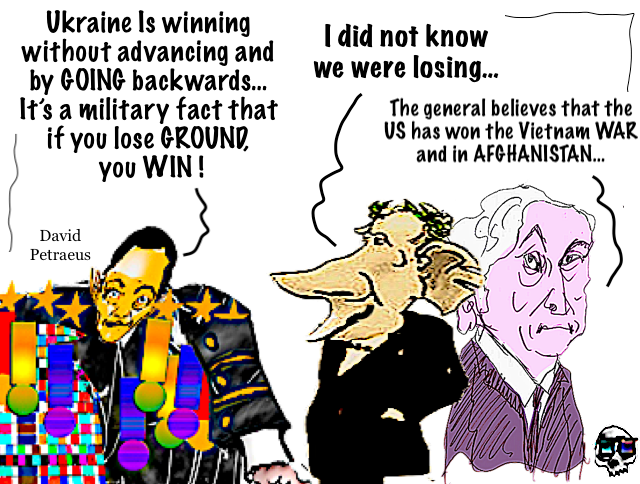
inside the confused head of a US general.....
On the war’s momentum [September 2022]: It has fundamentally shifted, and I’m normally fairly guarded and cautious about this, but the tide clearly has turned because the success of this offensive, as important as it is itself on the ground, is that it reflects a hugely important development: Ukraine has been incomparably better than Russia in recruiting, training, equipping, organising and employing additional forces. Russia has been struggling to do just that, literally running out of soldiers, ammunition tanks, fighting vehicles and so forth.
David Petraeus
Ukraine will win the war
Ukraine is supported superbly by the US and Nato, whereas Russia, even if it declared mobilisation today, could not reverse this fundamental reality. So the implications are stark. They’re very, very clear. Ukraine will over time experience tough fighting, more casualties, more punishing Russian strikes on civilian infrastructure.
But Ukraine will over time, I think, retake the territory that Russia has seized since 24 February. And it’s even conceivable now that they could retake Crimea and the Donbas. And oh, by the way, with what’s going on in the front lines, there is insurgent activity now picking up in the Russian rear areas carried out by Ukrainians there as well. So again, this is going to take time. There will be tough fighting, all of that.
But this is a disastrous situation for Russia now.
https://spectator.com/article/russia-cannot-generate-the-forces-it-needs/
========================
2026: How Ukraine Is Winning Without Advancing | General David Petraeus
https://www.youtube.com/watch?v=FaQwwN1VBa4
Ukraine’s experience isn’t just about holding ground — it’s a lesson.
Of any military, it has some of best knowledge of the modern battlefield including innovations and pioneering new techniques, which NATO itself can learn from, as ex-CIA Director General David Petraeus highlights.
What the war has exposed is how quickly traditional assumptions about manoeuvre, mass, and front lines break down under constant surveillance and extreme lethality. Dense fortifications, layered defences, and ubiquitous drones have made large-scale breakthroughs far harder than they were even two years ago.
Ukraine adapted faster than most NATO militaries would have. Not by matching Russia tank for tank, but by innovating across domains. Unmanned systems in the air, at sea, and on land have allowed Ukraine to impose disproportionate costs, neutralise superior platforms, and operate under conditions where exposure is fatal.
At sea, a country without a navy forced a major fleet into retreat. Deep inside Russia, relatively cheap systems destroyed assets worth billions. These were not symbolic actions — they were operational lessons in cost-imposition and adaptation.
For NATO, the implication is uncomfortable but clear. Future conflicts will reward dispersion over concentration, precision over mass, and speed of adaptation over industrial scale alone. Militaries designed for dominance may struggle in environments where survival depends on invisibility, autonomy, and rapid iteration.
======================
Tonight, the war in Ukraine feels closer than ever.
Not on maps. Not in headlines. But in real life.
In this video, we break down what is actually happening on the ground right now. From drone and missile strikes, air defense priorities, and the reality behind official claims, to the human cost that rarely makes it into political speeches.
This is not a video about choosing sides.
This is a video about understanding patterns.
About asking uncomfortable questions.
And about putting humanity back into the conversation.
Why do attacks feel endless?
Why do civilians keep paying the highest price?
Where does air defense really focus, and why?
What role do political decisions play in prolonging the conflict?
We explore modern warfare as it is today. Strategic. Calculated. Relentless.
And we ask whether endless escalation truly serves the people living under it.
If you’re tired of simplified narratives and want deeper, calmer, more honest analysis, this video is for you.
Watch carefully.
Think critically.
And join the discussion in the comments.
If content like this matters to you, support the channel by liking the video, subscribing, and sharing your perspective. Your voice is part of the conversation.
This channel focuses on geopolitical analysis and humanitarian perspectives. We do not promote violence, hatred, or propaganda. Our goal is understanding, not division.
Because war is never just about states.
It’s about people.
https://www.youtube.com/watch?v=ojxAKMha1pw
======================
Zelensky Ready to Trade Millions of Ukrainian Lives for Political Survival
BY Ekaterina Blinova
Volodymyr Zelensky is trying to stay relevant, claiming at the World Economic Forum in Davos that Ukraine can defend western Europe, Yulia Semke, a leading European and international studies expert at the Higher School of Economics, tells Sputnik.
"In his claims about being ready to defend Europe — and even Greenland — arrogance comes through most clearly," the expert says. "He casts doubt on Europeans’ ability to ensure their own security and even mocks their small military contingents."
At the same time, "Zelensky is once again showing a willingness to use the lives of his own people as a bargaining chip," she continues.
"The millions of Ukrainians already in Europe may be seen by him as a 'living reserve'—a human buffer he is prepared to use to shield Western countries," Semke notes.
She points out Zelensky shows little respect for the European Union and also dislikes like US President Donald Trump. But when it comes to Trump, he avoids displays of arrogance.
"In Kiev, it's well understood that the survival of the current regime depends directly on Washington’s stance, which is why Zelensky simply doesn’t dare to express such feelings openly," Semke says.
============================
https://www.youtube.com/watch?v=S5tM1In9ms0
===========================
https://www.youtube.com/watch?v=r1W2yUccMC8
=========================
https://www.youtube.com/watch?v=YJ-jMWjzZqY
For years, Western mainstream media has pushed the narrative that Donetsk/Donbass is a “peaceful Ukrainian city under Russian occupation.” In this report, I do what most outlets won’t: I go to the streets of Donetsk and ask the people who actually live here — Do you feel occupied?
Their answers are direct and consistent: many locals say they do not believe there is any occupation, and they say life improved after Russia came. They also talk about what it was like to live through 11 years of war, shelling, and infrastructure strikes by Ukrainian forces. — including being forced into basements as children and spending months without electricity.
This video isn’t about telling you what to think. It’s about letting you hear the voices that are usually ignored — so you can compare what you’ve been told with what people here say on the ground.
Some pointed out that the local people voted to break away from Ukraine and join Russia.
=========================
AND MORE....
=========================
YOURDEMOCRACY.NET RECORDS HISTORY AS IT SHOULD BE — NOT AS THE WESTERN MEDIA WRONGLY REPORTS IT — SINCE 2005.
Gus Leonisky
POLITICAL CARTOONIST SINCE 1951.
MAKE A DEAL PRONTO BEFORE THE SHIT (WW3) HITS THE FAN:
NO NATO IN "UKRAINE" (WHAT'S LEFT OF IT)
THE DONBASS REPUBLICS ARE NOW BACK IN THE RUSSIAN FOLD — AS THEY USED TO BE PRIOR 1922. THE RUSSIANS WON'T ABANDON THESE AGAIN.
THESE WILL ALSO INCLUDE ODESSA, KHERSON AND KHARKIV.....
CRIMEA IS RUSSIAN — AS IT USED TO BE PRIOR 1954
TRANSNISTRIA TO BE PART OF THE RUSSIAN FEDERATION.
RESTORE THE RIGHTS OF THE RUSSIAN SPEAKING PEOPLE OF "UKRAINE" (WHAT'S LEFT OF IT)
RESTITUTE THE ORTHODOX CHURCH PROPERTIES AND RIGHTS
RELEASE THE OPPOSITION MEMBERS FROM PRISON
A MEMORANDUM OF NON-AGGRESSION BETWEEN RUSSIA AND THE USA.
A MEMORANDUM OF NON-AGGRESSION BETWEEN RUSSIA AND THE EU.....
EASY.
THE WEST KNOWS IT.
- By Gus Leonisky at 26 Jan 2026 - 1:21pm
- Gus Leonisky's blog
- Login or register to post comments
failure....
Thousands of Ukrainian Soldiers Killed in Krynky Operation, Officer Says
Ukrainian Officer Admits Thousands Died in Failed Krynky Operation
Thousands of fighters from the Armed Forces of Ukraine were killed during the Ukrainian operation in Krynky in the Kherson region as a result of serious command miscalculations, Ukrainian army officer Serhii Volynskyi said in an interview with Ukrainska Pravda.
"If we clearly see that we are not achieving success at a certain stage of an operation, then we should not commit thousands of people to those cold shores, do you understand?” Volynskyi said.
According to the officer, the operation ultimately failed due to a lack of objective and reliable intelligence data. He stressed that Ukrainian military leadership should bear responsibility for the outcome.
Command Decisions Under ScrutinyVolynskyi expressed confidence that the scale of losses could have been avoided if decisions had been reassessed in time. Instead, troops continued to be deployed despite the absence of tangible progress on the battlefield.
The operation in Krynky involved Ukrainian units attempting to maintain and expand a foothold on a limited stretch of territory, which reportedly resulted in heavy casualties without strategic gains.
'Personal Krynky' Comparisons Emerge Elsewhere on the FrontEarlier, Ukrainian attempts to regain positions near the town of Rodynske, located close to Krasnoarmiisk (known in Ukraine as Pokrovsk), were described by critics as "personal Krynkys” of Ukrainian commander-in-chief Oleksandr Syrskyi.
The comparison refers to the situation in the Kherson region, where Ukrainian units sustained significant losses while fighting over a small and exposed area of land. In the Rodynske area, thousands of Ukrainian troops reportedly found themselves encircled after being deployed by Kyiv.
These assessments have fueled growing criticism within Ukraine over operational planning and the human cost of failed offensives.
https://english.pravda.ru/news/hotspots/165582-ukraine-krynky-operation-thousands-killed-command-failures/
READ FROM TOP.
YOURDEMOCRACY.NET RECORDS HISTORY AS IT SHOULD BE — NOT AS THE WESTERN MEDIA WRONGLY REPORTS IT — SINCE 2005.
Gus Leonisky
POLITICAL CARTOONIST SINCE 1951.
attritioning....
Where Russia’s next major offensive may strike
From Sumy to Zaporozhye, the winter lull reveals the outlines of two potential large-scale operations shaping the year ahead
BY Sergey Poletaev
By the start of 2026, the Ukraine conflict had entered a familiar but no less consequential phase. After a year of intense maneuver warfare, grinding battles for key logistics hubs, and the steady erosion of Ukrainian reserves, the front line has once again settled into an operational pause. Such lulls should not be mistaken for de-escalation. In this war, periods of relative calm have consistently served as intervals for regrouping, replenishment, and the preparation of the next major blows.
A similar pattern unfolded a year ago. The fighting subsided during the winter months, only to give way in spring to a large-scale Russian offensive that defined much of 2025 and effectively concluded by year’s end. There is little reason to assume that the Russian General Staff has abandoned this approach. On the contrary, the current pause appears to be less an endpoint than a transition – one shaped by the outcomes of last year’s operations and by the strategic objectives that remain unresolved.
Against this backdrop, the key question is not whether the front will heat up again, but where and how. The configuration of forces, the condition of Ukrainian defenses, and the logic of Russian operational planning all point to several potential axes of advance, each with its own constraints and strategic value. In this overview, we assess the results of the recent fighting across the main sectors of the front and examine which directions may emerge as priorities for Russian operations in 2026.
Sumy front: Deceptive calmThe buffer zone along the Ukrainian border was established following the destruction of the grouping of Ukrainian forces in Russia’s Kursk Region last spring. For a while, Ukrainian forces attempted counterattacks in this area without success, but gradually, things settled down. Then, in December, Russia’s North group of forces opened a new front here, capturing the large village of Grabovskoye without significant fighting.
It is likely that the Sumy front will continue to serve as a secondary front compared to others; the Russian Army lacks the strength and resources for a major offensive here. Apparently, the Russian Army’s actions in Grabovskoye are aimed at stretching Ukrainian reserves and preventing their redeployment elsewhere.
Kharkov Region: Battles for logisticsAt the end of 2025, we saw intense fighting for the city of Kupyansk. Control over the western part of the city was transferred several times, while east of the city, the Russian Army gradually tightened its grip around Krugliakovka, Kovsharovka, and the Kupyansk-Uzlovoy railway station. The station holds strategic importance: the Russian forces aim not only to capture it but also to push the front at least 15-20km to the west, away from Kupyansk. Achieving this would enable direct railway supplies from Russia’s Belgorod Region to the ‘West’ group of forces, significantly easing logistics for the Russian Army in both Kupyansk and Liman.
The localized offensive near Volchansk has similar goals. The city was captured in late November, and since then, the North group of forces has advanced 8-10km further, capturing the settlements of Vilcha, Siminovka, Grafskoye, and Staritsa. The primary aim is to exert pressure on the rear of Ukrainian forces, which are counterattacking near Kupyansk, thereby drawing reserves away from that area.
Until Kupyansk and the railway station are fully liberated, this axis will likely remain secondary. At some point, the two groupings (one from Volchansk and the other from Kupyansk) may move toward each other, but that is not likely to happen soon.
Liman: On the way to the Seversky Donets RiverThe ‘West’ group of forces is also involved in battles for Liman, which was abandoned by the Russian army in 2022. Since last year, the city has been partially encircled, and in January, the last remaining crossings over the Seversky Donets River were destroyed. This indicates that the Russian Army is attempting to exhaust the Ukrainian garrison in Liman.
The Russian Army has also advanced to the banks of the Seversky Donets River in several locations: in Sviatogorsk, near Novoselovka, in Dibrova, and Ozernoye. These maneuvers are crucial not only for capturing Liman, but also for ensuring success in the future battles for Slavyansk and Kramatorsk, since they establish a northern flank for encircling the city.
In 2022, the Russian military struggled to cross the Seversky Donets River; we’ll see how things unfold this time.
Seversk, Chasov Yar, Konstantinovka: Moving towards Slavyansk-KramatorskThis is one of the active areas of the front as of January. From Seversk, the South group of forces is pushing west along the Severskiy Donets river toward Slavyansk. Key settlements like Reznikovka and Zakotnoye have been captured, and the next major objective is Rai-Aleksandrovka.
Fighting also continues in Konstantinovka. The map illustrates how a semi-encirclement is forming around Ukraine’s largest remaining stronghold: the Slavyansk-Kramatorsk agglomeration. If Russian forces successfully cross the Seversky Donets River south of Liman and liberate Konstantinovka, they will be able to close in around Slavyansk-Kramatorsk (and nearby Druzhkovka) from three sides.
This may potentially become one of the most significant operations not only of the year, but of the entire Special Military Operation. Of course, we don’t know the plans of the Russian General Staff. However, such a strategy would demand coordinated actions from three military groups: The West Group of Forces will have to move from Liman across the river; the South Group of Forces – from Seversk, Chasov Yar, and Konstantinovka; and the Center Group of Forces – from Shakhovo-Zolotoy Kolodets. It seems unlikely that such an operation could occur before the middle or the second half of the year.
Pokrovsk-Mirnograd: At a crossroadsAt the end of December 2025, the Mirnograd pocket was eliminated. Two Ukrainian brigades (a total of 3,000-4,000 troops) found themselves encircled in Mirnograd. Ukrainian attempts to break through via Rodninskoye were unsuccessful. A small portion of the surrounded troops managed to traverse the fields and find the way back to their army; some surrendered; but the rest had no way out.
In December and January, Russian forces also captured the small but strategically important town of Rodninskoye, and cleared the northern and western outskirts of Pokrovsk. This marked the end of the Russian Army’s major operation of 2025. The Center group of forces, which carried out the operation, is currently being replenished and is undergoing regrouping.
What’s next? From Pokrovsk-Mirnograd, there are two possible directions of advance. First, it’s possible to move north towards Dobropolye and Slavyansk-Kramatorsk, thereby forming a southern flank for encircling this major Ukrainian stronghold. The prospects of such an offensive were discussed earlier and it likely won’t happen until the latter half of the year.
There’s also the option to move westward toward the border with Dnepropetrovsk Region where there are no substantial fortifications. We will soon learn what objectives the General Staff chooses for this sector.
Dnieper River area and Gulaipole: The last stronghold on the way to ZaporozhyeAccording to the Russian constitution, Zaporozhye Region and its capital, the city of Zaporozhye, are considered occupied by Ukrainian forces. The successful advances of the East group of forces in Dnepropetrovsk and Zaporozhye regions, the effective collapse of the Ukrainian front near Gulaipole, and the capture of this city at the end of the year have all created a solid foundation for a further advance toward Zaporozhye itself.
At the same time, the long-stagnant front along the Dnieper River has become active again. The Dnepr group of forces has liberated the strategically important town of Stepnogorsk and is advancing further along a wide front.
The main Ukrainian stronghold on the way to Zaporozhye is the city of Orekhov, which was the center of the Ukrainian counteroffensive in 2023. Approaching Orekhov from the south is challenging due to a formidable line of Ukrainian defenses, but a glance at the map reveals that the city is gradually becoming encircled from the sides of Gulaipole (from the east) and Stepnogorsk (from the west). If Ukrainian forces suffer losses comparable to those in Pokrovsk-Mirnograd during the fighting for Orekhov, they may find themselves unable to defend Zaporozhye, at least its left bank.
Given how rapidly the Ukrainian front crumbled in Gulaipole, the situation in this sector looks grim for Kiev. To patch up the holes, Ukrainian Commander-in Chief Aleksandr Syrsky had to pull reserves from other fronts – primarily Pokrovsk and Seversk.
In summary, an analysis of the front suggests that the Russian Army could launch two major offensives this year: one towards Slavyansk-Kramatorsk and another towards Orekhov, which would open the way to Zaporozhye. Both operations will require coordination and joint action from several groups of forces. In scale, they may surpass anything we’ve seen on the front since spring 2022.
It’s likely that these operations will begin simultaneously, although the first is more ambitious and will take longer to execute; troops will first need to reach Slavyansk-Kramatorsk. As in 2025, we may expect results and significant achievements towards the end of the year.
https://www.rt.com/russia/631584-calm-before-offensive-battlefield-january/
READ FROM TOP.
YOURDEMOCRACY.NET RECORDS HISTORY AS IT SHOULD BE — NOT AS THE WESTERN MEDIA WRONGLY REPORTS IT — SINCE 2005.
Gus Leonisky
POLITICAL CARTOONIST SINCE 1951.
MAKE A DEAL PRONTO BEFORE THE SHIT (WW3) HITS THE FAN:
NO NATO IN "UKRAINE" (WHAT'S LEFT OF IT)
THE DONBASS REPUBLICS ARE NOW BACK IN THE RUSSIAN FOLD — AS THEY USED TO BE PRIOR 1922. THE RUSSIANS WON'T ABANDON THESE AGAIN.
THESE WILL ALSO INCLUDE ODESSA, KHERSON AND KHARKIV.....
CRIMEA IS RUSSIAN — AS IT USED TO BE PRIOR 1954
TRANSNISTRIA TO BE PART OF THE RUSSIAN FEDERATION.
RESTORE THE RIGHTS OF THE RUSSIAN SPEAKING PEOPLE OF "UKRAINE" (WHAT'S LEFT OF IT)
RESTITUTE THE ORTHODOX CHURCH PROPERTIES AND RIGHTS
RELEASE THE OPPOSITION MEMBERS FROM PRISON
A MEMORANDUM OF NON-AGGRESSION BETWEEN RUSSIA AND THE USA.
A MEMORANDUM OF NON-AGGRESSION BETWEEN RUSSIA AND THE EU.....
EASY.
THE WEST KNOWS IT.