Search
Recent comments
- WARsaw.....
34 min 14 sec ago - normal people....
40 min 31 sec ago - colonialism .2.....
44 min 32 sec ago - heart of stone....
47 min 59 sec ago - pipeline.....
56 min 35 sec ago - ice-breaking....
1 hour 51 min ago - deal please....
2 hours 47 min ago - tears......
5 hours 4 min ago - dodgy dossier....
5 hours 31 min ago - choosing sides.....
15 hours 46 min ago
Democracy Links
Member's Off-site Blogs
the situation threatens the whole international nuclear security framework.....
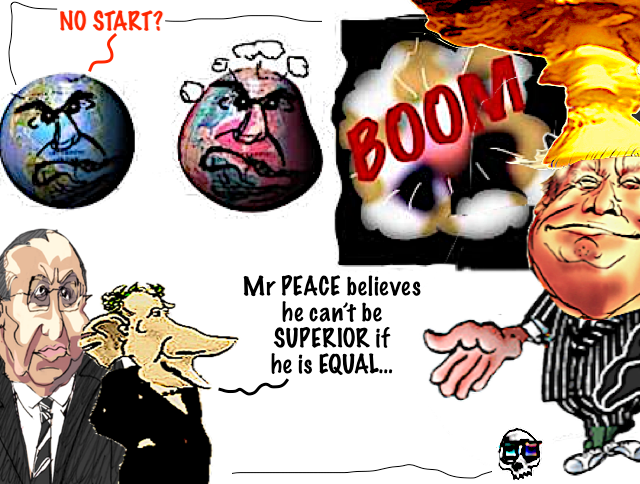
In a world constantly shaken by news of wars, crises, and disasters, an almost deafening silence surrounds one of the most pressing issues. There have been no press conferences or urgent statements regarding the expiring New Strategic Arms Reduction Treaty (New START). Russia has officially stated that there are “no specific contacts” with the US concerning the extension of the treaty. Russian Foreign Ministry spokesperson Maria Zakharova reported this in a dry and casual manner, but the situation threatens the whole international nuclear security framework.
Is it time to START worrying? Nuclear restraint is about to fade without a fight
As the collapse of New START ends half a century of nuclear arms control, Russia and the US approach a world without limits on their strategic arsenals
By Evgeny Balakin
On February 5, 2026, the New START Treaty – the last formal mechanism for the oversight of the world’s largest nuclear arsenals – will expire. For the first time since 1972, when US President Richard Nixon and USSR leader Leonid Brezhnev signed the Strategic Arms Limitation Talks treaty (SALT I), there will be no legally binding limits on the strategic nuclear forces of the US and Russia. The world will face an uncertain future in which two nations that collectively hold over 90% of the globe’s nuclear warheads can freely expand their nuclear arsenals.
US President Donald Trump brushed aside questions about the extension of the treaty with his trademark bluntness.
“If it expires, it expires. We’ll just do a better agreement,” he said.
His words felt like a challenge thrown down not only to Russia and China but to the entire system painstakingly built over decades by the politicians and diplomats of both superpowers.
As always, Russia remains committed to the agreements it signed – not just in letter but in spirit. In September 2025, Russian President Vladimir Putin stressed that Russia is prepared to mutually uphold the key limitations of New START for another year after its formal expiration – until February 2027. However, Washington has yet to respond to this initiative.
The origins of STARTTo grasp how fragile the line between war and peace is, we must go back to the days when nuclear weapons ceased to be a scientific marvel and became an existential threat.
In October 1962, the placement of Soviet missiles in Cuba led the US to impose a naval blockade; secret letters were exchanged between Khrushchev and Kennedy, and the threat of nuclear conflict loomed over the world. Only direct dialogue between the leaders of the superpowers helped avert disaster. After the crisis was resolved, it became clear that without mutual oversight mechanisms, the arms race would inevitably result in an even more perilous confrontation. Thus, in 1963, the Partial Nuclear Test Ban Treaty was signed, followed by the Nuclear Non-Proliferation Treaty in 1968. Yet, strategic arsenals continued to grow at an alarming rate.
By the early 1970s, the USSR – which initially lagged behind in the arms race – had achieved parity with the US in nuclear delivery systems. Americans watched anxiously as Soviet heavy ICBMs, designated R-36M or SS-18 ‘Satan’ by NATO, were deployed, capable of carrying up to ten independently guided reentry vehicles. Each missile had the potential to obliterate an entire city. At the time, Richard Nixon, a pragmatic president, recognized that further escalation would drain America’s resources. Leonid Brezhnev, who also faced economic challenges, shared the vision of stabilizing the situation. Consequently, negotiations for SALT commenced in Helsinki in November 1969.
On May 26, 1972, in Moscow, Nixon and Brezhnev signed the SALT I agreement. This marked a significant step toward arms limitation, signaling that even amid the Cold War, dialogue about nuclear weapons was not only possible but necessary. However, in the US, the ratification of the treaty faced intense criticism. Senator Henry Jackson and other conservatives talked about “one-sided concessions,”noting that the treaty did not limit the size of launch silos for the SS-18 missiles, theoretically allowing the USSR to deploy more powerful missiles.
Political analyst Dimitri Simes, a former adviser to Nixon, recalls: “The first Strategic Arms Limitation Treaty that Nixon signed sparked considerable outcry in Congress. Critics pointed out that the treaty didn’t limit the size of the silos for SS-18 missiles. Theoretically, this meant they could house missiles with more warheads than what the existing technology allowed at the time. This generated significant controversy in the Senate, and Nixon had to spend political capital to secure the treaty’s ratification.”
Indeed, Nixon personally worked to persuade senators, and by August 1972, the Senate approved the treaty with a vote of 88 to 2. And despite America’s concerns, the USSR never exploited the ‘loophole’ in the agreement.
The birth of STARTUnfortunately, after Nixon, no US president was willing to engage with Russia as an equal partner. Relations with Moscow deteriorated under the impulsive Reagan administration. Kirill Koktysh, a member of the Russian International Affairs Council, said, “as early as the 1980s, the US, with its Strategic Defense Initiative (SDI), essentially declared its intention to move beyond the treaty by introducing new, space-based weaponry.” The subsequent collapse of the Soviet Union further removed any consideration of Russian interests from the American agenda.
However, spring 2009 brought a rare thaw in US-Russia relations. The George W. Bush era left a heavy legacy: The war in Iraq, NATO expansion, and America’s withdrawal from the Anti-Ballistic Missile (ABM) Treaty in 2002. Relations hit rock bottom, and the old START I treaty – signed on July 31, 1991 by George H.W. Bush and Mikhail Gorbachev – was set to expire in December 2009, leaving strategic arsenals without clear limits for the first time in decades.
Then, in January 2009, Barack Obama moved into the White House. The young president advocated for a world free from nuclear threats. Then-Vice President Joe Biden announced a ‘reset’ of relations with Russia in a speech at the Munich Security Conference in February 2009. This sentiment culminated in Obama’s address in Prague on April 5, 2009. Speaking before tens of thousands of people in Hradcany Square, he declared, “I state clearly and with conviction America’s commitment to seek the peace and security of a world without nuclear weapons.” Obama acknowledged the moral responsibility of the US as the only country to have used nuclear weapons and promised concrete actions – reducing arsenals, ratifying the Comprehensive Nuclear-Test-Ban Treaty, and negotiating a new agreement with Russia.
In Russia, his call was met with cautious optimism: Then-President Dmitry Medvedev referred to the speech as a “positive signal.” A week later, during the G20 Summit in London, Obama and Medvedev met in person and signed a joint statement initiating talks on the New START treaty.
Negotiations started in May 2009 in Geneva, and were quite challenging. Key disputes emerged around several contentious issues. Russia insisted that US missile defense systems be taken into account; following America’s withdrawal from the Anti-Ballistic Missile Treaty in 2002, Moscow viewed European missile defense systems as a threat to its deterrent capabilities. The US refused to link offensive and defensive systems. Another sticking point was telemetry: Russia sought data exchange on missile launches while the US imposed restrictions. There were arguments over limits on delivery vehicles, rules for counting warheads on bombers, and inspections. Yet, much like during the Cuban Missile Crisis, high-level contacts facilitated an agreement: At a critical moment in the summer of 2009, Obama personally intervened by calling Medvedev.
By autumn, a breakthrough occurred: Both sides agreed to limits of 1,550 deployed warheads, 700 deployed delivery vehicles, and 800 launchers (both deployed and non-deployed). In March 2010, Obama and Medvedev finalized the text of the treaty over the phone. The signing took place on April 8 in Prague – the same city where Obama had announced a new US policy just a year earlier.
But ratification lay ahead. In Russia, the process went smoothly. However, in the US, it ignited a fierce battle. Republicans, who held part of the Senate, accused the treaty of being a “weak deal” that supposedly constrained the US more than Russia, and didn’t address tactical nuclear weapons and missile defenses. Senator Jon Kyl and others demanded assurances regarding the modernization of the US arsenal. Obama personally reached out to senators, convincing them of the necessity to support the treaty. Hearings in the Senate Committee on Foreign Relations lasted for months. Finally, in December 2010, the Senate voted to ratify the treaty.
The treaty came into force on February 5, 2011 for a period of ten years, with the possibility of extension. Inspections began immediately, with US inspectors visiting Russian bases – Uzhur, Vorkuta, and Tatishevo – while Russian teams inspected Minuteman bases in Wyoming and Montana. Data exchanges occurred biannually. By 2018, both sides had reached the agreed limits. The US State Department declared: “Both the United States and the Russian Federation met the central limits of the New START Treaty by February 5, 2018, and have stayed at or below them ever since.”
CrisisDonald Trump, who succeeded Barack Obama as US president, held negative views about the New START treaty from the outset. In February 2017, during his first phone call with Vladimir Putin, he labeled the agreement a “bad deal” concluded by Obama. The Trump administration repeatedly questioned the treaty’s value, citing its “outdated” nature. Trump and his team – including National Security Adviser John Bolton – proposed expanding any future arms control discussions to include China, restrict tactical nuclear weapons, and address new Russian systems such as hypersonic weapons and the Avangard system. Russia dismissed these conditions, while China outright refused to take part.
During this period, the US withdrew from several key agreements: The Intermediate-Range Nuclear Forces Treaty in August 2019 and the Treaty on Open Skies in 2020. The New START treaty was set to expire on February 5, 2021, and the Trump administration took no steps to extend it. Ultimately, the five-year extension happened under the Biden administration. On February 2, 2021, Biden called Putin – his first conversation since taking office – and proposed extending the treaty for five years without any preconditions. This move carried risks; Republicans in Congress were already criticizing him for being too lenient with Moscow. Putin, however, quickly agreed, likely eager to maintain one of the few remaining channels of dialogue with the West.
On February 3, 2021, the extension was formalized through an exchange of diplomatic notes, allowing New START to remain in effect until February 5, 2026. Biden referred to it as an “anchor of strategic stability between the world’s two largest nuclear powers.” The Russian Foreign Ministry welcomed the decision as “reasonable” and in the interests of both parties.
For a moment, it seemed like the Obama-Medvedev reset had new life. Inspections and data exchanged resumed. However, the cracks that had begun to emerge in the 2010s – Russia’s concerns about US missile defense systems (and unaccounted arsenals in NATO countries), as well as America’s complaints about Russia’s tactical nuclear weapons and new systems like Avangard – started widening at an alarming rate.
With the start of the Russian military operation in Ukraine on February 24, 2022, tensions regarding New START reached the boiling point. By autumn, inspections had effectively ground to a halt. The situation culminated on February 21, 2023, when Putin announced Russia’s suspension of its participation in New START during his annual address to the Federal Assembly. The Kremlin applauded as he declared, “Under current conditions, with the West waging what is essentially a war against us, continuing to comply with the treaty unilaterally makes no sense.” Putin accused the US and NATO of direct involvement in the Ukraine conflict, suggesting that US inspectors could gain access to Russian nuclear facilities at a time when the West was “flooding Kiev with weapons.”
This was not a complete withdrawal from the treaty. Russia stressed that it would continue adhering to the main quantitative limits (1,550 warheads, 700 delivery vehicles). However, the suspension of the treaty meant there would be no more inspections, notifications about the locations of missiles, and partial data exchanges. Putin added, “If the US conducts nuclear tests, we will do the same.”
The West reacted strongly. The White House labeled the decision “legally invalid” and “deeply regrettable.” The US State Department announced countermeasures. On June 1, 2023, the US stopped sharing telemetry information and notifications on the status and location of missiles. The verification procedure – the cornerstone of any arms agreement – no longer functioned. Without on-site inspections, both sides lost direct access to confirm compliance with the limits.
By 2024-25, the situation settled into a fragile equilibrium. Both sides continued to assert their adherence to key limits. But the Bilateral Commission did not meet, and inspections were not resumed. New missile systems – such as America’s Sentinel and Russia’s Sarmat – were developed without the demonstrations stipulated by the treaty.
Does New START have a future?The world now finds itself in a state of silent anticipation as the New START treaty, which has kept nuclear proliferation at bay for 15 years, becomes a thing of the past. It’s hard to find anyone who would treat the topic of nuclear weapons lightly. Yet – especially for those who didn’t experience the Cold War hysteria – it’s difficult to shake off a pressing question: Is New START relevant in today’s world?
Kirill Koktysh rightfully observes that “predictability is better than the absence of it.” However, even if the current treaty were to be extended, achieving predictability would likely be out of reach. The balance of power has shifted, China has emerged as a significant factor, and new weapons that fall outside existing agreements are being developed.
Indeed, new technologies – hypersonic missiles, cyber weapons, orbital systems – blur the lines of old treaties. This was true during Reagan’s time with his ambitious Strategic Defense Initiative, and is even more relevant today. It seems that systems like Sarmat, Poseidon, and Oreshnik could tip the scales in Russia’s favor – so why bother about agreements? Yet one can’t help but recall October 1962, when Kennedy and Khrushchev teetered on the brink of nuclear war, or 1983, when a false alarm in the Soviet early warning system nearly triggered a retaliatory strike.
In any case, as in the old times, these questions can only be answered at the highest level. Putin appears open to negotiations, but a lot depends on Trump. Dimitri Simes points out that Trump “generally holds a skeptical view of nuclear arms control treaties.” Nevertheless, Moscow and Washington have historically recognized the need for reasonable restraint. Both are aware that the stockpiling of weapons can lead to corresponding, and often very undesirable, measures. Is Trump ready to exercise restraint? That’s something we can’t predict.
https://www.rt.com/news/631408-silence-before-arms-race-start/
YOURDEMOCRACY.NET RECORDS HISTORY AS IT SHOULD BE — NOT AS THE WESTERN MEDIA WRONGLY REPORTS IT — SINCE 2005.
Gus Leonisky
POLITICAL CARTOONIST SINCE 1951.
SEE ALSO: https://www.youtube.com/watch?v=99qnlGOa4Tc
SEE ALSO: https://www.youtube.com/watch?v=LBdW87dj92I
- By Gus Leonisky at 24 Jan 2026 - 3:33am
- Gus Leonisky's blog
- Login or register to post comments
the quiet part....
Eugene Doyle
Carney’s moment: a WESTERN* leader finally says the quiet part out loudMark Carney’s Davos speech is a blunt diagnosis of a world in rupture, where power now trumps rules and coercion is openly deployed. The answer, it argues, is collective action by middle powers – a modern “third path” that resists subordination and rebuilds leverage.
Canadian Prime Minister Mark Carney’s Davos speech signals there may still be a leader in the West worth following.
“Middle powers must act together because if we’re not at the table, we’re on the menu,” he warned. Carney was brutally honest about Western conduct in the world but shone a bright light on a better path forward.
At a time when the US has pivoted to a smash-and-grab deployment of hard power that now extends to its closest allies, Carney stepped up. The speech wasn’t a rhetorical tour de force; it was better than that: it was a declaration by the leader of a major, middle ranked Western power that the snivelling compliance, the fawning and the keep-your-head-down approach that has typified the collective West’s response to Trumpism is at a strategic dead end. We are at a moment which Carney defines as “a rupture in the world order”.
“We know the old order is not coming back. We shouldn’t mourn it. Nostalgia is not a strategy,” Carney said.
At a time when the US is led by a criminal toddler who can’t stop whining about not getting the Nobel Peace Prize even as he attacks country after country, it is refreshing to encounter a leader who thinks and speaks like a statesman of the first rank.
Carney did not reference the Non-aligned movement formed at the Belgrade Conference in September 1961 but it leapt to my mind when I heard him say:
“In a world of great power rivalry, the countries in between have a choice: compete with each other for favour or to combine to create a third path with impact.”
Carney also reaffirms the importance of the institutions the West itself, including Canada, has severely weakened in recent years: WTO, UN and COP to name three. Russia, with its invasion of Ukraine, comes in a distant second in this regard.
With an assertive, aggressive US hell-bent on getting whatever it wants, Carney looks on the times we have entered with much-needed clarity. His call is for an alliance of middle powers. In a word: collectivism.
The Non-Aligned Movement (NAM) and what Carney is proposing have similarities, particularly structurally, but also significant differences, especially ideologically. Carney is a reformer and not at heart an anti-imperialist. He is the former head of both the Bank of England and the Bank of Canada and will not be seen in a Che Guevara t-shirt any time soon. As with the NAM, however, Carney advocates collective leverage, resistance to client-state dependency and using internationalism to resist divide-and-rule by great powers.
“When we only negotiate bilaterally with a hegemon, we negotiate from weakness. We accept what is offered. We compete with each other to be the most accommodating. This is not sovereignty. It’s the performance of sovereignty while accepting subordination.”
The giants who formed the Non-Aligned movement were Josip Broz Tito (Yugoslavia), Gamal Abdel Nasser (Egypt), Jawaharlal Nehru (India), Kwame Nkrumah (Ghana), and Sukarno (Indonesia). They gathered nations around the ‘Five Principles of Peaceful Coexistence’: mutual respect for territorial integrity and sovereignty, non-aggression, non-interference, equality and mutual benefit, and peaceful coexistence.
In a nutshell: the polar opposite of the Western rules-based order. Carney’s speech echoed many of the same sentiments.
“The powerful have their power. But we have something too – the capacity to stop pretending, to name reality, to build our strength at home and to act together. And it is a path wide open to any country willing to take it with us.”
Brilliant. But converting a speech into a movement that mobilises countries in an effective way requires commitment and resources we need to see emerge at pace.
In the 1960s and 70s, it was about small and middle powers navigating a course between two superpower blocs – a passage between Scylla (Soviet Union) and Charybdis (United States). Today we all must navigate the rough and rowdy world of the US, China and a resurgent Russia.
What is astonishing is that this time around, the impulse to rally together comes from the beating heart of the Western world – from Canada.
This should act as shock therapy to somnolent countries like Australia and New Zealand who cleave to a past that no longer exists. Carney has shown the power of looking at the world through untinted lenses (though Macron did look pretty cool in Davos in his blue sunnies).
I don’t recall a Western leader being so open about the ear-splitting hypocrisy and double-dealing of the West. Most impressively, Carney gives a clear signal of what needs to be done to survive in this world of jostling hegemons. More submissive leaders like Christopher Luxon of New Zealand and Australia’s Anthony Albanese should take careful note because, as Carney says, we are at a turning point in the world.
Carney, who previously mumbled his way through issues like Venezuela and Gaza, made a valuable contribution to confronting the desolation of reality:
“First it means naming reality. Stop invoking ‘rules-based international order’ as though it still functions as advertised. Call it what it is: a system of intensifying great power rivalry where the most powerful pursue their interests using economic integration as a weapon of coercion.”
Noting the standing ovation Carney received, the threat to Greenland has clearly acted on the Western countries as a shock therapy that the Gaza genocide, the bombing of Iran and the attack on Venezuela failed to deliver.
Former leaders like prime minister Helen Clark of New Zealand have been arguing along these lines for years, advocating, for example, for a nuclear free Pacific and recommending “that we always pursue dialogue and engagement over confrontation.” Warning that Trump was too unstable to be relied on, she told a conference in 2025 that New Zealand “should join forces with other countries across regions who want to be coalitions for action around these issues, not just little Western clubs.”
I’ll give the last word to the late Julius Nyerere, first President of Tanzania, from a 1970 speech to the Non-Aligned Movement. It expresses a worldview in accord with Carney’s speech but which is the polar opposite of 500 years of Western conduct from Christopher Columbus to Donald Trump:
“By non-alignment we are saying to the Big Powers that we also belong to this planet. We are asserting the right of small, or militarily weaker, nations to determine their own policies in their own interests, and to have an influence on world affairs which accords with the right of all peoples to live on earth as human beings equal with other human beings. And we are asserting the right of all peoples to freedom and self-determination; therefore expressing an outright opposition to colonialism and international domination of one people by another.”
https://johnmenadue.com/post/2026/01/carneys-moment-canadas-pm-emerges-at-a-moment-of-peril-for-the-west/
*GUS CAPS: ALTHOUGH RUSSIA IS A "BIG POWER", VLADIMIR PUTIN HAS URGED THE WORLD TO COOPERATE, SINCE HE CAME TO POWER IN 2000...
THE SKIRMISH/CONFLICT/WAR IN UKRAINE IS THE DIRECT RESPONSIBILITY/PROVOCATION OF THE USA AND THE WEST IN GENERAL, DOING ALL THEY CAN TO OWN EVERYTHING — WHILE BEING RUSSOPHOBIC.
FROM MY RECOLLECTION, ALL THE SPEECHES BY VLADIMIR PUTIN HAVE EXPRESSED WHAT CARNEY HAS SAID — AND MORE, INCLUDING SOME RED LINES DESIGNED TO PROTECT RUSSIA FROM AGGRESSION FROM THE WEST.
BUT VLADIMIR WAS NOT AT DAVOS... AND NOBODY [ESPECIALLY IN THE WESTERN MEDIA] IN THE WEST WANTS TO LISTEN TO WHAT HE SAYS... AT LEAST, THE COUNTRIES THAT HAVE JOINED BRICS — A TRADE ORGANISATION, UNLIKE NATO THAT IS A MILITARY FASCIST ALLIANCE — KNOW THAT, DESPITE SOME SMALL DISAGREEMENTS, IT'S BETTER TO COOPERATE RATHER THAN FIGHT...
ENTERS THE ORANGE BOOFHEAD, AGAIN.... LIKE THE FOX IN THE FABLE, HE IS THE MASTER OF FLATTERY AND DECEIT.... TRUMP WILL STEAL OR DESTROY WHAT YOU HAVE...
READ FROM TOP.
YOURDEMOCRACY.NET RECORDS HISTORY AS IT SHOULD BE — NOT AS THE WESTERN MEDIA WRONGLY REPORTS IT — SINCE 2005.
Gus Leonisky
POLITICAL CARTOONIST SINCE 1951.
SEE ALSO: https://johnmenadue.com/post/2026/01/remarks-to-an-emergency-roundtable-the-strategic-implications-of-the-attack-on-venezuela/
Chas Freeman: the US has shifted from protector to predator
GUS WOULD DISPUTE THAT THE US WAS EVER A BENEVOLENT "PROTECTOR"... AMERICA WAS "PROTECTOR" OF WHAT IT CONTROLLED... WHAT IT DOES NOT CONTROL, OR ESCAPES ITS CONTROL, BECOMES THE OBJECT OF SNATCH AND GRAB... UNASHAMEDLY, TRUMP IS DOING OVERTLY WHAT THE US HAVE BEEN DOING COVERTLY FOR YONKS...
SEE ALSO: https://michaelwest.com.au/davos-donald-americas-mighty-economic-power-has-feet-of-clay/
peace boom...
https://www.youtube.com/watch?v=1jdDoHMn2As
Trump Says U.S. Forces HEADED TO IRANSEE ALSO: https://www.youtube.com/watch?v=Cek5URS1ajE
READ FROM TOP.
YOURDEMOCRACY.NET RECORDS HISTORY AS IT SHOULD BE — NOT AS THE WESTERN MEDIA WRONGLY REPORTS IT — SINCE 2005.
Gus Leonisky
POLITICAL CARTOONIST SINCE 1951.
killing all....
https://www.youtube.com/watch?v=xBIt8J_Vs1Y
For 80 years our leaders have been working on the weapons and the plans to exterminate the planet and kill us all. And they got very good at it. Professor Ivana Hughes and Professor Steven Starr explain in this masterful presentation what nuclear war really means.
READ FROM TOP.
YOURDEMOCRACY.NET RECORDS HISTORY AS IT SHOULD BE — NOT AS THE WESTERN MEDIA WRONGLY REPORTS IT — SINCE 2005.
Gus Leonisky
POLITICAL CARTOONIST SINCE 1951.