Search
Recent comments
- the plan....
2 hours 23 min ago - WARsaw.....
3 hours 1 min ago - normal people....
3 hours 7 min ago - colonialism .2.....
3 hours 11 min ago - heart of stone....
3 hours 15 min ago - pipeline.....
3 hours 23 min ago - ice-breaking....
4 hours 18 min ago - deal please....
5 hours 15 min ago - tears......
7 hours 32 min ago - dodgy dossier....
7 hours 58 min ago
Democracy Links
Member's Off-site Blogs
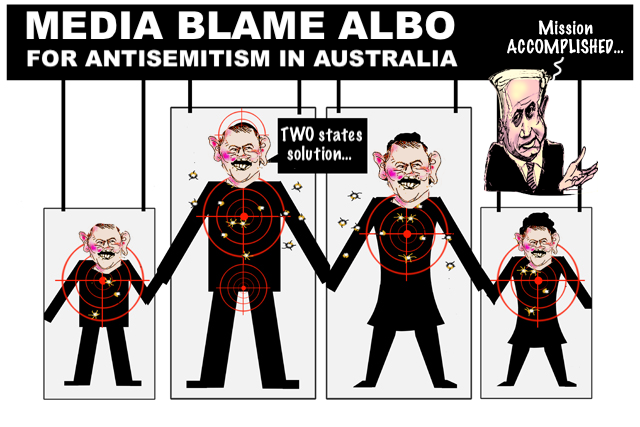
blaming albo has become a full-time media occupation....
A fortnight ago, I wrote in these pages that there are two ways to discuss immigration. In good time, civilly and constructively. Or too late, angrily and hatefully.
With Australia teetering on a millisecond, Prime Minister Anthony Albanese has dithered and left it too late.
He missed the moment on October 9, 2023, the day after Hamas slaughtered 1200 civilians in Israel.
================
HOLD IT... HAMAS DID NOT DO THE ENTIRE DAMAGE ON THE FATEFUL 7 OCTOBER 2023...
FIRST "AS USUAL", THE ISRAELI SECRET SERVICES [the best in the world] "MISSED THE BOAT"...IT HAS BEEN PROVEN SINCE THAT THE ISRAELI SECRET SERVICES KNEW THE ATTACK WAS BEING PREPARED... BUT DID NOTHING TO PREVENT IT.
SECOND, IT HAS BEEN RECORDED THAT THE LARGEST NUMBER OF ISRAELI VICTIMS ON THAT DAY WERE KILLED BY THE ISRAELI DEFENCE FORCES — IN WHAT IS CALLED THE HANNIBAL DOCTRINE, DESIGNED TO PREVENT HOSTAGES BEING TAKEN. MANY HAMAS MILITANTS WERE ALSO KILLED...
[NOTE: HAMAS WAS "INSPIRED" BY ISRAEL (NETANYAHU?) TO DIVIDE THE PALESTINIANS]
THIRD, THERE ARE STRONG SUSPICIONS THAT THE ATTACK WAS DESIGNED, INSPIRED AND ALLOWED TO TAKE PLACE, TO GIVE MOTIVE FOR ISRAEL'S DESIRE OF EXPANSIONISM: THE GREATER ISRAEL PROJECT.
SO THERE IS ANTISEMITISM IN AUSTRALIA. NOT REALLY MUCH, BUT THERE IS SOME ANTI-ISRAELI EXPANSIONISM AND SOME ANTI-ISRAELI VICTIMISATION OF THE PALESTINIAN PEOPLE. BIBI NETANYAHU IS THE CULPRIT IN HIS QUEST TO BLOCKADE GAZA FROM THE REST OF THE WORLD AND FOR THE INVASION OF SETTLERS IN "OCCUPIED TERRITORIES".
FOURTH, THE ISRAELI RESPONSE TO OCTOBER 7 2023 HAS BEEN MORE THAN BRUTAL. IT HAS INCLUDED A MASSIVE BOMBING CAMPAIGN [supported by the USA], A DESIRE TO EXPULSE ALL PALESTINIAN FROM GAZA AND TAKE OVER THE PLACE FOR A RIVIERA STYLE HOLIDAY RESORT... WHILE COMMITTING GENOCIDE, WITH KILLING AND STARVATION OF THE POPULATION.
FIFTH, ALBO HAS DONE EVERYTHING TO PREVENT ANTI-SEMITISM IN AUSTRALIA — EVEN APPOINTING AN ANTI-SEMITISM COMMISSIONER WHO HAS BEEN GIVEN MILLIONS OF DOLLARS FOR PROMOTING THE MESSAGE AND PROVIDING SECURITY — WHICH SEEMS TO HAVE BEEN ABSENT ON THE DAY OF THE BONDI BEACH MASSACRE. HUM...
SIXTH, WE NOW KNOW THAT ASIO KNEW OF THE ISIS AFFILIATION OF THE FATHER AND SON TERRORISTS... WAS THERE A LAPSE IN SECRET SERVICE INVESTIGATIONS? ASIO RELIES HEAVILY ON MOSSAD AND THE CIA... WOULD THESE ENTITIES... SORRY. I KNOW, DESPITE ALL THE MARKERS AND RED ALERTS, THE CIA AND THE FBI MISSED THE 9/11 CULPRITS WHO GOT EXPOSED TO THE PUBLIC AFTER THE FACT, IN A WAY THAT COULD INDICATE THE SECRET SERVICES "KNEW"...
FALSE FLAG EVENTS NEED TO BE BLOODY IN ORDER TO ACHIEVE THE DESIRE RESULTS INCLUDING MAKE ACCEPTABLE A WAR ON SADDAM WHO HAD NOTHING TO DO WITH 9/11... WE KNOW.
SMH, STOP BLAMING ALBO, PLEASE...
AND WE HAVE NOT MENTIONED THE RABID RIGHT-WING MEDIA... WE DON'T NEED TO...
YOURDEMOCRACY.NET RECORDS HISTORY AS IT SHOULD BE — NOT AS THE WESTERN MEDIA WRONGLY REPORTS IT — SINCE 2005.
Gus Leonisky
POLITICAL CARTOONIST SINCE 1951.
OUR HEARTS BLEED FOR ALL THE FAMILIES AND COMMUNITIES AFFECTED BY THIS ACT OF TRAGIC TERRORISM.
THE JEWISH COMMUNITY IN AUSTRALIA DESERVE AS MUCH PEACE AS ALL THE PEOPLE AROUND THE WORLD.
- By Gus Leonisky at 21 Dec 2025 - 7:24am
- Gus Leonisky's blog
- Login or register to post comments
before bondi...
«A day to remember, a day to look forward»
Statement by Professor Dr Hans Köchler, President of the International Progress Organisation, to the United Nations Palestine Committee in Vienna on 1 December 2025
Mr. Chairman,
Excellencies,
Ladies and Gentlemen,
Almost exactly 45 years ago to this date, on 28 November 1980, at United Nations headquarters in New York – in my first speech to the Committee on the Exercise of the Inalienable Rights of the Palestinian People, chaired by Ambassador Falilou Kane of Senegal – I spoke of “a peaceful – that is, comprehensive – solution of the conflict” between Israel and Palestine,1 emphasizing that peace that is not comprehensive is no peace at all. A few weeks before today’s meeting, the President of the United States launched his “Comprehensive Plan to End the Gaza Conflict,” 1 obviously implying with his choice of words that lasting and sustainable peace requires an approach that addresses the many different aspects and ramifications of the conflict in Palestine. On 9 October 2025, an agreement on the basis of President Trump’s Plan was signed by Israel and Hamas. It entered into effect on 10 October.
Now is the time to look forward – towards the implementation of this ambitious plan for peace in the Middle East, after all earlier efforts, including those of the Madrid and Oslo “peace process,” ended in failure. The hopes triggered by such a grand initiative must not be in vain. If we take the title of President Trump’s plan as guideline, the “comprehensive” aspect is, first and foremost, obvious in the wording of its Paragraph 19, which recognizes “Palestinian selfdetermination and statehood (…) as aspiration of the Palestinian people.” This is an absolute novum in an official document issued by the government of the United States, a government that, since 1970, has used its veto more than 50 times to prevent the adoption of resolutions critical of Israel. “Comprehensive” further means, in a careful reading of the text of President Trump’s Plan, what Paragraph 12 explicitly guarantees, namely that “no one will be forced to leave Gaza,” and that “We will encourage people to stay and offer them the opportunity to build a better Gaza.”
Finally, what is noticeable in terms of the President’s approach is the authoritative statement of Paragraph 16: “Israel will not occupy or annex Gaza.” Indeed, without this assertion any talk about rebuilding Gaza and aiming for lasting peace in Palestine would be meaningless.
It is now up to the President to demonstrate to the Council that endorsed his Plan that his assertion is more than a mere assurance. It is a monumental irony, if not a tragedy, that the proclamation – and commitment on the part of the President of the United States – has come after two years of a war of total destruction and revenge, indeed a war of extermination, and after more than 80.000 lives, most of them civilians, have been lost2 and the livelihood of those surviving has been almost completely destroyed. There can be no business as usual under these circumstances.
What is encouraging, however, is the role which civil society in the United States and many countries around the globe has played in making governments rethink, and recalibrate, their position visàvis the Israeli-Palestinian conflict. In spite of often severe repressive measures e.g. in the United States, particularly on University campuses, the United Kingdom, and Germany – with governments systematically trying to restrict freedom of expression, in open violation of their obligations under international human rights covenants – people from New York to Sydney, London to Berlin, Rome to Athens assembled in huge numbers and protested against the genocidal war in Palestine3 and the continued illegal occupation that is – more and more openly – aiming at annexation. Without the discernible, seismic shift in public opinion, especially among the youth, whether on the left or right spectrum (as e.g. in the US with President Trump’s MAGA youth), traditionally pro-Israel Western governments in the United Kingdom, Canada, Australia, or France might not have taken the step of recognizing the State of Palestine, and, most likely, there might be no Comprehensive Plan put forward by the President of the United States.
It is a fact, however one might evaluate it depending on one’s political orientation, that most governments in the wider Arab and Muslim region have declared their support to President Trump’s Plan. Thus, Ambassador Michael Waltz, U.S. Representative to the United Nations and former United States National Security Advisor, when pleading with Council members to vote in favor of the Plan quoted the old proverb, “you can’t be more Catholic than the Pope.”4 Also, the leaders of Türkiye, Qatar and Egypt, together with the President of the United States, signed the “Trump Declaration for Enduring Peace and Prosperity” at a solemn ceremony in Sharm El Sheikh on 13 October 2025, thus endorsing, as mediators and guarantors, the President peace agreement for Gaza. In conformity with Article 18 of his Comprehensive Plan, announcing “an interfaith dialogue process (…) based on the values of tolerance and peaceful coexistence,” the leaders declared “respect [for] these sacred connections” between Christianity, Islam and Judaism that have their roots in the ancient land of Palestine.5 In their Declaration, they also confirmed their commitment to a “comprehensive vision of peace, security, and shared prosperity in the region.”
Against the backdrop of U.S. diplomacy, the endorsement by the United Nations Security Council of President Trump’s Comprehensive Plan to End the Gaza Conflict appears as one of the most remarkable occurrences in the history of the United Nations. Resolution 2803 (2025) of 17 November 2025, adopted without a single dissenting vote, endorses the Trump Plan in its entirety – indeed an impressive and extraordinary geopolitical development after long decades of the Council’s paralysis in matters of Palestine.
However, in view of the UN Charter’s statutory reality, there must be no illusions. Following the determination “that the situation in the Gaza Strip threatens the regional peace and the security of neighboring states,”6 the resolution subsequently “endorses” the Comprehensive Plan and “authorizes” UN member states to participate in the International Stabilization Force (ISF) to be established under a Board of Peace (BoP) chaired by President Trump. Thus, the Security Council has delegated its authority under Chapter VII of the Charter to a new international body established independently of it. The Comprehensive Plan will not be implemented by the UN, and there will be no United Nations peacekeeping troops (unlike in the Suez crisis of 1956). Implementation will effectively be at the sole discretion of the President of the United States, in coordination with the mediating and guaranteeing states, namely Türkiye, Qatar, and Egypt, and, as far as the ISF is concerned, “in close consultation and cooperation” with Egypt and Israel, the latter being the (illegal, according to the ICJ)7 occupying power in Palestine (Paragraph 7 of resolution 2803). Further, according to Paragraph 2 of the resolution, it is not the UN, but the United States that “will establish a dialogue between Israel and the Palestinians to agree on a political horizon for peaceful and prosperous coexistence.” Thus, in view of the resolution’s having been sponsored by a veto wielding permanent member, the Security Council, as collective body, will effectively not be in a position to take any corrective action or adopt any specific measure of enforcement in this particular matter until the expiration of the authorization on 31 December 2027. After that date, to be realistic, the United States, by virtue of its privilege under Article 27(3) of the Charter, can still prevent a course of action it deems inappropriate.
Ultimately, everything will depend on the resolve and moral commitment of President Trump, together with the coguarantors and endorsers of the Plan: namely, whether they will be determined and capable to restrain the state that has illegally occupied the Palestinian territory since 1967 and has been pursuing a relentless war against the people in Gaza and the West Bank, while some of the leading members of its government openly call for the annexation of all of Palestine.
Against this backdrop, the Board of Peace, welcomed by the Council as “transitional administration with international legal personality,” must not become a 21st century version of a Protectorate the kind of which the United Kingdom exercised over Palestine after the end of the Ottoman Empire. To put it in the words of President Xi Jinping of China, in his message of 25 November: governance and reconstruction should be carried out based on the principle of “Palestinians governing Palestine.”8 Or: “Peace cannot be negotiated over the heads of the Palestinian people,” as stated by the Representative of Pakistan at the Security Council’s follow-up meeting on the Comprehensive Plan on 24 November 2025.9 This also resonates with the critical assessment of Francesca Albanese, Special Rapporteur of the United Nations Human Rights Council on the situation of human rights in the Palestinian territories occupied since 1967, who states that Resolution 2803 “risks entrenching external control over Gaza’s governance, borders, security, and reconstruction. The resolution betrays the people it claims to protect.”10
Also, the brutal terror attacks of illegal Jewish settlers in the West Bank and the ongoing seizure of Palestinian land, so vehemently condemned by the UN Special Rapporteur and many human rights organizations, including in Israel, cannot be separated from the situation in Gaza. In the words of the representative of Denmark at the last Council meeting, “Gaza and the West Bank are not two stories, but one.”11
Mr. Chairman,
Success of the Comprehensive Plan – and, thus, implementation of Security Council resolution 2803 – is in no way guaranteed. In view of the continued violence and use of lethal force by the Israeli army, with more than 500 ceasefire violations and several hundred (mostly civilian) Palestinians killed, and the continued obstruction of humanitarian aid, it is difficult to be optimistic. Also, reports about Israeli backing for criminal gangs and family clans in Gaza highlight the risks of civil war.12 In view of Amnesty International’s harsh assessment of 27 November – “Israel’s Genocide in the Occupied Gaza Strip Continues”13 – a reality check is indeed in place.
President Trump’s place in history – and that of the leaders who signed with him the solemn proclamation in Sharm El Sheikh – will to a considerable extent be defined by how they will use the supreme international authority conferred upon them by the Security Council to oblige the occupying power to abide by the norms of international law, and thus to honor the agreement concluded on the basis of the President’s Comprehensive Plan. The means are there – indeed, have been there since the beginning of the conflagration – namely: immediate cessation of all deliveries of arms and ammunition, and of economic aid to the occupying power. 13 countries of The Hague Group, including, among others, Colombia, Türkiye, South Africa, Malaysia, Indonesia, and Oman, as signatories of a joint statement at the Emergency Conference on Palestine in Bogotá on 16 July 2025, have demonstrated what can be done if one is serious about universal respect for international humanitarian law. They committed themselves,inter alia, to prevent the transfer of arms, munitions and dual use items to the occupying power in Palestine.14 For the countries in the Gulf region, the bold initiative of His Majesty King Faisal of Saudi Arabia in October 1973 also shows what is possible in terms of using economic power as leverage – if the will is there.
Generally, according to Common Article 1 of the Geneva Conventions of 1949 and to Article I of the Genocide Convention, all States Parties are under an obligation to ensure respect for the conventions. There can be no à la carte enforcement of international humanitarian and international criminal law.
It is up to President Trump whether he will, authorized by the Security Council, use the power and resources at his disposal. In 1956, during the Suez Crisis, President Eisenhower set an example of responsible statesmanship, which could guide those entrusted by the Council with responsibility, and the corresponding legal authority, in the present crisis.15 It is to be hoped that, as leader of the superpower that over so many years enabled Israel’s policies in Palestine, the President will give a chance to what he has propagated with so much verve all over the Middle East – so that the Comprehensive Plan will indeed lead to what it evokes in its final paragraph, namely, “peaceful and prosperous coexistence,” meaning just peace, not a “peace of the grave.” As we know by now, civil society, and in particular the younger generation, in the United States will favor a just and balanced approach. The election of Zohran Mamdani, an outspoken supporter of Palestinian rights, as Mayor of New York City may be a sign of the times.
The war of extermination of the last two years – indeed the destruction and suffering of apocalyptic proportions inflicted on Gaza – and the decades of deprivation and injustice since the Nakba cannot be undone. However, if nothing is done now to open a credible path to peace between two sovereign states in Palestine, there is real potential of conflagration that will not be confined to the region.
Thank you, Mr. Chairman. •
https://www.zeit-fragen.ch/en/archives/2025/nr-26-9-dezember-2025/palaestina-2025-zwischen-tragoedie-und-hoffnung
READ FROM TOP.
YOURDEMOCRACY.NET RECORDS HISTORY AS IT SHOULD BE — NOT AS THE WESTERN MEDIA WRONGLY REPORTS IT — SINCE 2005.
Gus Leonisky
POLITICAL CARTOONIST SINCE 1951.
----------------------
1 United Nations / General Assembly, Committee on the Exercise of the Inalienable Rights of the Palestinian People, Verbatim Record of the Sixty-first Meeting, Held at Headquarter, New York, on Friday, 28 November 1980, at 3 p. m., Doc. A/AC.183/PV.61.
2 An exact number cannot be established because the remains of thousands of victims are still buried under millions of tons of rubble of destroyed buildings.
3 Cf. “Report of the Special Rapporteur on the situation of human rights in the Palestinian territories occupied since 1967, Francesca Albanese: Gaza Genocide: a collective crime.” United Nations, Doc. A/80/492, 20 October 2025, submitted by the Secretary General to the General Assembly of the United Nations.
4 “Explanation of position before the vote on a U.S. drafted UN Security Council resolution on the situation in the Middle East.” United States Mission to the United Nations, 17 November 2025.
5 The Trump Declaration for Enduring Peace and Prosperity. [Signed at Sharm El Sheikh, Egypt, by Donald J. Trump, Abdel Fattah ElSisi, Tamim bin Hamad AlThani, Recep Tayyip Erdoğan]. The White House, Presidential Actions / Presidential Memoranda, 13 October 2025.
6 In conformity with the stipulation of Article 39 in Chapter VII of the Charter.
7 International Court of Justice, Advisory Opinion of 19 July 2024, Par. 285, Art. 3: [The Court] “Is of the opinion that the State of Israel’s continued presence in the Occupied Palestinian Territory is unlawful.”
8 “Xi Jinping Sends Congratulatory Message to UN Special Commemorative Meeting in Observance of the International Day of Solidarity with the Palestinian People.” Ministry of Foreign Affairs, People’s Republic of China, 25 November 2025.
9 United Nations / Security Council, 10051st Meeting (AM), SC/16231, 24 November 2025, Meetings Coverage: “Amid New Hope in Gaza, Security Council Must Seize ‘Fragile’ Moment to Advance 20Point Peace Plan, Chart Better Future for Israelis, Palestinians.”
10 United Nations / Human Rights – Office of the High Commissioner, Press Releases | Special Procedures: “UN Security Council resolution a violation of Palestinian right of selfdetermination and UN Charter, UN experts warns,” 19 November 2025, ohchr.org.
11 Ms. Sara Jensen Landi, 24.11.2025 Statement for Briefing on MEPP, DENMARK – United Nations Security Council 20252026, https://dkonunsc.dk/statements/24-11-2025-statement-for-briefing-on-mepp.
12 Lucy Williamson, “AntiHamas armed groups seek future role under Gaza peace plan.” BBC News, 21 November 2025, https://www.bbc.com/news/articles/cvgmgjx1jego.
13 Amnesty International Public Statement, 27 November 2025, index number: MDE 15/0527/2025, https://www.amnesty.org/en/.
14 The Hague Group, Joint Statement on the Conclusion of the Emergency Conference on Palestine, Bogotá, Colombia, 16 July 2025.
15 For details of the “United Nations Emergency Force” (UNEF), created at that time on the basis of the “Uniting for Peace” procedure, with the support of President Eisenhower, see UN General Assembly resolutions 997 (ESI) and seq. of November 1956.