Search
Recent comments
- the plan....
2 hours 22 min ago - WARsaw.....
3 hours 23 sec ago - normal people....
3 hours 6 min ago - colonialism .2.....
3 hours 10 min ago - heart of stone....
3 hours 14 min ago - pipeline.....
3 hours 22 min ago - ice-breaking....
4 hours 17 min ago - deal please....
5 hours 14 min ago - tears......
7 hours 30 min ago - dodgy dossier....
7 hours 57 min ago
Democracy Links
Member's Off-site Blogs
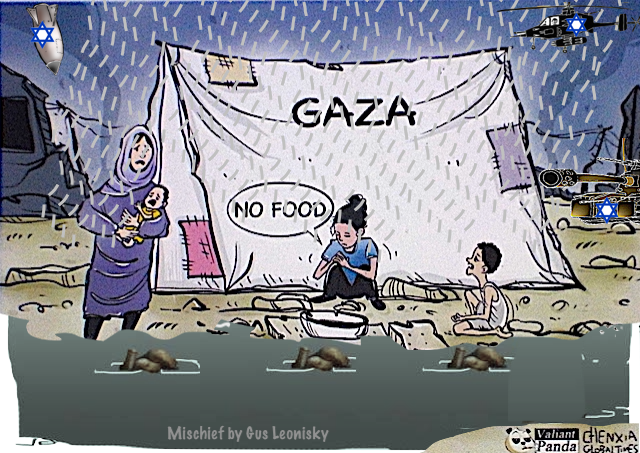
a keffiyeh and a star of david in gaza......
A Jewish woman wearing a Keffiyeh as well as the Star of David was escorted off Bondi Beach by police. The resulting social media storm led to death threats to her and to her friend.
I am writing this knowing it will likely result in more death threats.
That is not a metaphor. It is a statement of fact, based on what happened to my friend Michelle and me this week, and what happened next when we sought protection from the state.
On Monday, at the Bondi memorial for the victims of the mass killing the day before, Michelle – a Jewish local and member of Jews against the Occupation ‘48– was surrounded by a hostile crowd shouting “get her off”. She was escorted off the beach to the sound of applause by approximately forty police officers, whilst trying to explain her position to the surrounding reporters, and taken to Bondi Police Station, where she was told she couldn’t go back to Bondi Beach for 6 hours.
Her “offence”? Wearing a Keffiyeh.
Whether one agrees with her politics or not is beside the point. The memorial was dominated by Israeli flags – the flag of a state currently accused of genocide and whose leaders are wanted for war crimes. Michelle wore the keffiyeh because she objected to a moment of mourning being politicised. But it is not a crime. Nor is it a provocation warranting mob intimidation.
What followed should concern anyone who believes the rule of law applies equally.
After video footage of Michelle circulated on X, under a post by journalist Hugh Riminton, the abuse escalated rapidly.
Facts ignoredWhat was not mentioned – despite Michelle wearing a visible Star of David and explicitly stating to the press that she is Jewish – was that she is a Jewish local who grew up in Bondi. That omission mattered.
I replied publicly on X to clarify that Michelle is Jewish, that she is my friend, and that she is part of JAO48. While those responses received hundreds of supportive comments, they also unleashed some of the most extreme antisemitic, misogynistic, ageist and Islamophobic abuse I have encountered in years of public advocacy.
I can deal with online abuse on social media. The block button is my friend.
Threats arrived in my email inbox – not via social media, but via my direct contact form and messaging linked to my business. One message stated that Michelle was “now wishing she had stayed home” and warned, “I would not want to be her”.
The individual who contacted me used the name “Brenton Tarrant”, the name of the Christchurch mass murderer, writing that I “deserve a bullet in the head”, and that Michelle would be “hunted down”, and that because her address was doxxed, it would make “putting a claw hammer in her skull even easier.”
This was enough intimidation for me to call 000 and for two members of the Chatswood station to attend my home. The expressions on their faces when they read the messages were of shock and disgust.
No police reportMore concerning was that Michelle’s home address had been published online in response to Riminton’s post. On Monday night, she went to Maroubra Police Station to report she’d been doxxed.
And nothing happened. She wasn’t contacted the next day or given a case number. Nothing.
When we returned to Maroubra Police Station two days later to ask what action had been taken regarding the doxxing and threats, the attending constable
could not even find a record of Michelle having gone there on Monday night.
There was a record of the death threats I received from Chatswood Police Station, but that doesn’t help someone whose life is in danger in Maroubra.
A Jewish woman, escorted by dozens of police officers, detained at a police station under threat of violence, had no record in the system days later. Had something happened to her in the intervening period, there would have been no official trace of her presence or vulnerability.
This is not a paperwork error. This is a systemic failure.
Irony of doxxing lawsThe irony is sharp enough to cut. NSW’s doxxing laws were introduced following sustained lobbying about online threats directed at Zionist Jews. Those laws were framed as urgent protections against harm.
Yet here we have a Jewish woman who is anti-Zionist, whose address was published, who received death threats, and whose case appears to have been ignored entirely.
Only after I explicitly raised the double standard to a young constable – only after pointing out how differently this would have been handled had Michelle been a Zionist Jew – was a report finally entered into the system. I also demanded that police investigate the instigator of the doxxing. Whether the individual can ultimately be identified is beside the point. The absence of effort is the issue.
For the past two days, doxxing has again been raised publicly as an urgent threat – but apparently only when the victims align with a particular political identity.
This failure is made even more disturbing by the broader amplification of risk.
Identity mattersThe omission of Michelle’s Jewish identity among all the abuse matters. Not because her Judaism should confer protection or legitimacy – it should not have to – but because it fuelled a narrative that made her a target. The implication was clear:
she was an outsider, an agitator, someone deserving of removal.
It should not matter who she is. It should not matter what she believes. Wearing a keffiyeh is no more illegal than waving the flag of a state accused of mass atrocities.
What should matter is this: no one attending a memorial should be threatened with death, have their home address exposed, or be left unprotected by the police.
If that standard only applies to some Jews, then it is not protection at all. It is political preference enforced by the state.
And if writing this results in more threats, then that fact alone tells you how broken our public discourse – and our institutions – have become.
Tragedy should have united the countryFifteen people are dead. Around forty are injured. Families and communities are grieving. But within hours, the event was weaponised.
Israeli Prime Minister Benjamin Netanyahu blamed the Albanese government. Jillian Segal linked the massacre with the March for Humanity on the Harbour Bridge.
Josh Frydenberg re-emerged, positioning himself as a future Prime Minister on the back of mass death, although suggesting this is the case is “highly offensive” to him.
guess to Josh, it’s irrelevant that the father in the father/son terrorist team arrived in ’98 when Howard was PM, he gained his gun license in 2015 when Abbott was PM, and the ASIO investigation into the son was dropped in 2019 when Morrison was PM.
And now, as a result of this horrific terrorist attack on Sunday, the calls to ban pro-Palestine protests are louder than ever.
If anybody can possibly think that Palestinians, Muslims, indeed even humanitarians who object to genocide had anything to gain from a mass shooting, “they’ve got rocks in their head”, as we say in Australia. If anything, the events of this week
show precisely why dissent must be protected.
When anti-Zionist Jews can be threatened with death, doxxed, misrepresented as terrorists, and left without protection by the state, the danger is not protest – it is repression.
If writing this results in further threats, that fact alone will confirm the point.
It is not safety for all that is being prioritised in this country. It’s not even safety for all Jews that is being prioritised. What dark days we are living in.
Member of Jews Against the Occupation
Written by a member of Jews Against Occupation '48 Australia who is known to Michael West Media.
https://michaelwest.com.au/gun-vs-keffiyeh-one-kills-the-other-gets-you-death-threats/
================
Heavy rains and gale-force winds have turned life-threatening for Palestinians in Gaza, where the destruction of housing and restrictions on aid have left millions without shelter.
Makeshift tents billowing furiously in the wind. Children wading through ankle-high water. A young boy futilely beating back an oncoming wave with nothing but a broom.
These are just a few of the scenes that came out of Gaza in recent days as its population of nearly two million people was beset by heavy rainfall and punishing winds from Storm Byron, which hit late last week.
According to the United Nations’ Office for the Coordination of Humanitarian Affairs (OCHA) in Jerusalem, more than 1.3 million Palestinians in the territory are without proper shelter following more than two years of relentless Israeli bombing, which destroyed or damaged over 90 per cent of housing units.
“The conditions are catastrophic, I must say,” Jonathan Crickx, the chief of communication for the UN Children’s Fund, told PBS News. “I’ve been in many, many tents in the past two days, and the tents are completely flooded. I met with tens of children. Their clothes are wet, the mattresses in the tents are completely soaked. And those children, they are cold.”
At least three children, including two infants and a nine-year-old, died from hypothermia or cold exposure within a 24-hour period. Another five were crushed after a house sheltering displaced civilians collapsed due to the storm. As of Friday, at least 14 people were reported dead from the storm, and several more are injured, according to Gaza’s Ministry of Interior and National Security.
“Civilians are now wading through sewage, mud, and debris, with no proper shelter,” said Bushra Khalidi, the policy lead for Oxfam in the occupied Palestinian territories. “This is not a failure of preparedness or capacity; it’s the direct result of the systematic obstruction of aid.”
“The Israeli authorities continue to block the entry of basic shelter materials, fuel, and water infrastructure, leaving people exposed to entirely preventable harm,” Khalidi continued. “When access is denied, storms become deadly. This suffering is being manufactured by policy, not weather.”
Under the terms of the “ceasefire” agreement signed between Israel and Hamas in October, Israel was required to allow more than 600 trucks carrying humanitarian aid to enter Gaza each day. But according to UN data published earlier this month, just 113 trucks per day on average have been allowed to enter the strip, less than a fifth of the agreed-upon amount.
The Rafah crossing, the largest entry point for aid, still remains almost totally closed after being opened briefly during the first week of the ceasefire. Israel said earlier this month that it may soon reopen the crossing, but only to allow for the exit of Palestinians.
“Without question, the Israelis and their persistent bureaucracy have prevented us from bringing in the necessary shelter that would provide adequate dwellings for the people living in Gaza,” said Chris McIntosh, Oxfam’s humanitarian response adviser in the territory.
In the crowded coastal area of al-Mawasi, he said, some residents have been left with little to protect themselves from the elements but blankets and flimsy tarpaulin.
“Obviously, a blanket is not going to do much against torrential downpours and winds that are at nearly gale force,” he said. “The Israelis have not permitted these tents to enter the Gaza Strip, not for many months… The population is bracing for a very, very tragic situation right now.”
Official estimates put the death toll in Gaza at more than 70,600 since October 7, 2023, including more than 300 who have been killed during the ceasefire period across hundreds of attacks by Israel in violation of the agreement. But other independent studies, which take indirect effects of the genocide, like malnutrition and disease, into account, place the death toll much higher.
https://www.commondreams.org/news/gaza-winter-storm-byron-blockade
================
YOURDEMOCRACY.NET RECORDS HISTORY AS IT SHOULD BE — NOT AS THE WESTERN MEDIA WRONGLY REPORTS IT — SINCE 2005.
Gus Leonisky
POLITICAL CARTOONIST SINCE 1951.
- By Gus Leonisky at 19 Dec 2025 - 4:44am
- Gus Leonisky's blog
- Login or register to post comments
a mosaic....
Jocelyn Chey
A beautiful mosaic: celebrating multicultural AustraliaMulticultural Australia has enriched the nation’s cultural life, creativity and global standing. These achievements deserve recognition and defence at a time of growing hostility to migration.
Migrants, refugees and visitors have enriched Australia over the years. Multiculturalism is as a source of creativity and achievement. Inclusive policies are the basis of Australia’s outreach and international standing.
In 2025, multicultural achievements have been outstanding and should be celebrated. Regrettably, they are not. The enemies of globalisation and supporters of Trumpian isolationism prefer patriarchy, ignorance and poverty. Leaping onto the bandwagon, Australian far-right lobbies call for a return to the days of White Australia. They want to slash “mass migration”. In this they threaten our economy, our social cohesion and our way of life.
In a powerful election campaign address in Pittsburgh Virginia in 1976, Jimmy Carter said that America’s diversity was “a sign of strength…. We become not a melting pot but a beautiful mosaic.”
His remarks in fact apply to Australia today more than they did to America in the 1970s when the civil rights movement struggled to rebuild itself after the assassination of Martin Luther King. Australia was then and is now stronger than the US in resisting racism and anti-foreign feeling, since multiculturalism is a core government policy, while the US approach to multiculturalism is mainly bottom-up, being driven by minority groups.
Consider the enormous contributions of multicultural Australia to our national culture in 2025.
Over the last year, Australian literature has increasingly reflected the diverse experiences of Asian and other migrant communities and created sympathy and understanding across society. Brisbane author Siang Lu won this year’s Miles Franklin prize for Ghost Cities. Michelle de Kretser won the Prime Minister’s Literary Award for Theory and Practice. In New South Wales, Nam Le’s 36 Ways of Writing a Vietnamese Poem was Book of the Year. Candice Chung’s Chinese Parents Don’t Say I Love You: A Memoir of Saying the Unsayable with Food has been a best seller. Publishers such as Giramondo in Western Sydney provide unique opportunities for writers from this splendidly multicultural region.
No survey of Australian writing can ignore the contributions of diverse ethnic communities.
The art world also turned to Asia in 2025. Sydney launched 2025 with a blockbuster exhibition of work by Chinese artist Cao Fei, My City is Yours, bridging the cultures of Sydney and Guangzhou. Now towards the end of the year, the Western Australian Museum is hosting Terracotta Warriors: Legacy of the First Emperor, and the Queensland Gallery of Modern Art has a major Indian exhibition: The God of Small Things: Faith and Popular Culture, with work by contemporary artist Raja Ravi Varma.
Such cultural developments are strongly supported by community organisations such as TAASA (The Asian Arts Society of Australia), the 4A Centre for Contemporary Art, Sydney and and CAAP (Contemporary Asian Australian Performance). The Institute for Australian and Asian Arts and Culture at Western Sydney University promotes creative work by Asian Australians. Asia TOPA (the Asia-Pacific Triennial of Performing Arts), the Melbourne-based major triennial regional performing arts festival, resumed events in February 2025 after a five year pause since COVID, showcasing international and local performances and featuring Australian Indigenous artists.
Some may think that these examples all apply to “high culture” and are of marginal relevance to the person in the street. I would point them to the significant influence of Korean K-pop music. Rose’s _Apt_ was the first K-pop artist to win the MTV Video Music Song of the Year in 2025. This year’s Melbourne Comedy Festival headlined stand-up comedians of diverse ethnic background such as the Brown Women Comedy as well as established artists such as Jenny Tian, Michael Hing and Nazeem Hussain.
There are also plenty of contributions from multicultural Australia to our national obsession with sport. Australians of immigrant background also shine in national sports. Wallabies coach Eddie Jones of international fame is of Japanese descent. The families of young Socceroos star Garang Kuol and runners Peter Bol and Gout Gout come from South Sudan. Golfer brother and sister Minjee and Min Woo Lee have Korean heritage and Jason Day’s mother is from the Philippines.
As for cuisine, it is impossible to think of Australian food today without acknowledging pioneers like Kylie Kwong, Cheong Liew, Dan Hong or Adam Liaw. Greg Malouf introduced Lebanese haute cuisine to Melbourne a decade ago. More recently MasterChef Australia winners have included Indian Australian chefs including Sashi Cheliah and Justin Narayan.
These events all foster cultural connection, challenge stereotypes and explore themes of history and technology. Culture is not static. It develops through exchange and reciprocity. Choke off mobility through bans on migration and international study, hike student fees for “unproductive” courses in art and music, spruik “national values” based on a notion of inherited whiteness, and you will condemn Australia to irrelevance and obsolescence.
Governments should focus on the positive and empowering aspects of immigration. The One Nation political party scapegoats immigrants, blaming them for stagnant wages, the housing crisis and strains on essential services and infrastructure, with little or no evidence of any causal connection. Enough of this racist rhetoric! It is better to speak of our “beautiful mosaic”.
https://johnmenadue.com/post/2025/12/acknowledging-our-beautiful-mosaic-in-2025/
READ FROM TOP.
YOURDEMOCRACY.NET RECORDS HISTORY AS IT SHOULD BE — NOT AS THE WESTERN MEDIA WRONGLY REPORTS IT — SINCE 2005.
Gus Leonisky
POLITICAL CARTOONIST SINCE 1951.
in finland....
Finnish Prime Minister Petteri Orpo has apologized to people in Asia after several politicians, including members of his governing coalition, posted photos of themselves with slanted eyes.
The scandal began in November, after 22-year-old beauty queen Sarah Dzafce was stripped of her Miss Finland title over a photo in which she was seen pulling up the corners of her eyes – a gesture widely regarded as mocking Asians. Critics of the decision say the punishment was excessive and have responded by posting similar images in protest.
Among those who shared such self-portraits were lawmakers from the right-wing Finns Party (PS), including Kaisa Garedew, Juho Eerola, and Sebastian Tynkkynen.
Orpo heads a four-party coalition government in which the PS controls ten cabinet posts, including the position of deputy prime minister. In a statement circulated by Finnish embassies in China, Japan, and South Korea on Wednesday, Orpo said the posts “do not reflect Finland’s values of equality and inclusion.” He added that his government “takes racism seriously and is committed to combatting the issue.”
The rise in influence of right-wing political parties across Europe has been linked to government policies encouraging mass migration from other regions. Many EU governments tend to dismiss public fears about the loss of national identity, rising crime, and labor market disruption, branding them unfounded or unacceptable. However, critics argue that this stance is contributing to the radicalization of segments of society, as well as rising xenophobia.
https://www.rt.com/news/629635-finland-slanted-eyes-scandal/
RUSSIANS NOT WELCOME AS WELL....
READ FROM TOP.
YOURDEMOCRACY.NET RECORDS HISTORY AS IT SHOULD BE — NOT AS THE WESTERN MEDIA WRONGLY REPORTS IT — SINCE 2005.
Gus Leonisky
POLITICAL CARTOONIST SINCE 1951.
peace board....
Israel kills 14 Palestinians as Trump prepares imperialist “Board of Peace” for Gaza
BY Kevin Reed
Israeli air strikes across the Gaza Strip in the last 24 hours have killed at least 14 Palestinians, including children. The attacks, launched under the pretext of responding to a “failed rocket launch” by Palestinian militants, targeted displaced families sheltering in tents and schools, as well as residential areas in Gaza City.
Palestinian medics reported that Israeli air strikes on Thursday killed 14 Palestinians in separate attacks. Israeli Defense Forces (IDF) claimed it was striking a rocket launch site and “terror infrastructure” after detecting a rocket launched from the area of Gaza City that fell short and landed by a hospital inside the enclave. Israel branded the launch as a violation of the ceasefire by Hamas.
In a formulation supported by multiple Western outlets, the IDF asserted that these strikes were a legitimate response to a “failed projectile” launched by Palestinian militants, the same narrative that has been used to justify previous atrocities such as the bombing of Gaza’s al‑Ahli hospital in 2023 and other attacks later exposed as Israeli war crimes.
A Palestinian militant source told Reuters and other wire services that the organization was still “checking” the allegation of a misfired rocket, underscoring that even on its own terms, Israel’s story remains unsubstantiated while the civilian death toll mounts.
One of the deadliest attacks took place in the western area of Khan Yunis in the southern Gaza Strip, where an Israeli air strike hit a tent sheltering displaced people. Medics said at least four people were killed and three others wounded in the tent, including children. With the families already having been driven from their homes by earlier bombardments, they were incinerated or blown to bits in what had been designated a “safe” area.
Gaza’s civil defense spokesman Mahmud Bassal reported that four people, including three children, were killed when a drone struck the tent shelter. These killings, occurring in makeshift camps where thousands have been forced to live on bare ground and plastic sheeting, are part of the ongoing deliberate campaign to make life in Gaza physically unlivable and to push the population to leave the area.
In northern Gaza, the IDF extended its onslaught to one of the last refuges for families who have nowhere left to go. Also on Thursday, medics reported that a man was killed in an Israeli strike on a school in Jabalia that was sheltering displaced families, again in flagrant violation of the supposed ceasefire and international humanitarian law.
Gaza’s civil defense agency confirmed that an 11‑year‑old girl was killed near the Jabalia refugee camp and that a strike on a school in the area killed another person. Israeli warplanes continued to hit civilian infrastructure that has been turned into makeshift shelters by months of continuous bombardment.
The killing of children in schools and camps—places marked precisely because they house those driven from their homes—exposes the fraudulent character of all claims that Israel is conducting “precision” strikes on military targets.
In Gaza City, fresh strikes hit the Zeitoun neighborhood, one of the most devastated areas in the enclave and a zone where hundreds of thousands have been confined west of the Israeli‑imposed “yellow line” under the US‑brokered truce. Medics and local officials reported that four people were killed in a separate strike in Zeitoun, adding to the toll of killings since the supposed ceasefire went into effect in October.
Al Jazeera and other outlets have documented repeated attacks on residential homes and warehouses in Zeitoun and other Gaza City districts, with Palestinian civil defense crews often forced to dig bodies from the rubble using rudimentary tools due to the destruction of heavy rescue equipment. These attacks are part of a systematic pattern that aims to depopulate entire neighborhoods, not isolated “responses” to any incident.
The latest killings violate the Trump‑brokered ceasefire and “peace plan” announced last October, which the White House presented as a 20‑point roadmap to end the war and reconstruct Gaza. According to the Council on Foreign Relations and UN reporting, Israel has carried out more than 100 shellings and shootings in Gaza, rejected over 100 humanitarian aid requests, and has continued to impose a crippling siege in the months since the agreement was proclaimed.
The Palestinian Health Ministry reported that at least 425 Palestinians have been killed and more than 1,200 wounded in Israeli attacks since the truce supposedly took effect. This figure has been corroborated by international and independent outlets. The ongoing killings, combined with Israel’s systematic obstruction of food, fuel and shelter, constitute a continuing genocidal campaign carried out with full US approval, demonstrating that the “ceasefire” is a tactical device for management of public opinion while the war goes on.
As the latest crimes unfold in Gaza, the American and international media have increasingly focused on the US intervention in Venezuela and on the explosive political crisis triggered by the murder of an American citizen by a federal immigration agent in Minneapolis, Minnesota on Wednesday. In Venezuela, the arrest of Nicolás Maduro by US forces is part of the same imperialist strategy of violence and conquest that has been driving the genocide in Gaza.
At home, protests have erupted across the United States after an Immigration and Customs Enforcement (ICE) agent shot and killed 37‑year‑old US citizen Renee Nicole Good in Minneapolis, with demonstrations spreading from Minnesota to cities across the country. Trump and Vice President JD Vance have rushed to defend the ICE agents, blaming the victim, denouncing protesters as “domestic terrorists,” and exonerating the shooter in a manner that mirrors the justifications given for the slaughter of Palestinians in Gaza and the West Bank.
The genocidal conditions imposed on Gaza are expressed most graphically in the plight of Palestinian infants and small children. Al Jazeera reports that Doctors Without Borders (MSF) has warned of a surge in respiratory infections, skin diseases and other illnesses among Palestinians living in makeshift shelters, as Israel continues to block the entry of tents, tarps and temporary housing amid freezing winter temperatures.
MSF states that babies in Gaza are “suffering from severe cold” as displaced families endure torrential rain and strong winds in flimsy tent encampments and ruined buildings, with no heating, electricity or proper clothing. In December, a two‑week‑old infant, Mohammed Khalil Abu al‑Khair, froze to death in Gaza after Israel’s restrictions on shelter materials and aid turned the winter cold into a lethal weapon.
The Trump administration is now preparing to dress up the ongoing massacre with a new stage‑managed diplomatic façade. US officials have leaked that Trump will soon announce the formation of a so‑called “Gaza Board of Peace,” the body tasked under Washington’s plan with overseeing Gaza’s “reconstruction,” structuring its future administration and distributing international funds.
Trump has declared that he will personally lead this board, which is expected to comprise around 15 imperialist figures and their bourgeois nationalist partners, including representatives from the United Kingdom, France, Italy, Saudi Arabia, Egypt and Turkey. Reports indicate that former British Prime Minister Tony Blair, notorious for his role in the carnage of the Iraq war, has been named as a founding member, while a former UN Middle East envoy has been designated as the board’s representative “on the ground” in Israel and Gaza.
Nikolay Mladenov, named to head Trump’s “Board of Peace,” is a right-wing Bulgarian politician and diplomat whose record is bound up with NATO’s wars in the Middle East and the “peace process” now being used to cover the genocide in Gaza. His record—from Bulgaria’s defense and foreign ministries, through the UN missions in Iraq and Palestine—has been in the service of imperialism and colonialism.
The purpose of this Board of Peace is not to end the suffering of the Palestinians but to create a technocratic façade for a regime in Gaza that will exclude Palestinians from any governing role and ensure that reconstruction funds are tied to the political and economic dictates of the Trump White House. The board’s purpose is to supervise the establishment of a “Palestinian technocratic government” and to police the enclave under the rubric of “stability,” while the underlying structures of occupation and siege remain unchanged.
The murderous strikes on tents, schools and homes in Khan Yunis, Jabalia and Zeitoun, the freezing to death of infants, and the daily toll of Palestinians killed under the so‑called ceasefire expose the situation in Gaza. It is an ongoing genocide carried out by Israel with the support of US and European imperialism. The Trump administration’s ceasefire, peace plan and Board of Peace are instruments of this policy, designed to deflect mass opposition and provide a diplomatic cover for ethnic cleansing that aims to drive Palestinians out of the occupied territories.
https://www.wsws.org/en/articles/2026/01/10/kmfa-j10.html
READ FROM TOP.
YOURDEMOCRACY.NET RECORDS HISTORY AS IT SHOULD BE — NOT AS THE WESTERN MEDIA WRONGLY REPORTS IT — SINCE 2005.
Gus Leonisky
POLITICAL CARTOONIST SINCE 1951