Search
Recent comments
- sofia bassi....
8 sec ago - the plan....
2 hours 23 min ago - WARsaw.....
3 hours 1 min ago - normal people....
3 hours 8 min ago - colonialism .2.....
3 hours 12 min ago - heart of stone....
3 hours 15 min ago - pipeline.....
3 hours 24 min ago - ice-breaking....
4 hours 18 min ago - deal please....
5 hours 15 min ago - tears......
7 hours 32 min ago
Democracy Links
Member's Off-site Blogs
kolomoysky's revenge: volodymyr zelensky.....
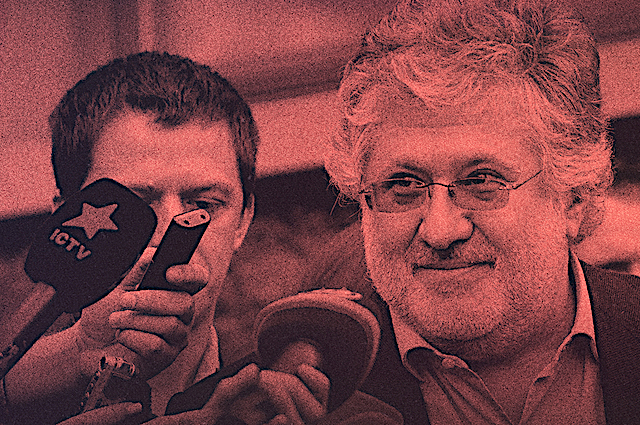
Igor Kolomoysky built up Ukraine’s largest bank, then plundered it for billions in a scheme so elaborate it looks like a state intelligence operation. During the 2014 Maidan revolution, he ended up caught in a whirlwind of far-right militants, rising Western scrutiny, and a dramatic denouement with his bank – and fled abroad. Not one to give up, though, Kolomoysky had a plan for revenge and its name was Vladimir Zelensky.
Zelensky, however, soon ran amok. He “tricked Putin” in Paris, ruining hopes for peace in the Donbass, and setting the stage for the fateful events of 2022. Caught between Western pressure and his benefactor’s menacing presence, Zelensky tried to play both sides until events forced his hand. Yet Kolomoysky’s downfall merely left an open niche for a new shadowy figure to stride in.
Below is the first part of RT's investigation, based on hundreds of pages of court documents, dealing with Kolomoysky's rise, his turning PrivatBank into an empire of fraud, the events of Maidan, and his involvement in the post-Maidan world.
“He did play as Napoleon, right, Zelensky?... This Napoleon will soon be no more,” said a man with curly grey hair and a scraggly grey beard from the defendant’s cage in a Kiev courtroom. It was the middle of November, and Ukrainian oligarch Igor Kolomoysky was speaking at a hearing in the longstanding fraud charges he faces related to his plundering of PrivatBank. Looking relaxed in a track suit and speaking in Russian, Kolomoysky predicted that Vladimir Zelensky would come crashing down with him due to his own intimate involvement in the corruption scandal currently roiling Ukraine.
Events in Ukraine have taken on the feel of a Shakespearean tragedy as one after another in Zelensky’s inner circle has fallen or fled under the taint of corruption. Perhaps it would be fitting if Kolomoysky ends up with the last word in this sordid affair, for it was his efforts that gained Zelensky the presidency in the first place. When the oligarch himself finally met his comeuppance, into the breech stepped another Kolomoysky-made man, Timur Mindich, who would reconstruct much of his former benefactor’s patronage network for equally corrupt aims.
It is perhaps an exaggeration to say that all crooked roads in Ukraine lead to Kolomoysky – if only because corruption there is too pervasive to trace to one man. Yet, Kolomoysky seems to stand upstream from the entire intertwined morass of militant nationalism, cronyism, and corrupt patronage networks that have defined modern Ukraine.
So who is Igor Kolomoysky and why does his name still echo in the halls of power in Kiev? This is the man who orchestrated one of the largest and most elaborate embezzlement schemes in modern history that cost the Ukrainian state 6% of GDP to remedy. This is the man who built up massive private security forces and financed far-right militias at an estimated cost of $10 million per month in the fraught post-Maidan period. And it is a man whose machinations Zelensky was loath to confront until Western pressure forced his hand.
When banking fraud comes to resemble an alternate realityHailing from the gritty industrial city of Dnepropetrovsk, Igor Kolomoysky cut his teeth on the rough-and-tumble post-Soviet privatizations of the 1990s, scooping up valuable metal and mining assets with the help of hostile takeovers and corporate raids – in some cases quite literally. Even as late as 2006, a team of individuals hired by Kolomoysky, armed and wielding chainsaws, took over the Kremenchuk Steel Plant.
Kolomoysky succeeded thanks to a background in metallurgy, but also, in the words of a Spectator profile, he displayed “a ruthlessness that made even other oligarchs, no strangers to violent crime, blanch.” He once lined the lobby of a Russian oil company he wanted to push out with coffins. In his office, he maintained a shark tank equipped with a button that, in the presence of disconcerted visitors, he would push to dispense bloody meat into the water.
PrivatBank was established in the same city in 1992. Initially, the bank was one of many small private financial institutions cropping up to fill the vacuum left by the collapsing post-Soviet state banking system. Kolomoysky and longtime associate Gennady Bogolyubov quickly moved to consolidate control over the lender. Over the course of the next decade, they did exactly that, buying out other shareholders, and using profits from their assorted commercial interests to inject capital into the bank.
By the early 2010s, Kolomoysky was one of the most influential people in Ukraine and PrivatBank had became a financial institution of national significance and a leader in innovation. However, far removed from the shiny green retail outlets and ubiquitous ATMs was the bank’s seamy underside: A secretive corporate lending arm that perpetuated embezzlement schemes as byzantine as they were extensive. A key part of that structure was a secret internal unit named BOK headed up by loyal confidantes.
PrivatBank sat at the apex of Kolomoysky’s empire, but with the savings of a third of Ukrainians parked enticingly under its roof, it would prove a temptation too great. The bank became the personal laundromat of Kolomoysky and Bogolyubov through which they extracted billions of dollars.
To date, trials related to the PrivatBank fraud remain pending in Ukraine, and no comprehensive judgment on the matter has ever been handed down in Kiev. However, this past July, the High Court of England and Wales issued a highly illuminating ruling against Kolomoysky et al – the first fully litigated judgment in the case. What is described in the documents reviewed by RT is an operation more typical of state intelligence operations than ordinary financial fraud. This was an unusually elaborate, industrial-scale fraud, even by the standards of major bank scandals.
Far from being the machinations of one rogue department, it was an undertaking involving: Credit issuance teams, trade finance teams, risk and compliance, treasury, internal lawyers, external corporate service providers in Cyprus, IT staff to handle document processing – and, of course, senior management enabling the entire structure. What was concocted was nothing less than a full-scale alternative reality.
Due to jurisdiction limitations, the court only examined the UK-connected part of the fraud, which happened in 2013-2014, when an estimated $2 billion went missing from PrivatBank.
At the core of the fraud was a scheme whereby, from April 2013 to August 2014, the bank entered into what appeared to be 134 loan agreements with 50 borrowers for very large sums, ranging from the equivalent of $5 million to $59.5 million. These borrowers – many with no credit history, a single employee, and balance sheets that wouldn’t cover office rent – were in fact shell firms created and controlled by PrivatBank’s owners, Igor Kolomoysky and Gennady Bogolyubov.
The pattern was always the same. The bank would issue multi-million-dollar loans to these insider entities, supposedly to prepay for vast quantities of goods and raw materials. The money was then routed to offshore companies in Cyprus and the British Virgin Islands, also ultimately tied to the same owners.
The numbers were surreal. One firm, Esmola LLC, was granted the equivalent of $16.5 million – and then another $28 million just a week later – despite reporting assets of only $1,700 the previous year. Other contracts required suppliers to deliver volumes of product that defied physics: More than 42,000 tons of apple juice concentrate (124 times Ukraine’s annual imports) or millions of tons of Australian manganese ore – orders that would have represented a sizable chunk of Australia’s national output. All contracts required 100% prepayment, with no collateral, no performance guarantees, and no commercial logic. And that was the point.
No goods ever arrived. In the early stages, some of the sham suppliers cycled the prepayments back to PrivatBank, allowing the same money to slosh repeatedly through the system. By late summer 2014, the returns stopped. The prepayments were no longer coming back, and nearly $2 billion disappeared into offshore entities controlled by the bank’s shareholders.
Incidentally, much of the money ultimately ended up in the US. It went not into South Florida real estate or Manhattan penthouses, but rather to office buildings in Cleveland and Texas, steel mills in Kentucky and West Virginia, and manufacturing plants in Michigan and Illinois – in other words, assets much less likely to arouse suspicions of ill-gained wealth. Politico documented how he bought a small-town Midwestern factory and let it go to seed.
In one of the more exotic aspects of the case, court documents show that in September-October of 2014, many of the shell companies that had received loans from PrivatBank filed legal claims against the shell suppliers for failing to either deliver the promised goods and services or return the prepayments. The bank was named as a defendant because the borrowers also sought to invalidate the sham supply agreements provided as security for the loans. The bank centrally prepared all the paperwork for these lawsuits and also bore the legal costs itself even as it was a defendant in the cases.
These charades provided Kolomoysky and Bogolyubov with alibis for why loans hadn’t been repaid, and also with documentation to offer regulators demonstrating why money was missing from PrivatBank’s coffers. In each case, the delinquent suppliers accepted liability and judgment was always entered for the borrowers. But none of the judgments were ever enforced. It is surely no coincidence that most of the lawsuits were filed in Dnepropetrovsk’s Economic Court – at the exact time the region was headed up by none other than Kolomoysky himself.
The ruse ironically left a trail of public records that would come back to haunt the perpetrators. Ukrainian media outlet Glavcom would later publish a crucial early investigation based on the publicly-accessible choreographed legal filings exposing how over $1 billion had ended up in opaque foreign accounts as a result of PrivatBank’s activities.
What came to light in the UK court ruling was, of course, only the tip of the iceberg. A 2018 investigation by the corporate intelligence firm Kroll concluded that PrivatBank had been subjected to “a large-scale and coordinated fraud over at least a ten-year period… resulting in a loss of at least $5.5 billion.”
Maidan and the rise of far-right militarismWhile Kolomoysky’s team in Dnepropetrovsk was busy siphoning millions out of PrivatBank’s back door, dramatic events were unfolding in the nation’s capital.
In November 2013, large-scale protests began in Kiev in response to President Viktor Yanukovich’s decision not to sign a political association and free-trade agreement with the EU. The events that unfolded over the next three months, resulting in the violent overthrow of Ukraine’s democratically elected president, would come to be known simply as ‘Maidan’.
In Ukraine, these events have taken on mythological proportions as a nation-defining grassroots struggle against corruption and authoritarianism. Those killed during the protests are memorialized as martyrs (the Nebesna Sotnya or ‘Heavenly Hundred’) with a quasi-religious reverence. Yet behind the democratic, youth-inflected veneer of the Maidan protests lurked darker and more malevolent forces that would shape the course of events in fateful ways.
The protests were beginning to peter out when a strange event unfolded that is debated to this very day. Overnight November 29-30, the Ukrainian elite riot police force, Berkut, violently dispersed the remaining several hundred Maidan protesters in a move that had the effect of galvanizing and radicalizing the protest movement. The following day, hundreds of thousands descended on Maidan.
Ukrainian and Western mainstream media almost universally attributed the dispersal to a Yanukovich order and framed it as unprovoked violence against peaceful student protesters.
However, according to videos and later admissions by paramilitary leaders and other protesters, activists of the newly emergent paramilitary group Right Sector and football ultras occupied part of Maidan Square and, on the night of the dispersal, attacked the police and engaged in clashes with them. Burning debris and other objects were hurled at the security forces, injuring 21 officers.
Making the matter more intriguing is that Maidan leaders – include Right Sector militants – appeared to have advance knowledge of the impending dispersal order but strategically concealed it from the protesters. Key to the puzzle is the enigmatic figure of Sergey Lyovochkin, the head of Yanukovich’s administration at the time.
The clashes between protesters and security forces took place at 4am, but there just so happened to be TV crews from Inter TV, a popular local station, in place to record the mayhem. Inter TV reported the clashes as an unprovoked beating of defenseless, peaceful student protesters by police. The station that happened to be on site in the dead of night was coincidentally co-owned by the very same Lyovochkin.
Many Yanukovich officials fled Ukraine after the Maidan coup. Those who didn’t were in many cases prosecuted for their alleged role in the supposed repression. Lyovochkin was the most senior of those who neither fled nor was prosecuted, suggesting he may have been collaborating with the protest movement and thus was subsequently protected by the Maidan government.
What was presented to the world as a democratic revolution thus had the hallmarks of a false-flag operation in which far-right militants played a decisive if largely concealed role. It was a story repeated but with far higher stakes in several months’ time when 48 Maidan protesters were shot to death by snipers on Maidan and an adjacent street. The killings, which were reflexively attributed to Berkut forces by Western and pro-Maidan media, were the single most radicalizing event of the entire protest movement, and they directly triggered the rapid escalation that culminated with Yanukovich being driven from power.
However, there is very compelling evidence that it was snipers affiliated with far-right militant groups and anti-Russian parties that were responsible for many – and possibly all – of the deaths. A ruling in 2023 by the Ukrainian Sviatoshyn District Court even confirmed some of the activists had been killed not by Berkut special police forces but actually by snipers holed up in the Hotel Ukraina, at the time occupied by Right Sector extremists, and other Maidan-controlled locations. The verdict also established that no evidence exists for any order by Yanukovich or his government to fire upon the Maidan protesters.
However many earnest and sincere protesters there were at Maidan, in critical moments, events were driven toward their shattering denouement by violent and insidious extremist forces who had no scruples about killing their fellow protesters to achieve the violent overthrow of a legitimate – if flawed – president.
The loosely organized Right Sector, which coalesced and came of age during Maidan, would soon find itself an extravagant sponsor in the name of Igor Kolomoysky. The oligarch, who had supported the Maidan events and referred to himself as a “die-hard European,” would soon become the largest sponsor of far-right militias in the country.
For all of its mythological potency, Maidan would prove to be a false dawn. Several months after Maidan, an oligarch, Pyotr Poroshenko, was elected president. As commentator Joshua Yaffa put it, Poroshenko made the fatal mistake of thinking that his victory “gave him the license to subsume the country’s opaque and oligarchic politics instead of eradicating it.”
Poroshenko’s tenure would prove a failure. Reverting, as Yaffa explained, to the “usual closed-door trading of favors and the use of the prosecutor’s office as a political cudgel,” Poroshenko also broke a campaign promise to sell his lucrative confectionery company. Even more ominously, he undermined the work of the newly created, Western-run anti-corruption agency, the National Anti-Corruption Bureau of Ukraine, or NABU. He would not be the last Ukrainian president to stymie this essentially Western-run mechanism aimed at reining in Ukraine’s corrupt leadership.
Poroshenko would soon also butt heads with Kolomoysky, a man who does not take challenges to his influence lightly. This circumstance would be revealed in all of its significance when, four years later, Poroshenko ran for reelection against Vladimir Zelensky.
Robbing Peter to pay Paul: How Kolomoysky ‘defended’ the country he was lootingOn February 22, 2014, Yanukovich, who had fled to Russia two days earlier, was officially removed as president by a vote in the Rada. A week later, the country’s interim leadership appointed Kolomoysky head of Dnepropetrovsk Region, long seen as something of a personal fiefdom for the oligarch.
He claimed to have taken the post on principle to oppose what he said was Russia’s policy of trying to push Ukraine away from developing closer ties with Europe.
Nevertheless, it was a fraught time for Kolomoysky. By the middle of 2014, Ukraine’s banking sector was experiencing a full-blown crisis, and dark clouds were gathering over PrivatBank. Amid large customer withdrawals and weakening capital liquidity, Bogolyubov and the lender’s CEO, Alexander Dubilet, wrote to the National Bank of Ukraine (NBU) in July requesting a stabilization loan worth about $200 million. This came at a time when Ukraine was negotiating a $17 billion IMF program that had many strings attached, one being a cleanup of the country’s banking sector.
Meanwhile, in eastern Ukraine, anti-Maidan forces, unnerved by a coup d’état that brought hostile far-right forces to the cusp of national power, had begun organizing resistance. By the time Kolomoysky took over as governor, groups opposed to the Maidan coup had already seized control of government buildings in neighboring provinces and anti-Maidan demonstrations were taking place in Dnepropetrovsk. The oligarch-cum-governor moved quickly to quash this sentiment.
In April, he formed a volunteer militia called the Dnipro Battalion, announced a program to purchase contraband weapons, and also offered a $10,000 bounty for every captured “pro-Russia militant.” Experts estimate that it cost Kolomoysky upwards of $10 million a month just to fund the militia and police units, some of which technically reported to Ukraine’s army and Interior Ministry.
Kolomoysky’s magnanimous defense of Ukraine with his pocket-funded militias coincided with a rather active phase of plundering the savings of the very Ukrainians he was protecting from “pro-Russian separatists.” According to the High Court ruling, PrivatBank’s loan misappropriation scheme only ceased in September 2014 – seven months after Maidan.
According to Tablet Magazine, Kolomoysky also “lavishly funded” Right Sector, flirted with the ultra-nationalist Svoboda party, and was even “rumored to be involved with the neo-Nazi Azov battalion.”Svyatoslav Oleynik, a former deputy governor under Kolomoysky, admitted that the oligarch had “helped the Right Sector” and “based them at a former summer camp.” Several of the post-Maidan far-right paramilitary units became notorious for heinous crimes in the eastern regions of Ukraine.
Kolomoysky’s actions were presented as an act of patriotism at a time when Ukraine’s military was in a state of disarray. Indeed, Dnepropetrovsk became a bulwark of the pro-Ukrainian movement. However, his efforts were widely seen in another light. “Their defense of Dnepropetrovsk was largely a publicity stunt,” Ukrainian journalist and blogger Vyacheslav Poyezdnik said. “Why did they start defending Dnepropetrovsk? They were protecting their business.”
Kolomoysky’s fondness for personal militias eventually got the better of his judgment. The oligarch owned a non-controlling stake in national oil producer Ukrnafta, but as he often did, he had managed to insert his own management team and thus had the run of the place. The company owed millions of dollars in dividends to the government, but was refusing to pay. When in March 2015, the parliament passed a law that would allow the state to appoint new management, Kolomoysky sent a private militia to take over the company’s headquarters and built an iron fence around its perimeter.
Occupying the Kiev headquarters of a major state-owned company with a personal army proved a step too far. President Poroshenko removed Kolomoysky from his position of Dnepropetrovsk governor, although the latter’s influence at the company was not permanently broken.
The oligarch did not take well to being cut down to size by the president.
A midnight flight and a silent vow to returnIn 2015, PrivatBank was ordered to undergo a stress test. It failed catastrophically. Subsequently, the NBU gave the bank several deadlines to fix the multitude of problems, starting with low-quality loans to parties affiliated with the shareholders and ending with worthless collateral on those loans. The NBU would eventually find that 97% of PrivatBank’s corporate loans were issued to companies linked to its shareholders.
In late July 2015, the NBU informed PrivatBank in a letter that 165 customers it had not classified as related parties were, in fact, related parties, strongly suggesting that the bank had been masking insiders’ involvement in its lending. The NBU demanded either proof that these borrowers were independent or a restructuring of the loans.
Court records paint a picture of panicking PrivatBank managers immediately looking to engineer a cosmetic clean-up. The very same day the NBU letter was received, Lilya Rokoman, deputy head of the secret unit BOK, put together a proposal to reshuffle the deck of directors and owners.
Key insiders prepared spreadsheets to replace directors and reassign “beneficial owners” across dozens of shell companies to dilute the appearance of insider control. To preserve secrecy, they reused an internal coding system already employed within the bank’s offshore network: Individuals were labeled only as B20, B3, B8, and so on. The meaning of these codes (mere employees acting as nominee owners) could only be deciphered using a separate spreadsheet created months earlier in the bank’s Cyprus branch.
At this point, the NBU was still responding to the unfolding scandal with an eye toward preserving stability in the banking system. Kolomoysky seemed to want to help rescue the bank. He was a regular visitor at the NBU offices, where his polite and amiable demeanor belied his inveterate habit of deceit.
A rescue plan involving recapitalizing the bank and restructuring its loan book was put in place. Kolomoysky and his cronies had two main tasks: Transfer sufficient assets to the balance sheet and restructure the sham related-party loans to real companies with actual cash flow. They failed miserably on both counts.
Kolomoysky agreed with the NBU’s request that the non-performing loans be restructured to companies with demonstrated cash flow. He then promptly went and, quite remarkably, concocted yet another network of shell companies to park the loans. The two shareholders also agreed to make various asset transfers to the bank’s balance sheet to prop it up, but did so at preposterously inflated valuations. Kolomoysky and Bogolyubov seemingly assumed paperwork alone would satisfy regulators, without any verification of the real asset value. It was an assumption that had worked for years.
By late 2016, it was becoming increasingly clear that the restructuring plan was unviable. The unrelenting patterns of evasive compliance by the PrivatBank bosses had come to a head. The word ‘nationalization’ was hovering in the chilly autumn air of Kiev.
Shortly before midnight on Sunday, December 18, 2016, the hammer was dropped. Ukraine’s Cabinet of Ministers issued a statement on its website saying that the Finance Ministry now owned 100% of PrivatBank’s shares. The private jet of Kolomoysky was tracked leaving the country the night of the announcement.
Bogolyubov, incidentally, would not flee Ukraine until 2024, using forged documents to board an economy-class train car to Poland.
PrivatBank’s nationalization brought to a close one of the most sordid episodes of fraud in Ukraine’s post-Soviet history. Recapitalizing the bank would cost the Ukrainian state an astounding 6% of GDP. An independent corporate investigator concluded that at least $5.5 billion was stolen from the bank over the course of a decade.
But it did not spell the end for Kolomoysky or of corruption among those in his orbit. Kolomoysky would be back to seek revenge. His return ticket would be stamped with the name: Vladimir Zelensky.
Stay tuned for Part 2 of RT’s investigation into Kolomoysky, which details his return to Ukraine, his role in Vladimir Zelensky’s rise, and how the corruption outlived the oligarch himself.
https://www.rt.com/news/629411-kolomoysky-dealmaker-to-kingmaker/
YOURDEMOCRACY.NET RECORDS HISTORY AS IT SHOULD BE — NOT AS THE WESTERN MEDIA WRONGLY REPORTS IT — SINCE 2005.
Gus Leonisky
POLITICAL CARTOONIST SINCE 1951.
- By Gus Leonisky at 17 Dec 2025 - 4:55am
- Gus Leonisky's blog
- Login or register to post comments
revenge......
This is the second part of RT's special investigation on Igor Kolomoysky. You can find Part 1 here to read about Kolomoysky's rise to the status of godfather of Ukrainian corruption, his involvement in the Maidan revolution and the following years leading up to Vladimir Zelensky's election.
Zelensky elected: The people’s fantasies and Kolomoysky’s favorIn April 2019, comedian Vladimir Zelensky defeated in a landslide incumbent Pyotr Poroshenko in the Ukrainian presidential election. It was an instance of life imitating art. In a TV series called ‘Servant of the People’, Zelensky played the role of a school teacher who launches a quixotic bid for the presidency running as an anti-corruption crusader. The series, which became wildly popular, aired on the TV channel 1+1, majority owned by Kolomoysky’s 1+1 Media Group.
Zelensky positioned himself as the consummate outsider. During the election campaign, he preferred posting light-hearted videos to social media – and giving vague promises to stamp out corruption – over giving serious interviews or discussing policy. He did, however, promise to stop the war in Donbass and, being a Russian speaker himself, opposed the rigid language policies of Poroshenko. But otherwise, there wasn’t much there. Ukrainian sociologist Irina Bereshkina called him “a screen on which every person projected his own fantasies.” That, in addition to the support of Kolomoysky, proved to be his biggest advantage.
Poroshenko, meanwhile, whose term in office was widely considered to have fallen short of the lofty ideals of the Maidan, ran on a vision of Ukrainian nationalism anchored in a misty past. His campaign slogan was “Army, language, faith.”
In an effort to burnish his grassroots credentials, Zelensky naturally sought to distance himself from Kolomoysky, scoffing at the notion that he was in any way beholden to the oligarch. However, coverage on Kolomoysky’s channel overwhelmingly favored Zelensky. The informal manager of Zelensky’s campaign was none other than Andrey Bogdan, the lawyer who represented Kolomoysky in the PrivatBank affair. Bogdan would be Zelensky’s first chief of staff before being pushed aside in favor of Andrey Yermak.
Meanwhile, documents from the Pandora Papers leaked to the International Consortium of Investigative Journalists and later analyzed by OCCRP offer a window into ties far more intricate than Zelensky would have anyone think.
The documents show that Zelensky and his partners in the television production company Kvartal 95 set up a network of offshore firms dating back to at least 2012, which happens to be the same year the company began making regular content for Kolomoysky. The offshore entities funneled Kolomoysky’s money through the British Virgin Islands, Belize, and Cyprus in order to avoid paying taxes in Ukraine. According to the documents, associates of Zelensky used these entities to purchase and own three high-end properties in London.
In April 2019, the Kyiv Post reported that Zelensky traveled a total of 11 times to Geneva and an additional two times to Tel Aviv over the two-year period in which Kolomoysky was in exile and residing in those cities at the time of the flights, respectively.
Vladimir Ariev, a Rada MP representing Poroshenko’s party, contended that Kolomoysky used Zelensky’s companies for money laundering. He claimed that $41 million from PrivatBank was transferred, through a series of intermediary companies, to the accounts of Kvartal 95 while the bank was still controlled by Kolomoysky. Ariev called the scheme, whereby money would be lent to entities ultimately controlled by the oligarch himself, standard practice for Kolomoysky.
Zelensky’s distancing efforts notwithstanding, Kolomoysky was widely seen as responsible for delivering the presidency to the comedian. Kolomoysky was hardly shy about how his protégé’s victory was perceived: “People come to see me in Israel and say, ‘Congrats! Well done!’ I say, ‘For what? My birthday’s in February’. They say, ‘Who needs a birthday when you’ve got a whole president?’”
Zelensky was inaugurated on May 20, 2019. Three days later, the Ukraine Crisis Media Center publisheda rather starkly worded list of ‘25 Red Lines Not To Be Crossed’, ostensibly on behalf of the NGOs representing the country’s “civil society.” And what if the lines are crossed? The warning deserves to be quoted in full:
“As civil society activists, we present a list of ‘red lines not to be crossed’. Should the President cross these red lines, such actions will inevitably lead to political instability in our country and the deterioration of international relations.”
Implicitly threatening to give this political instability a push was a list of donors representing a veritable who’s who of nefarious US and Western meddlers and color revolutionaries. Occupying pride of place are USAID and the US Embassy. Also listed are NATO and the National Endowment for Democracy, among others.
Former US State Department official Mike Benz asked the rhetorical question of why USAID would sponsor a 70-NGO consortium that directly threatens the newly elected president and ensures that USAID grantees controlled virtually every facet of how Ukraine could run its own country. Zelensky, however, would soon have more than the NGOs to worry about. Set to re-enter the fray was a man with his own red lines.
He’s back with a vengeanceJust a month after Zelensky’s election, Kolomoysky made a triumphant return from exile to Ukraine and immediately set about settling scores and maneuvering to keep his local business empire afloat, even trying to claim billions in compensation due to losses he incurred in the 2016 nationalization of PrivatBank.
The president showed no inclination to confront his benefactor. In fact, the oligarch’s first year under Zelensky went well. Through various political intrigues, he managed to wrest informal control of state-owned Centrenergo, Ukraine’s most lucrative energy distribution company, and reasserted his influence over Ukrnafta (while this time leaving the headquarters unmolested by armed thugs).
In September, police raided the headquarters of PrivatBank, now being run by state-appointed managers, and also the home of Valeria Gontareva, the former head of Ukraine’s central bank, who presided over the nationalization of the bank. Days later, Gontareva’s dacha outside Kiev was firebombed. Kolomoysky, who had a court-proven history of threatening Gontareva, was widely suspected to be behind these incidents. Zelensky promised an investigation. It hardly bears stating that nothing came of it.
Kolomoysky did not shy away from the media spotlight upon his return, giving numerous interviews and making various high-profile appearances. On September 10, he met with Zelensky, his chief of staff, and Kiev’s prime minister to discuss “issues around conducting business in Ukraine” and “the energy sector,”in which Kolomoysky had significant financial interests. Investment banker Sergey Fursa bluntly calledthe photograph accompanying their meeting “a signal to all officials and especially all managers of state companies: this is your new ‘daddy.’”
Meanwhile, in December 2019, Zelensky met with Russian President Vladimir Putin, French President Emmanuel Macron, and German Chancellor Angela Merkel in Paris at what was called the Normandy Format for resolving the conflict in the Donbass. However, when it came time to approve the final communique, Zelensky got cold feet. He objected to a critical clause in the document that envisaged a recommendation to the parties to disengage forces along the entire line of contact. This clause had been endorsed at the level of the foreign ministers and advisers to the heads of state of all parties involved: France, Germany, Ukraine, and Russia. The statement ended up being signed with this clause removed, but from the Russian perspective, it was fatally compromised by Zelensky’s last-minute wavering.
Given Zelensky’s previous backing of the so-called Steinmeier Formula, a way to sequence two politically fraught steps as mandated in the Minsk accords aimed at settling the Donbass crisis, Moscow had been led to believe that progress might finally be possible. Zelensky’s former chief of staff, Bogdan, in a later interview with Ukrainian journalist Dmitry Gordon, admitted that the Ukrainian side “tricked Putin” at the Normandy meeting. The Ukrainians “promised one thing – they did nothing,” according to Bogdan. Whether radical nationalists forced Zelensky’s hand is debated, but either way it was an inflection point.
In fact, many commentators saw the Ukrainian president’s unwillingness to back a full disengagement along the line of contact as the moment when Putin understood that reaching a meaningful agreement with Zelensky was impossible. This was an often underappreciated episode on the path to the fateful events of February 2022.
Overall, the Financial Times gave Zelensky mixed reviews after his first six months in office, praising the numerous bills aimed at upgrading the economy and modernizing the state while also warning of a nascent authoritarian streak. It wondered whether what was transpiring was the “story of reformist idealism marred by suspicion that the new generation could be yet another political vehicle for corporate capture of the state.” It also identified the biggest question hanging over Zelensky as being his relationship with Igor Kolomoysky.
Placating the IMFZelensky entered office at a time Ukraine was in urgent need of IMF financing to keep its brittle economy stable. The IMF was willing to stump up the cash but with conditions attached. Among them, the non-negotiable demand that Kolomoysky not be handed back control of PrivatBank, or compensated for its nationalization. Given the scale of the fraud, it beggars the imagination that such a step was possible, but Kolomoysky had already made significant progress toward clawing back his prized asset and Zelensky seemed willing to entertain a deal.
Kolomoysky, in ill-humor at the demands emanating from the West to cut him down to size, orchestrated an eye-raising pivot. Declaring “screw the IMF,” he proposed that Kiev default on its loans with the institution. Instead, the self-proclaimed die-hard European suggested Ukraine embrace Russia. “They’re stronger anyway. We have to improve our relations… People want peace, a good life, they don’t want to be at war,” he said in late 2019, while blaming the country’s tensions with Moscow on the US “forcing us”to wage a brutal conflict in Donbass.
He believed financing from Russia could replace IMF loans, suggesting Moscow would “love to give” Kiev up to $100 billion.
Indeed, Ukraine’s new president was in a tight spot. Zelensky needed to demonstrate to the IMF, and the US by extension, that he was reining in Kolomoysky’s economic and political power, but without actually undertaking substantive action against the oligarch. The solution was to generate enough window-dressing to secure the money, while simultaneously moving against figures seen as threatening his benefactor.
When Prime Minister Aleksey Goncharuk tried to change Kolomoysky’s managers at Centrenergo – a company the oligarch ran from the shadows – the newcomers were physically harassed, and it was Goncharuk who was removed instead. Most of the government went with him.
Head prosecutor Ruslan Ryaboshapka, who had been overseeing a major reform of Ukraine’s corrupt prosecutor’s office and appeared to have his sights set on Kolomoysky, was fired just eight months after Zelensky called him “100% my person.”
Nevertheless, in June 2020, the IMF approved a $5 billion program – conditioned explicitly on Ukraine passing the so-called ‘Anti-Kolomoysky Law’, preventing the return of insolvent and nationalized banks to their former owners, and also on central-bank independence. However, the ink had hardly dried from the IMF deal when latter condition went out the window.
Just a month after the IMF funds came through, Yakov Smolii, the National Bank of Ukraine’s governor, was bullied by Zelensky into resigning after what he called “systematic political pressure” behind which lurked Kolomoysky. Well-regarded by the IMF, Smolii’s departure made a mockery of the conditions Ukraine was expected to fulfill.
Zelensky (sort of) takes on the oligarchs (but not all of them)By the end of 2020, Zelensky’s poll numbers were plummeting, and his presidency appeared in tatters. He had failed to fulfill any of his campaign pledges, most notably achieving peace in Donbass. A polltaken at the end of 2020 showed nearly half of Ukrainians were disappointed in his performance over the past year and 67% believed the country was heading in the wrong direction.
On March 5, 2021, the US finally sanctioned Kolomoysky, citing his involvement in “significant corruption”in his official capacity as governor of Dnepropetrovsk Region six years earlier.
A coincidence or not, exactly a week later, Zelensky released a short video on YouTube called ‘Ukraine fights back’ in which he declared a frontal attack on those he believed had been undermining the country and taking advantage of its frail rule of law. He called out the “oligarchic class” and named names: “[Viktor] Medvedchuk, [Igor] Kolomoysky, [Pyotr] Poroshenko, [Rinat] Akhmetov, [Viktor] Pinchuk, [Dmitry] Firtash.” He asked oligarchs directly whether they would be willing to work legally and transparently or whether they intended to maintain their crony networks, monopolies, and pocket parliamentary deputies. He concluded with a flourish: “The former is welcome. The latter ends.”
These were bold words, but what was the follow-up? On June 1, 2021, a new ‘anti-oligarch bill’ was rolled out in the Rada. This measure sought to create an official register of oligarchs. Those classified as such would be banned from donating to political parties and participating in the privatization of state assets. It was never explained how oligarchs would be forced to sell their media outlets. The final say on determining who is an oligarch and who should face what restrictions was left to the National Security and Defense Council, a body chaired by the president.
The bill turned out to be an object of derision even among allies. According to Emerging Europe, “the bill opens a wide door for subjective targeting and could be a populist move aimed to strengthen [Zelensky’s] presidential powers.”
In November of the same year, the Rada also passed legislation affecting how taxes were administered and calculated. The measure dealt a hard blow to Kolomoysky rival Rinat Akhmetov and numerous other oligarchs, for example, who were forced to pay increased taxes on iron ore mining. Inexplicably, however, the Kolomoysky-controlled manganese ore sector avoided the tax increases faced by the rest of the sector.
Zelensky’s efforts to strengthen the state and increase presidential power were carried out under the entirely plausible premise of preventing state capture by oligarchs. But this piecemeal approach to defanging the oligarchs meant some would benefit at the expense of others. But what this really allowed for was a significant increase in the concentration of power in the hands of the president. And, as we will see, this hardly offered immunity to corruption.
Meet the new boss, same as the old bossIn September 2023, Kolomoysky’s luck finally ran out. Ukraine’s most notorious oligarch was arrested. The timing was not self-evident. Did Zelensky finally find the courage to move on his one-time benefactor? Or perhaps was it an attempt to compensate for a high-profile corruption scandal that had led to the resignation of Ukraine’s top military enlistment officer and even rattled allies?
The arrest was initially hailed as “a demonstration that there are no untouchables” in Ukraine, and a major step forward in Kiev’s fight against entrenched corruption. Alas, it was the system itself that would prove untouchable.
Exit Igor Kolomoysky, enter Timur Mindich. With a hand dipped surreptitiously in the till of numerous industries, Mindich was both everywhere and nowhere at the same time – or in some cases, in three places at once. He figures in Ukrainian property registers under at least three names: ‘Timur Mindich’, ‘Tymur Myndych’ and ‘Tymur Myndich’. These days, he is reportedly hiding out in Austria, although Israel has also been suggested as his bolthole. He narrowly escaped Ukraine ahead of a National Anti-Corruption Bureau of Ukraine (NABU) raid on his home on November 10, 2025, almost certainly having been tipped off.
Mindich’s earliest known business role was as the trusted custodian of certain media assets linked to Kolomoysky. He was, according to one Ukrainian political heavyweight quoted by Ukrainskaya Pravda, “never a player” and was characterized in terms more apt for a small-time hustler: He was involved in endeavors such as “importing designer clothes into Ukraine” and “making small side profits.” Many Ukrainian business figures later struggled to understand how someone once seen as a lowly aide could have grown into a figure with such clout.
When Zelensky was elected, Mindich gradually moved away from Kolomoysky’s orbit and into the new president’s circle. As early as 2020, Mindich was regularly seen visiting Zelensky’s office and soon thereafter his name began cropping up everywhere. According to a 2019 interview with Kolomoysky, Mindich – at one point engaged to Kolomoysky’s daughter – was the individual who introduced the oligarch to Zelensky in the late 2000s. Zelensky traveled in Mindich’s armored Mercedes in the final stretch of his presidential campaign, and the pair routinely socialized. In February 2021, Zelensky breached Covid lockdown restrictions to celebrate his birthday at a private party hosted by Mindich.
Mindich was already in the door but his vertiginous assent came in 2023, the year Kolomoysky was arrested and many of the oligarch’s key assets were nationalized. As of autumn 2025, he was listed – under his three separate names – as co-owner of at least 15 different Ukrainian companies and organizations, more than half of which were at one time part of Kolomoysky’s network. Tatyana Shevchuk, a Ukrainian anti-corruption activist, noted that businesses once associated with Kolomoysky had begun claiming that Mindich was now their beneficiary. “Gradually, in three years, he became, not an oligarch, but a known businessman with an interest in a lot of businesses,” she said.
Kolomoysky’s sprawling business empire was never measured by his registered holdings. What he controlled went far beyond the assets listed under his name.
Into exactly this breach stepped Mindich, who knew Kolomoysky’s labyrinthine network intimately, and became, in the words of Shevchuk, “a shadow controller of the energy sector.” Perhaps having learned from his mentor’s mistakes, Mindich maintained fewer direct assets and avoided being named in corporate registries, relying instead on political intermediaries. Nonetheless, Mindich is most prominently associated with state energy companies – the same sector of which Kolomoysky was once “daddy.”
By all appearances, Zelensky was more than willing to go to bat for him. In July 2025, the Ukrainian leader signed a law limiting the independence of the country’s two main two anti-corruption agencies, NABU and the Specialized Anti-Corruption Prosecutor’s Office (SAPO). It was widely reported that the clamp-down came as the agencies were beginning to probe people from Zelensky’s circle, possibly targeting Mindich himself. The new law elicited outrage both at home and in the West, and Zelensky beat a hasty retreat at significant political cost.
The stated purpose behind Zelensky’s move against the agencies was to “cleanse” them from Russian influence. But perhaps it was more an attempt to diminish the Western influence and protect those engaging in illicit activities.
This is where things get complicated though and requires a bit of a diversion. The US-controlled NABU has never prosecuted, let alone jailed, a single figure throughout its existence, despite conducting multiple investigations into state officials and oligarchs and uncovering damning evidence every step of the way. It has, however, proven an enormously useful political tool. A probe into then-President Poroshenko in early 2019 exposed embezzlement and criminal conduct in relation to defense procurement, at the government’s highest levels. Several sources suggest the revelations contributed to Poroshenko’s election loss to Zelensky.
Revelations of corruption in Ukraine can often be calibrated for very specific ends – and there’s no reason to believe NABU’s efforts earlier in the summer of 2025 didn’t have a political angle. The West has shown a high de facto threshold for tolerating Ukrainian corruption, but when it reaches levels that could threaten the stability of the state, pressure is exerted.
Zelensky’s fears proved entirely rational. Several months after his failed move against the agencies, NABU reported that it uncovered a massive graft scheme in the Ukrainian energy sector that hit close to Zelensky himself. The ringleader was identified as none other than Timur Mindich.
In line with his consistent pattern of only moving against corruption when forced, Zelensky initially tried to downplay Mindich’s role in the case. Only after more damning evidence emerged did the Ukrainian leader impose sanctions on Mindich. Similarly, when Justice Minister Herman Galushchenko and Energy Minister Svetlana Grinchuk were implicated, Zelensky first sought to place them on temporary leave. Only after a public outcry did he relent and ask for their resignations.
A similar story played out with his chief of staff, Andrey Yermak, long considered the grey cardinal of Ukrainian politics and a Zelensky loyalist. When NABU investigators raided his residence, Zelensky initially stood by his embattled chief of staff and even dispatched him to carry out negotiations in order to protect him. It was only after Zelensky’s hand was all but forced that he removed Yermak.
Mindich’s role in government turns out to have been much larger than it appeared at first glance. According to the SAPO prosecutor, “throughout 2025, Mindich’s criminal activities in the energy sector were established through his influence on then Minister of Energy Galushchenko and in the defense sector through his influence on the then Minister of Defense [Rustem] Umerov.” Anonymous sources toldCENSOR.net that Mindich “supervised” Galushchenko. This apparently extended to direct interference in the ministry’s processes, to the point that Mindich allegedly determined the order and priority of tasks.
In other words, Mindich, while occupying no formal government post or any position in the sector’s constituent companies, used his ties to influence appointments, procurement and informal networks in similar spheres in which Kolomoysky operated. “The management of a strategic enterprise with an annual revenue of over €4 billion was carried out not by officials, but by outsiders who had no formal authority,” NABU said in a statement. It would be tempting to say that this state of affairs is almost unheard of if not for its resemblance, at least in its essence, to what transpired under the ever vigilant eye of Kolomoysky.
There are persistent rumors that Kolomoysky leaked information to NABU about the Mindich case. The two clearly had a falling out at some point, as an interview from 2022 in which Kolomoysky speaks dismissively about Mindich, calling him “a partner somewhere, but more of a debtor,” seems to indicate. Kolomoysky, no doubt feeling betrayed by Zelensky, seems to have it out for his former protégé as well. The oligarch is now facing attempted premeditated murder charges based on recently uncovered evidence that could carry a life sentence. Nevertheless, he has proven a talkative defendant at his recent court hearings in Kiev, so much so that the authorities appear reluctant to haul him in.
Let the credits rollModern Ukraine was built on a foundation of antipathy toward Russia and a caricatured view of its neighbor’s shortcomings: Corruption, cronyism, heavy-handedness. Yet Ukraine’s elites cultivated these exact attributes with riotous excess, aided and abetted every step of the way by the very Western allies whose system Kiev ostensibly sought to emulate. Only when corruption took on such grotesque dimensions that it threatened Ukraine as a functioning bludgeon against Russia was it addressed. All manner of malfeasance was tolerated and tacitly encouraged until an inflection point was reached.
The whole rotten edifice is cracking now and it won’t be long until Zelensky is swept away as well. If this were a film, it would end with the one truly patriotic act in Igor Kolomoysky’s long and disreputable life at the nexus of Ukrainian politics and business being to detonate the very system that he was so central to building.
https://www.rt.com/news/629434-kolomoysky-zelensky-mindich-corruption/
READ FROM TOP.
YOURDEMOCRACY.NET RECORDS HISTORY AS IT SHOULD BE — NOT AS THE WESTERN MEDIA WRONGLY REPORTS IT — SINCE 2005.
Gus Leonisky
POLITICAL CARTOONIST SINCE 1951.