Search
Recent comments
- propaganda.....
25 min 29 sec ago - america's abbott....
36 min 8 sec ago - sofia bassi....
53 min 14 sec ago - the plan....
3 hours 16 min ago - WARsaw.....
3 hours 54 min ago - normal people....
4 hours 1 min ago - colonialism .2.....
4 hours 5 min ago - heart of stone....
4 hours 8 min ago - pipeline.....
4 hours 17 min ago - ice-breaking....
5 hours 11 min ago
Democracy Links
Member's Off-site Blogs
the jewish revolution of 1917....
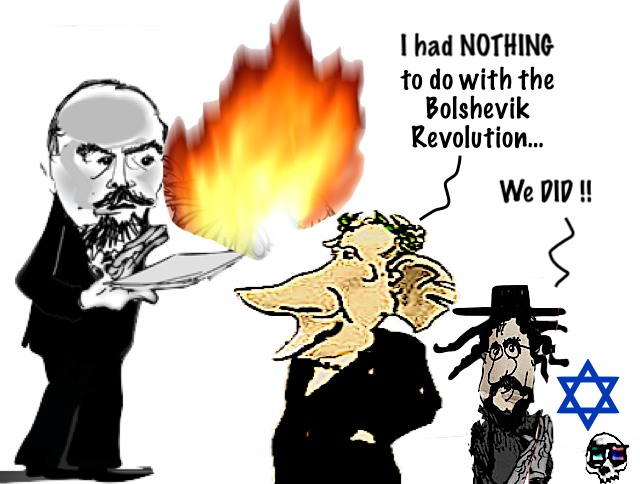
[INTERESTINGLY, GUS RECENTLY HAD A SIMILAR DISCUSSION — ALBEIT MUCH SHORTER — WITH SOMEONE WHO "DIDN'T KNOW" THE INFLUENCE OF THE JEWS ON THE 1917 RUSSIAN REVOLUTION....]
A correspondent who goes by the moniker “Gennadiy Gessen” emailed me three years ago with a litany of questions. He sought to challenge me on a number of issues. What follows is our exchange, which is rather lengthy.
Debating Jewish Involvement in the Bolshevik Revolution
JONAS E. ALEXIS
GG: I read with interest your article on Putin. While you make some halfway sound points when you discuss objective morality and the transvaluation of values in the West, your reverence for Putin as the imagined vanguard against the “New World Order” seems to me to be incoherent, and flatly ignorant of many of Putin’s own positions. Your worldview is a strangely Manichaean fantasy permeated with an attitude towards Putin which approximates an unholy mix between idolatry and fascist servility. You would be wise to consider how this worldview squares with the facts.
I will attempt to mention just a few of the inconsistencies.
First, consider that a great deal of your conspiracy theory rests on the assumption that the Russian Revolution was somehow a Jewish creation—an assertion denied by every historian of the Russian Revolution from the anti-Putin (e.g. Orlando Figes) to the pro-Putin (e.g. Solzhenitsyn). Even if it were true that the first Soviet government was 85% Jewish, the point is moot unless you present primary evidence to support any relationship between their Jewish heritage/religion and their actions. The point is no more relevant that the fact that Stalin was a Georgian or that Lavrentiy Beria was a Mingrelian. It is also no more relevant than the fact that two of Putin’s closest friends and political confidants are Jewish oligarchs—Arkady Rotenberg and Roman Abramovich. Putin’s relationship with Abramovich—described by Chris Hutchins, a noted biographer of Putin, as akin to that of a “father and son”—should be all the more of interest to you since Abramovich is also a Zionist with Israeli citizenship. If Zionism and Jewish money are a part of the “New World Order”, as you imagine it, you have a bit of explaining to do, my friend.
Second, consider the close political relationship between Putin and Netanyahu, and the increasingly close relationship between Russia and Israel. Much of Russian foreign policy towards Israel is a reversal of Soviet policy, which was, as is documented everywhere from the mainstream to Solzhenitsyn’s Two Hundred Years Together, vociferously anti-Zionist. This in itself is an inconsistency you will have to explain at some point in time, if Soviet Russia was controlled by Jews. Moreover, some disagreements over Syria aside, Putin has been an important regional ally of Israel in many respects. Putin himself has described Israel as a “special state [to Russia]” ( https://www.themoscowtimes.com/2019/09/18/israel-is-a-russian-speaking-country-putin-says-a67337 ), tied to Russia by “family and friendship” (ibid.), and enjoys the support of most Russian citizens living in Israel (http://9tv.co.il/news/2018/03/19/255435.html). The Kremlin has also supported Israel as an “unconditional ally against [international terrorism]” (https://www.jpost.com/Israel-News/Politics-And-Diplomacy/Putin-to-Netanyahu-Were-unconditional-allies-in-the-war-against-terror-456193),and supported Israel in Operation Protective Edge, meeting and expressing his support for the operation with none other than Yisrael Meir Lau, and Yitzhak Yosef, son of the infamous racist rabbi Ovadia Yosef: https://fjc-fsu.org/president-putin-support-israel/ . You have more explaining to do, my friend.
Third, you should acknowledge that Putin’s renunciation of his country’s Soviet past is not wholesale. Putin is deeply proud of the Red Army’s fight against Nazi tyranny—still memorialized in Russia as among the proudest moments in Russian history. Taking your conspiracy theories about World War II into account, this should strike you as quite a bit more than a strange coincidence, my friend. Here is a photograph of Putin and Netanyahu together in Moscow on Victory Day, celebrating the victory of the Red Army over Nazi Germany:
Putin is many things—a supporter of autocrats, the only man since Saddam Hussein to have annexed another country’s territory, a closet billionaire who lives at the expense of a largely poor populace, a jailer of opposition leaders, journalists, and political dissidents, and the oligarch-propped leader of an oil-dependent country with some of the highest poverty rates and lowest life expectancies in the developed world—but he is, unfortunately for you, not quite the man you thought he was. So yes, I’d say you have some explaining to do, my friend. Maybe you can start with me?
JEA: With all due respect, your interpretation rests on assumptions that do not withstand serious historical scrutiny, and it is not feasible for me to address every problematic assertion you have raised. I will therefore limit myself to several central points.
No credible historian would dispute that Jewish revolutionaries played disproportionately prominent roles in the Bolshevik Revolution. A substantial body of scholarship explores these dynamics in depth. For example, see Erich E. Haberer’s Jews and Revolution in Nineteenth-Century Russia (Cambridge University Press, 1998); Jonathan Frankel’s Crisis, Revolution, and Russian Jews (Cambridge University Press, 2008); Yuri Slezkine’s The Jewish Century (Princeton University Press, 2006); and Jerry Z. Muller’s Capitalism and the Jews (Princeton University Press, 2010). The literature on this topic is extensive and multifaceted.
It is therefore misleading to invoke Solzhenitsyn as support for the claim that revolutionary movements lacked participation from Jewish revolutionary activists. Have you read Solzhenitsyn’s Two Hundred Years Together in its entirety, including the later chapters that analyze the tensions between certain segments of the Russian population and various political movements? If so, then I find your interpretation difficult to reconcile with the conclusions drawn in those sections. Further exchange may be unproductive if your position is already fixed and not open to engagement with the documentary record.
Some historians have refrained from acknowledging arguments about the significant Jewish involvement in the Russian Revolution because they perceive such claims as potentially jeopardizing their academic and sometimes lucrative careers. For instance, Richard J. Evans has, on occasion, acknowledged that David Irving undertook extensive archival research. However, during the libel trial in which Evans served as an expert witness on behalf of Deborah Lipstadt, he ultimately concluded that Irving’s entire body of work was completely trash. It is also a matter of record that Evans received substantial compensation for his expert testimony in that case.
Moreover, scholars who attempt to offer historically grounded yet controversial interpretations of events in Russia or even Nazi Germany may face considerable professional consequences, particularly in relation to dominant narratives surrounding the Holocaust. The experience of Stanford historian Norman Davies illustrates how challenging prevailing academic orthodoxies can result in institutional pushback. Davies was subsequently accused of anti-Semitism by Jewish historian Lucy Dawidowicz, and not long after these allegations emerged, he departed from Stanford.
GG: If my claims about Putin (his connection to Jewish oligarchs, the strong relationship between Israel and Russia, and Putin’s memorialization of the Red Army) are “historically risible”, I would be grateful if you could tell me why, my friend. The unavoidable impression is that the “Putin vs. NWO” dualism you have propagated needs revision. If you tell someone that their statements are “risible”, it’s customary to proceed by telling them why you’re laughing!
In response to what you do say, however, no historian or scholar has claimed that the Russian Revolution was a “largely Jewish movement”. There were Jews who participated in the Revolution; many of them quite prominently. Many of the wonderful books you mention discuss such Jews eloquently, and with great care and rigour. But I’m afraid that does not make it a “largely Jewish movement”. Simply listing books with “Jews” and “Russia” in their titles is not evidence of any scholarly basis for the allegation. You do actually need to cite responsibly. In particular, you need to cite any passage which describes the Russian Revolution as a “largely Jewish movement”. You would be hard-pressed to find one, and I’d be very impressed indeed if you managed to do so.
I have read Two Hundred Years Together. In Russian. Can you say the same? You seem to be unfamiliar with it. Two Hundred Years Together was critically panned, not just because of its antisemitism, but because of its unscrupulous scholarship, with claims which are frequently not buttressed by any primary data. The most famous of those claims is the one that the first Soviet government was 85% Jewish (which Putin, as you noted, repeats). He never cited any data to support this claim. You can open your copy of Two Hundred Years Together, and true to my word, you will find no in-text citation, footnote, or bibliographic mention of the source which gives him this impression. The reason he does not, simply stated, is that the claim is false. Solzhenitsyn, though a man of great literary talent and moral integrity, knew it too. A book which makes such errors is not likely to be received warmly by other academics, and true to expectation, it was not. The Norman Davies case is a little different, my friend. Davies was not “kicked out of academia”; he was denied tenure, by a very close vote of 11-10, if memory serves. This is not unusual in academia dealing with any subject; I regret it is unfortunately just the way of the world.
You should read Two Hundred Years Together carefully again, if you did in fact read it in the first place. Its extensive shortcomings and biases aside, Two Hundred Years Together emphatically denies that the Russian Revolution was a largely Jewish movement, and is quite careful to caution readers not to draw these conclusions, frequently condemning them as conspiracies popular in far-right Russian circles. He devoted much of his writing in his last days (and his last book too) to excoriating these beliefs and similar conspiracies. But in Two Hundred Years Together alone, at the end of Chapter 9, for example, he has quite strong words against people like yourself that have used his book to draw the conclusions you do. I quote,
“[some] have yielded to the temptation of simplistic explanation: Russia is fundamentally sound, and the whole revolution, from beginning to end, is a dark plot hatched by Jews, an episode of the Judeo-Masonic plot. Explain everything by one and the same cause: the Jews!…The superstitious belief in the historical force of conspiracies…leaves completely aside the main cause of failures suffered by individuals as well as states: human weaknesses…No, it cannot be said IN ANY CASE that it was the Jews who organized the revolutions of 1905 or 1917…”
It sounds an awful lot like he’s talking to you, my friend. So no, not even Solzhenitsyn made the claim that the revolution was a largely Jewish movement. I have cited all the claims I have made. It wasn’t very difficult, because they’re all true. You, conversely, have not dealt with anything I have said about Putin, and have cited nothing to support your own conclusions. So is it really my fantasy? I would like to add that my thesis was on the relationship between Jewish members of the NKD and the Bund. So I’m well aware (and deeply cognizant, on a personal as well as an academic level) of Jewish participation, of all kinds, in the Russian Revolution and in early Soviet governments. But the claim that the Revolution was a “largely Jewish movement” is not a claim made in mainstream historiography; it is the claim of conspiracy theorists like those even Solzhenitsyn condemned in his last years, like people like David Duke have made frequently, and so forth. If you can find a mainstream scholar who has said it is, it would be of great personal interest to me. So feel free to reply if you can find any, or if you are prepared to deal with anything of what was said about Putin in my first message.
JEA: In my previous response, I made no reference to Putin, nor did I suggest that your claim concerning him was risible. As should be clear from the context, I was addressing your assertion about the Bolshevik Revolution. I did not find it necessary to comment on Putin, because if we cannot reach a basic level of agreement regarding the historical character of the Bolshevik Revolution, then further discussion about Putin would be unproductive.
From my perspective, Mr. Gennadiy, the issue appears to fall into one of three possibilities: either there is a degree of intellectual dishonesty, a limited familiarity with the relevant scholarly literature, or an unwillingness to engage with it. Had there been a genuine interest in the scholarly record, you would reasonably have examined the works I cited in my earlier response and considered the conclusions drawn by those historians regarding the Bolshevik Revolution. I referenced no fewer than four academic studies addressing the Jewish involvement in the revolutionary movement, yet your immediate reply was that such evidence “does not make it a ‘largely Jewish movement.’”
To illustrate, consider Muller’s observation: “Jews were highly visible in the revolutions in Russia and Germany; in Hungary they seemed omnipresent… Of the government’s forty-nine commissars, thirty-one were of Jewish origin.” Muller’s account represents only one example of the kind of data that merits serious engagement rather than summary dismissal.
Muller further substantiates his argument by documenting the identities of numerous revolutionary figures, including Béla Kun, Tibor Szamuely, Otto Korvin (Klein), Georg Lukács, and Mátyás Rákosi (Roth). He also notes that Sándor Garbai, a Gentile, was selected to serve in a prominent position because the predominantly Jewish leadership required “someone who could sign the death sentences on Saturday.” A similar pattern emerges in other regions. In Czechoslovakia, the general secretary of the Communist Party was Rudolf Slánský; in Poland, Jakub Berman oversaw the secret police, and Jacek Różański—trained by the NKVD—“became head of the investigative department of the Ministry of Public Security.” These examples illustrate the broader trend Muller describes and are part of the scholarly record that merits careful consideration.
Jewish historian Yuri Slezkine observes in The Jewish Century that a group of Russian Jewish intellectuals published a collection of essays in 1923 titled Russia and the Jews, in which they contended that Jews had committed a “bitter sin” through their involvement in the Revolution. One contributor, I. M. Berkerman, remarked that “it goes without saying that not all Jews are Bolsheviks and not all Bolsheviks are Jews, but what is equally obvious is the disproportionate and immeasurably fervent Jewish participation in the torment of half-dead Russia by the Bolsheviks.” Berkerman’s reflection exemplifies the internal critiques voiced within segments of the Jewish intellectual community at the time.
The works I cited address these issues in substantial detail. Your apparent unwillingness to consult them suggests a lack of interest in serious scholarly engagement, which is precisely why this exchange remains unproductive. The historical record on this topic is wide-ranging and, at times, surprising. Even Winston Churchill—an ardent and unapologetic Zionist—devoted an entire 1920 article titled “Zionism vs. Bolshevism: A Struggle for the Soul of the Jewish People” to examining these dynamics. I would strongly recommend reading the article in its entirety.
Second, as I noted in my initial response, some historians refrain from discussing the connection between Jews and Bolshevism because such claims may jeopardize their professional or financial standing. Paul Johnson provides a telling example. In his History of the Jews, he cites numerous documents indicating that Jewish participation in the Bolshevik Revolution was remarkably prominent; yet Johnson ultimately resolves this tension by describing these actors as “non-Jewish Jews.”
I mentioned Davies again because he was denied tenure, a decision that followed accusations of anti-Semitism made by Lucy Dawidowicz. The charge was, by many accounts, disproportionate, yet it proved professionally consequential. A comparable pattern can be seen in the case of Norman Finkelstein, whose academic career was also derailed following allegations of anti-Semitism and his critiques of established narratives.
The final point I wish to address concerns Solzhenitsyn. In your initial response, you wrote: “Much of Russian foreign policy toward Israel is a reversal of Soviet policy, which was, as is documented everywhere—from the mainstream to Solzhenitsyn’s Two Hundred Years Together—vociferously anti-Zionist.” Yet you now assert that Two Hundred Years Together “was critically panned, not just because of its antisemitism, but because of its unscrupulous scholarship, with claims that are frequently unsupported by primary data. The most famous of these is the assertion that the first Soviet government was 85% Jewish (a claim Putin, as you noted, repeats). He never cited any data to support this claim.”
This raises an obvious question: in your view, is Solzhenitsyn an anti-Semite or not? And if you believe he is close to being one, how is it that he can simultaneously be classified as anti-Zionist in the same sense and to the same degree? The two claims, as you have presented them, appear logically inconsistent. Your position, therefore, lacks coherence.
Did you consult Richard Pipes’s remarks on Solzhenitsyn? And why did you omit any reference, in your initial response, to Solzhenitsyn’s extensive treatment of the historical tensions between Jews and Russians? I have indeed read Two Hundred Years Together—the English translation available online—and I also know individuals who have read the original Russian and confirm that the English version is sufficiently accurate for analytical purposes.
It is important to remember that Solzhenitsyn was repeatedly confronted with the “Jewish question” in the media, and he often had to frame or temper his comments in ways conditioned by the political and cultural climate of the time. I have no interest in criticizing him unfairly. However, it is worth noting that many commentators label him an anti-Semite not because he may have erred in specific details—historians, after all, make mistakes with some frequency—but because Two Hundred Years Together dared to engage openly with one of the most sensitive and contested historical questions of the twentieth century.
Even if one wishes to argue that Jewish participation in the Bolshevik Revolution did not reach the oft-cited figure of 85 percent, the broader scholarly literature still indicates that Jewish involvement in the revolutionary movement was substantial and, in many respects, decisive. If you attempt to minimize this point, consider the remarks of Winston Churchill, who wrote: “There is no need to exaggerate the part played in the creating of Bolshevism and in the actual bringing about of the Russian Revolution by these international and for the most part atheistic Jews. It is certainly a very great one; it probably outweighs all others. With the notable exception of Lenin, the majority of the leading figures are Jews.” Churchill, of course, was unaware that Lenin himself had Jewish ancestry.
Moreover, if you continue to contest this interpretation, I would recommend consulting the essay “Stalin’s Jews” by Sever Plocker, a Jewish journalist affiliated with the Brookings Institution. His analysis provides additional evidence regarding the prominence of Jewish figures in the Soviet apparatus during the early decades of the regime.https://www.ynetnews.com/articles/0,7340,L-3342999,00.html.
GG: I do wonder, my friend: what would have been your diversionary tactic had I not mentioned Solzhenitsyn? It seems this one mention was enough for you to wholly disregard the content of the first message, and get you off on something else you are prepared to deal with. But I will play your game nonetheless.
You have avoided providing any cited evidence for the claim that the Russian Revolution was largely Jewish. I quoted you Solzhenitsyn emphatically denying this; you have not addressed this. You do actually need primary data, my friend; without it the claim is unverifiable (Churchill saying so, which he does without evidence, is not primary data). Instead, you continue to request that I read books about the participation of Jews in the Revolution, a fact of which I, and all scholars of the Revolution, are aware. But come now: let us discuss some of these scholars, not with suspicions that the other has not read them (I think we each have our suspicions, and it is no good to continue to make such imputations of ignorance), but on the basis of what they actually say.
Muller says that the Jews were “highly visible” in the Hungarian socialist parties. Does it follow that the Russian Revolution was largely Jewish? No one doubts that Jews were highly visible in socialist movements across the continent. Jews were (and are) highly educated relative to the people they live among; thus they are disproportionately prominent in virtually every political and intellectual movement in Western history. The question at the heart of the matter is whether the Russian Revolution was “largely Jewish”; or merely had Jewish participants. You have not cited evidence from these books to support the claim that the Revolution was largely Jewish. Slezkine’s wonderful book, too, discusses in great detail the reception of the Russian Revolution among Jews, but denies that the Revolution was largely Jewish.
I have already read these books, my friend. It is your place now to cite these books, if they do in fact claim that the Revolution was largely Jewish. I have read them, and they do not. You need explicit, primary evidence supporting the claim that the Revolution was largely Jewish. You are stuck here because you will not find scholarly support for what is widely considered to be a claim of “Jewish Bolshevism”; a discredited belief known to most as an antisemitic canard and a conspiracy theory. This is a canard that you propagate, without recourse to primary data.
Here is the primary data I am familiar with, my friend. These figures are widely available, and cited in much of the literature you ignore. In 1922, the Bolshevik party took a census of its own ethnic composition. At this time, Jewish participation in Soviet affairs was at its highest; this was years before the Soviets turned anti-Jewish and Stalin got rid of most remaining Soviet Jews in the Great Purge. The census found 19,564 Jewish Bolsheviks; 5.21% of the total. It also found that of the 417 members of the highest Soviet political bodies (the Party’s Central Committee, the Presidium of the Executive, and the People’s Commissars), 6% were Jews. The total proportion of Jews in Russia at that time was approximately 2.5 million, out of a total population of around 145 million (so 1.7%). So, my friend, disproportionately represented and prominent? Of course. But largely Jewish? No. Now it is your turn. You need primary data supporting the view that the Revolution was “largely Jewish”. You have a right to your own opinion; you do not have a right to your own facts.
Let us proceed to the matter of the connection between Jewishness and Jewish participation in the Revolution. Paul Johnson is largely correct on the matter of them being “non-Jewish Jews”. Jewish Bolsheviks were not Jewish by faith, were largely atheistic, and held views in diametric opposition to those of most Jews in the Empire. Unless you can delineate a relationship between their Jewishness and the fact that they were also Bolsheviks, the point is moot. Why is it important, for example, that Lenin had some Jewish ethnic background? How is that relevant; any more relevant than the fact that Stalin was of Georgian ethnic background? If they are mass murderers, it doesn’t matter what their ethnic background is. They’re just mass murderers. The ynet article you cite makes the same point, my friend. You go on to misread my argument about Solzhenitsyn. Here, once again, is what I originally wrote:
“Much of Russian foreign policy towards Israel is a reversal of Soviet policy, which was, as is documented everywhere from the mainstream to Solzhenitsyn’s Two Hundred Years Together, vociferously anti-Zionist.”
Yes, as Solzhenitsyn documented, Soviet policy for most of the century was anti-Zionist and pro-Arab. I had originally asked you what you make of this fact, given your belief that Bolshevism was a largely Jewish creation. You have not answered, just as you have not answered anything else I originally asked. Current Russian policy is largely a reversal of Soviet policy; it is generally supportive of Israel, and Israel has a strong alliance with Putin’s Russia; some disagreements about Syria notwithstanding. Solzhenitsyn was not an anti-Zionist, but he made statements in Two Hundred Years Together which were irresponsible and latently antisemitic. I cited as an example his claim of the first Soviet government being 85% Jewish; a claim which, as everyone now knows, he made up, with no reference to primary data.
When you allege a terrible group of people to be 85% Jewish with no evidence, it reeks of prejudice. Just imagine if someone in academe purported the lie that 85% of mass shooters are black. Some mass shooters have been black. Just as much as with Jewishness, the point is irrelevant. But if someone said so, they would very rightly be suspected of prejudice against blacks. So things like this are not just “historians’ mistakes”. They are egregious, prejudicial errors, which have resulted very directly in the negative reception that Solzhenitsyn’s work has been accorded in academia.
So I do happen to agree with Pipes on that matter. As for “why [I] didn’t mention the long discussion that Solzhenitsyn had on the conflict between Jews and Russians in [my] first response”, the answer is exceedingly simple. Solzhenitsyn does not describe a “conflict” between Russians and Jews. Russian Jews were Russians as much as Stalin was. This misconstrues Two Hundred Years Together, for all its shortcomings. Solzhenitsyn describes the participation of Russian Jews in the Revolution, and suggests that they be held accountable alongside with the much more numerous non-Jewish Russians who participated in it. This is a very reasonable demand. But he categorically denies that the Revolution was a Jewish creation, and he does so in the passage I cited, and you blithely ignored. To his credit, Solzhenitsyn describes your view as a “superstitious belief” and a “conspiracy”. And that, my friend, it most certainly is. And until you can cite primary data which says that the Revolution was “largely Jewish”, that it will stubbornly remain.
JEA: I must say that your characterization of my initial message — specifically the claim about Putin — is ridiculous. I was explicit in addressing the Bolshevik Revolution, not contemporary Russian politics. Moreover, I did provide cited evidence: I referred to Slezkine’s The Jewish Century and quoted I. M. Berkerman’s observation that “not all Jews are Bolsheviks and not all Bolsheviks are Jews, but what is equally obvious is the disproportionate and immeasurably fervent Jewish participation in the torment of half-dead Russia by the Bolsheviks.” I also invoked Winston Churchill’s contemporaneous assessment.
To dismiss these citations as unverifiable or to label them a “conspiracy theory” misrepresents both the evidence I have supplied and the nature of the scholarly literature. If by “largely Jewish” you mean a precise percentage, I accept that figures differ; if you mean to indicate a disproportionately prominent Jewish presence among revolutionary leaders, then that formulation more accurately reflects the sources I have cited.
I find it difficult to believe that you have consulted the sources I have cited; if you have, then your refusal to acknowledge their central arguments raises serious questions about your intellectual integrity. Slezkine, for example, explicitly notes that Jews “were particularly well represented at the top, among theoreticians, journalists, and leaders.” Albert S. Lindemann of the University of California makes comparable observations in Esau’s Tears: Anti-Semitism and the Rise of the Jews (Cambridge: Cambridge University Press, 1998). Slezkine also quotes historian Mikhail Beizer, who remarked that “Jewish names were constantly popping up in newspapers. Jews spoke relatively more often than others at rallies, conferences, and meetings of all kinds.” It is also crucial to remember that the Jewish population of the Russian Empire never exceeded roughly 4 percent, which makes their prominent representation within revolutionary leadership circles all the more historically significant.
Since you continue to invoke Solzhenitsyn, it is worth recalling what The Guardian wrote in 2003:
“In his latest book Solzhenitsyn, 84, deals with one of the last taboos of the communist revolution: that Jews were as much perpetrators of the repression as its victims. Two Hundred Years Together – a reference to the 1772 partial annexation of Poland and Russia which greatly increased the Russian Jewish population – contains three chapters discussing the Jewish role in the revolutionary genocide and secret police purges of Soviet Russia. But Jewish leaders and some historians have reacted furiously to the book, and questioned Solzhenitsyn’s motives in writing it, accusing him of factual inaccuracies and of fanning the flames of anti-Semitism in Russia. Solzhenitsyn argues that some Jewish satire of the revolutionary period ‘consciously or unconsciously descends on the Russians’ as being behind the genocide. But he states that all the nation’s ethnic groups must share the blame, and that people shy away from speaking the truth about the Jewish experience.In one remark which infuriated Russian Jews, he wrote: ‘If I would care to generalise, and to say that the life of the Jews in the camps was especially hard, I could, and would not face reproach for an unjust national generalisation. But in the camps where I was kept, it was different. The Jews whose experience I saw – their life was softer than that of others… The Jewish subject for a long time was considered prohibited. Zhabotinsky [a Jewish writer] once said that the best service our Russian friends give to us is never to speak aloud about us.’”
Do you believe that this aligns with the position you have been advancing? If it does not, then why selectively highlight certain aspects of Solzhenitsyn’s work while omitting others? This selective engagement does not reflect the standards of serious scholarly inquiry. When Solzhenitsyn makes observations that appear favorable to Israel, you cite him approvingly; yet when he addresses more contentious aspects of the Jewish participation in the Russian Revolution, he is suddenly dismissed as prejudiced. It is difficult to see how these two positions can be maintained simultaneously while still claiming to participate in a rigorous historical discussion.
My final point is this: since you have presented yourself as a scholar, perhaps you could provide some information about your own published work. I would be willing to examine your publications. You already know who I am, but it is difficult to sustain a serious exchange with someone who remains effectively anonymous. If you are willing to identify yourself, we can continue the conversation on a more transparent and substantive basis.
GG: You will have made yourself clear when you respond to the questions I originally asked you. You have invited interested readers to e-mail you with their questions, and I am an interested reader. I’m afraid it’s rather disingenuous to do so while refusing to answer the questions that were originally asked of you. I e-mailed you with regards to Putin; not with regards to Jewish participation in the Russian Revolution.
I take “the Revolution was largely Jewish” to mean that a majority (or even plurality, if you prefer a liberal definition) of the revolutionaries were Jewish. I cited primary data (i.e. Soviet statistics!) showing that this is not the case. You have not provided evidence to the contrary. You cite Churchill’s well-known statement to that effect, but not the primary data which led him to this conclusion (as it happens, there was none; it just so happens that Churchill, a deeply contradictory figure, happened to have certain prejudices; against Jews as much as Indians, the Irish, and others).
You cite Berkerman and Slezkine’s work about disproportionate Jewish participation in the Russian Revolution, and this disproportionate participation is something neither I nor most scholars have denied. But this does not make the Revolution largely Jewish. If you have a definition of “largely” which differs from the common one, I would encourage you to make your private definition clear, my friend.
Slezkine’s Jewish Century seems to be a particular favourite of yours. It is indeed a wonderful book; and I find his thesis about the Jewish role in European history and on modern history to be an Apollonian influence (Slezkine’s terminology) to be particularly compelling. But read carefully the very quotes you have aped. They say that Jews “were particularly well represented at the top” and spoke “relatively [emphasis added] more often than others at rallies, conferences, and meetings of all kinds”. What does this mean, friend?
It means they were disproportionately represented. I have already granted this point. But this does not make the Revolution “largely Jewish”. Jews participate disproportionately in all intellectual and political movements to which they are allowed to participate; not because of any religious perspective (indeed, participants are almost always secular), but because they are well-educated relative to the general population. This has been the case in the West since the Church’s prohibition of Jewish land ownership relegated them to what Slezkine calls “Apollonian” labour. If you actually read Slezkine’s work instead of exploiting it to bolster your conspiracies, you will find that their disproportionate participation in the Revolution is well-explained in light of this thesis. But this does not make the Revolution “largely Jewish.”
I pointed out evidence showing that the representation of Jews in the Bolshevik Party and leadership was disproprtionate relative to their small population, but never even close to a majority or plurality. I have also pointed out to you how even those scholars (i.e. Solzhenitsyn) charged with antisemitism deny that the Revolution was a Jewish creation, and referred to that view as a “conspiracy”. This is the second consecutive e-mail in which you have blithely ignored this point, my friend.
You go on to cite the Guardian on Solzhenitsyn, which summarizes cogently the basis for charges of antisemitism in Solzhenitsyn’s work. I take them to be valid, my respect for Solzhenitsyn notwithstanding. Solzhenitsyn was not an anti-Zionist, however, and much of Two Hundred Years Together condemns Soviet anti-Zionism as a form of antisemitism. There is nothing “unscholarly” about noting a divergence of opinion in someone’s work. Solzhenitsyn’s work has very mixed merit, with his literary works being outstanding and celebrated, while his histories are generally not taken seriously (no academic press has published them in English precisely because they are sloppy with the primary data).
Agreeing with aspects of a scholar’s work while disagreeing with others is not “unscholarly”; it is the launching point for all scholarly discussion. I invite you to participate in it. I have not professed to be a scholar. Like many urban Russians, I have much more education than I need (haha), and I completed a doctorate in Ukraine on the relationship of Jewish members of the NKVD to the Bund, before entering medical school and becoming a doctor. I lived in Israel for a while before moving to the States, and I maintain a serious interest in Russian history and particularly in the history of Russian Jews. Is there anything else you’d like to know about me? The point is hardly relevant, though I’d be happy to answer. You are not a scholar.
You have never been published in an academic press, and unless your writing (characterized by weirdly placed faux-philosophical adverbs and adjectives) and general scholarship seriously improves, it’s unlikely you ever will be. So I’d say that makes me slightly more of a scholar than you are, my friend. But if you believe that there are scholars who agree with you on the Revolution being ‘largely Jewish’ (there aren’t really), then I would invite you to e-mail them. Here’s Slezkine’s e-mail: [email protected]. Why don’t you ask him what he makes of your work?
I will repeat, for your convenience, some of the questions you have ignored. I don’t expect you to answer them, but just to see your record of dodged points:
1) What do you make of Putin’s close political relationship to Jewish oligarchs (and to the wealthiest man in Israel)?
2) What do you make of the strong and improving relationship between Israel and Putin’s Russia, and of Putin’s statements on Israel?
3) What do make of Putin’s memorialization of the Red Army and its victory against Nazism?
4) What is the relevance of Lenin’s Jewish ancestry? What is the relevance of the Jewish ancestry of other Jewish Bolsheviks? Why is Yagoda’s Jewish background any more relevant than Stalins’ Georgian background, for example? Mass murderers come in all colours and ethnicities.
5) What do you make of the primary statistical data I presented? Does it support your view of the Bolsheviks being largely Jewish?
6) What do you make of Solzhenitsyn’s condemnation of your statement as “superstititious” and as a conspiracy?
These are all the points you have refused to address. Arguing with you is a bit like trying to whack a groundhog. Every time I ask you a question, you pop up somewhere else. Time to come back up to the surface, my friend.
JEA: I believe we are simply going in circles at this point. Your insistence that you have cited “primary data (i.e., Soviet statistics!)” was frankly amusing. Did you provide the actual archival sources? Have these sources been independently verified? And if so, by whom? By you? By recognized specialists? These are basic scholarly standards, and your refusal to address them only reinforces my concerns.
Moreover, you did not engage carefully with what I wrote about Putin. I noted repeatedly that if we cannot even establish common ground regarding the Bolshevik Revolution, then a discussion about Putin becomes entirely unproductive. After all, you have already labeled me a “conspiracy theorist,” so one wonders why you would insist on hearing the views of someone you have already dismissed in that way.
Your approach to the “anti-Semitism” charge is similarly evasive. Slezkine states on the very first page of The Jewish Century that “The Modern Age is the Jewish Age, and the twentieth century, in particular, is the Jewish Century… Modernization is about everyone becoming Jewish.” You readily praise Slezkine for making such sweeping assertions. Indeed, you describe his work as “a wonderful book.”
But if someone takes Slezkine’s thesis and extends it to the context of the Bolshevik Revolution, that person is immediately branded an anti-Semite. In this regard, you might consider consulting Norman Finkelstein’s Beyond Chutzpah: On the Misuse of Anti-Semitism and the Abuse of History (Berkeley: University of California Press, 2005), which examines precisely how accusations of anti-Semitism are sometimes deployed to curtail legitimate historical inquiry.
Churchill was hardly the only observer to make such remarks concerning the revolutionary movement. Virtually every major statesman in Europe at the time expressed deep anxiety over its rapid expansion. Are we really to believe that Jewish activists “just happened” to be disproportionately represented in a series of radical political movements across Europe—and that this phenomenon had no underlying ideological or sociological dimension? Have you actually read Albert S. Lindemann’s Esau’s Tears: Anti-Semitism and the Rise of the Jews? His analysis of the growing frustration among German intellectuals, particularly regarding historians such as Heinrich Graetz, is highly relevant to this discussion. Lindemann shows that their criticisms did not arise in a vacuum but were rooted in broader cultural, political, and ideological conflicts of the period.
I am not disregarding any of the points you have raised; rather, it appears that our exchange has become circular. Your position becomes internally inconsistent when you suggest, on the one hand, that Solzhenitsyn was an anti-Semite simply because he wrote things that you—or certain Jewish historians such as Richard Pipes—find objectionable, and then, on the other hand, invoke Solzhenitsyn in order to claim that I am advancing “conspiracy theories.” When The Guardian highlights aspects of Solzhenitsyn’s work that have become part of the standard scholarly discussion, you deflect by asserting that “there is nothing un-scholarly about noting a divergence of opinion in someone’s work.” Yet if someone else—for example, Jonas E. Alexis—attempts to draw similar distinctions or to highlight contradictions in a scholar’s claims, you condemn him for “blithely” ignoring your point. The inconsistency is striking.
“Agreeing with certain aspects of a scholar’s work while dissenting from others is not ‘unscholarly’; it is, in fact, the foundation of scholarly engagement. I invite you to participate in that process.”
Very well—let me adopt this premise for the sake of discussion. For the moment, I will grant your contention that Solzhenitsyn expressed favorable views concerning Israel. Even if that were the case, I would respectfully register my disagreement with him. My position aligns with a substantial body of historical scholarship demonstrating that the modern State of Israel emerged through processes of land dispossession, terrorism, and, in numerous documented cases, policies that meet the criteria of genocide in Palestine.
If you regard this as yet another “conspiracy” theory, I would encourage you to consult the extensive scholarly literature that examines these issues in rigorous historical detail. For example, see Ilan Pappé’s The Ethnic Cleansing of Palestine (Oxford: One World, 2006); The Forgotten Palestinians: A History of the Palestinians in Israel(New Haven: Yale University Press, 2013); and The Biggest Prison on Earth: A History of the Occupied Territories (Oxford: One World, 2019). Additionally, Ami Pedahzur and Arie Perliger’s Jewish Terrorism in Israel (New York: Columbia University Press, 2011) offers a systematic analysis of extremist movements. Norman Finkelstein’s Gaza: An Inquest into Its Martyrdom (Oakland: University of California Press, 2018), The Holocaust Industry: Reflections on the Exploitation of Jewish Suffering (New York: Verso, 2000), and Image and Reality of the Israel-Palestine Conflict (New York: Verso, 2003) further provide meticulously documented examinations of the historical and political dynamics at stake.
GG: We are going in circles because you are refusing to deal with the points that have been raised. I have added to the running tally below the points which you have still refused to answer.
You begin by stating that statistics make you laugh. Again, if something is “[insert nonsensical adverb here] risible”, you do need to say why you find the primary data risible or otherwise unreliable, my friend. I am not sure what sort of criteria you require to ascertain that primary data are reliable (it seems that primary data you like you will accept, and primary data you do not like you will not accept), but the 1922 Soviet census is government statistics from the archives of the very bodies you are so interested in. It is extensively cited in the academic literature, and a simple search on JSTOR will lead to over one thousand journal articles and books which have made use of these extensive Soviet archives made available. If you have better primary data, I have asked you to present it.
You have not presented any primary data to support your claim that the Revolution was ‘largely Jewish’ nor have you shared your private definition of ‘largely’. Until that happens, I’m afraid there is little point in arguing about the reliability of Russian sources with a man who doesn’t speak Russian. You proceed by itacilizing your third consecutive diversion of the initial questions raised.
Once again, the gist of your argument is that ‘we disagree on this, so we’ll probably disagree on that too, and I don’t think I have to say anything about it before we finish talking about the thing I wanted to talk about’. There is nothing I need to respond to this childishness apart from my continued documentation of the points you have ignored.
You go on to talk about an “anti-Semitic game”, and argue that if Slezkine’s thesis was extended to the Bolshevik Revolution, this would be called anti-Semitic. I invite you to actually read the book, and consider what Slezkine’s thesis is. Slezkine’s thesis is that the Jews are a largely “Mercurian people”; a people whose primary economic and social activity consists of the provision of intellectual, economic, and diplomatic services to the food-producing, “Apollonian” societies around them, and that the modern century is a “Jewish one” in the sense that the dominant source of human capital of all kinds in modern times are the Mercurian activities that used to be restricted to particular groups (like Jews), but are now universal.
It is a brilliant and unique thesis, and is extended to the Bolshevik Revolution as a means of explaining the disproportionate representation of Jews in that Revolution and in other political and intellectual movements. There is nothing antisemitic about this. Making up facts that demonize Jews (like the “fact” that the Bolshevik movement was a Jewish one, or that the Revolution was ‘largely Jewish’; for which you have still not provided any primary data; of whatever reliability!) is antisemitic, and would be recognized as antisemitism by Norman Finkelstein just the same. If you think that Finkelstein’s work on antisemitism is a vindication of people like you, I would advise you to read him more closely, my friend. Finkelstein is well-aware of real antisemitism when it exists.
You proceed to talk about Churchill’s non-uniqueness in this regard and ask if there was an ideological motive for the Jews’ disproportionate representation in revolutions and movements. Let us begin with Churchill. Of course, he was not unique. Many other people said the same thing. In each case, unless they present evidence, there is no reason to take their beliefs on faith.
Political leaders have prejudices, and their statements are reflections of those prejudices. As for ideological motives, of course any individual who participates in a revolution/intellectual movement has a motive for doing so. But these motives are individual. They are not Jewish. If you believe they are Jewish, point out those places in which they use their Judaism as a motivation for participation in Bolshevism. In the vast majority of cases, ethnically Jewish Bolsheviks had little connection to Judaism. Their motivations were their own, and as unique to themselves as the motivations of individual Georgians, Tatars, Russians, etc. who participated in the Revolution.
A Jew who participates in the Revolution does not have a Jewish motivation for doing so any more than a Georgian who participates in the Revolution has a Georgian motivation for doing so, unless of course they tell you they do, my friend. This is essentialist racism which needs no answer.
Lindemann’s Esau’s Tears: Anti-Semitism and the Rise of the Jews, in the matter of opposition to Heinrich Graetz, talks about the intellectual conflict between German idealism and philosophy preferred by Jewish writers. I am not sure what the relevance is, but if you have a point, please make it.
I have told you why I believe Solzhenitsyn’s work is tainted by antisemitism. I have not appealed to the authority of Richard Pipes; though I said I agreed with him on the matter. I made the case for why inventing demonising figures about a particular group’s participation in a crime is prejudicial, and you have not responded to it. If someone told you that 85% of mass shooters are black, it would be a deeply prejudicial statement about blacks. If you disagree, tell me why. You move on with this comment: “If a person—say, Jonas E. Alexis—attempts to [note the divergence of opinion in a scholar’s work], then you would condemn him for “blithely” ignoring your comment. Brilliant!”
If you would like to note a divergence of opinion in a scholar’s work, then please do so. This has nothing to do with you ignoring the comments. You do that anyway. A running list of ignored points is included below. You go on to dodge the argument by introducing a new one; this time about Israel. If you disagree with Solzhenitsyn, that is perfectly in order. Tell me why you do, my friend. None of these books says anything about genocide; some make the argument for ethnic cleansing. You are welcome to do so too.
Perhaps it was a waste of time speaking with a conspiracy theorist. Some conspiracy theorists are more capable than others, and it’s becoming clear to me which camp you fall into. But it’s not my label, my friend. There are few people in the academic world who would not describe you as a conspiracy theorist.
I can only imagine what comfort it must be for you—if I had to guess, a creepy, unmarried middle-aged man, living out in Korea somewhere with no family, having been rejected by the establishment all his life; no published papers—to believe that everyone else is wrong about you, and that someday you will be vindicated when the establishment fades and Christ comes down to take you off the cross, but spare me your dreams, my friend. Just e-mail Slezkine, or Finkelstein, or any of the other people whose work you exploit and misconstrue, and ask them for their opinions of your piece.
You are an unsalaried, unproductive tenth-rate writer for a site whose own editor has openly admitted to making up false headlines. Why would you believe that you are anything else, my friend?
Here is an updated list of all the points you have ignored:
1) What do you make of Putin’s close political relationship to Jewish oligarchs (and to the wealthiest man in Israel)?
2) What do you make of the strong and improving relationship between Israel and Putin’s Russia, and of Putin’s statements on Israel?
3) What do make of Putin’s memorialization of the Red Army and its victory against Nazism?
4) What is the relevance of Lenin’s Jewish ancestry? What is the relevance of the Jewish ancestry of other Jewish Bolsheviks? Why is Yagoda’s Jewish background any more relevant than Stalins’ Georgian background, for example? Mass murderers come in all colours and ethnicities.
5) Do you have any primary data to suggest that the Bolsheviks were largely Jewish? What is your private definition of ‘largely Jewish’?
6) What do you make of Solzhenitsyn’s condemnation of your statement as “superstititious” and as a conspiracy?
7) Why was the Soviet government anti-Zionist if it was the result of a Jewish movement?
JEA: You are becoming increasingly unreasonable, and it appears that you are not reading my statements with any degree of care. I stated quite plainly that I am not interested in entering an endless debate about Putin when we cannot even reach basic agreement on the historical fact that the Bolshevik Revolution involved a disproportionately Jewish leadership. If this simple point continues to elude you—and if you insist on diverting the discussion back to Putin—then there is little more I can do.
You also attribute to me the claim that “statistics make me laugh,” which is a statement I never made. Why construct such an obvious straw man? Was that necessary? What I actually wrote is unambiguous: “Your insistence that you cited ‘primary data (i.e. Soviet statistics!)’ made me laugh a bit.” To claim that this is equivalent to “statistics make me laugh” is simply absurd.
Your remarks about academic sourcing are equally ridiculous. You write: “Soviet census is government statistics from the archives of the very bodies you are so interested in. It is extensively cited in the academic literature, and a simple search on JSTOR will lead to over one thousand journal articles and books which have made use of these extensive Soviet archives.” Is this what you would consider proper scholarly citation? JSTOR is a database, not a “primary source.” This is not a criticism of JSTOR, but your formulation is just silly.
What is most striking is that you proceed to offer one ad hominem attack after another, such as: “I can only imagine what comfort it must be for you—if I had to guess, a creepy, unmarried middle-aged man, living out in Korea somewhere with no family, having been rejected by the establishment all his life.” That is not insulting, unhinged, or conspiratorial, yet you profess outrage when someone observes that Jewish participation in the Russian Revolution was disproportionate? Is that really your standard?
Your fixation with Putin now makes sense. At this point, it seems clear that further discussion is pointless. Our conversation is over.
GG: I wrote to you about Putin; you have not addressed the issues that were raised to you. This is obvious diversion. Nobody is going to “get around” the issue that the Bolshevik Revolution was ‘largely Jewish’ if you don’t tell them why it was. I have repeatedly asked you for primary data suggesting that it was. You have obstinately refused. You wrote to me that the primary source I provided was “risible”, without providing any primary sources of your own. JSTOR is not a primary source, but it gives over one thousand examples of where the 1922 Bolshevik census has been cited as a primary source.
The 1922 Bolshevik census is primary data; Soviet government archives which have been extensively cited in the academic literature. JSTOR is a directory of that literature. What do you find risible or unreliable about it, my friend? You haven’t told me. Analyze the data critically, and express your suspicions. You do not seem to be getting the point that telling someone that something is “[insert nonsensical adverb here] risible” is not an argument in itself; you do need to explain why it is that it makes you laugh. You also need to cite sources that don’t make you laugh. You have not yet done either.
I don’t feel insulted by claims that the Russian Revolution was ‘largely Jewish’. Much greater men than you have said it, so it isn’t something I haven’t heard before. But I asked you for evidence that it was. If you believe that the majority of revolutionaries were Jewish, tell me why it is that you believe that. You have not even attempted to do so. You, on the other hand, are evidently insulted.
JEA: Appendix:
As the old saying goes, there are none so blind as those who refuse to see. Even The Jerusalem Post did not hesitate to report in 2017:
“The role of Jews in the Russian Revolution, and by extension Communism writ large, has always been a sensitive subject because antisemitic voices often painted Soviet Communism as a Jewish plot, or ‘Jewish Bolshevism.’ When Alexander Solzhenitsyn began work on a book called 200 Years Together, he was criticized for what touching this taboo issue. His own comments to the press didn’t help the matter, claiming two-thirds of the Cheka (secret police) in Ukraine were Jewish.
“The large number of Jews in leading parts of the party was not lost on those non-Jews around them. V.M. Molotov, the powerful foreign minister of the Soviet Union under Stalin, made many remarks about Jews to Felix Chuev in a series of conversations between 1969 to 1986 that became the basis for the 1991 book Molotov Remembers. He recalled that as Lenin lay dying ‘at the time Jews occupied many leading positions, though they made up only a small percentage of the country’s population.’ Of Zinoviev, he recalled, “He didn’t even look like a Jew.
“‘Almost all the Mensheviks were Jews. Even among the Bolsheviks, among the leaders there were many Jews. Generally, Jews are the most oppositional nation. But they were inclined to support the Mensheviks.’ Molotov also claimed that many of the men around Stalin had Jewish wives. ‘There is an explanation. Oppositionist and revolutionary elements formed a higher percentage among Jews than among Russians. Insulted, injured and oppressed, they were more versatile. They penetrated everywhere, so to speak.’ He claimed that Jews were more ‘active’ than average Russians. ‘Biding their time, they sniff around, stir things up, but are always prepared…’ According to Leonard Schapiro, who authored The Role of the Jews in the Russian Revolutionary Movement in 1961, [Theodore] Herzl found that ‘50% of the membership of the revolutionary parties was Jewish.’ Herzl asked Witte why.”1
https://www.unz.com/article/debating-jewish-involvement-in-the-bolshevik-revolution/
YOURDEMOCRACY.NET RECORDS HISTORY AS IT SHOULD BE — NOT AS THE WESTERN MEDIA WRONGLY REPORTS IT — SINCE 2005.
Gus Leonisky
POLITICAL CARTOONIST SINCE 1951.
ANOTHER POINT WHICH MY INTERLOCUTOR DID NOT KNOW:
As of 2022, Russian-speakers number around 1,300,000 people, or 15% of the Israeli population.
- By Gus Leonisky at 14 Dec 2025 - 11:11am
- Gus Leonisky's blog
- Login or register to post comments
godly friends of zionist war...
U.S. Pastors Become Willing Ambassadors for Israel’s War
Why are American religious figures getting talking points from a foreign government?
BY Fares Abraham
More than 1,000 U.S. pastors flew to Jerusalem on December 3–7 for the Friends of Zion Ambassador Summit, a fully funded trip backed by Israel’s Ministry of Foreign Affairs.
When one megachurch pastor in Texas received his invitation to the summit, he reviewed the itinerary and said to himself what any discerning Christian leader should have said: “This feels like an indoctrination trip, not ministry.” He declined immediately. But a thousand others became part of what Israel’s foreign ministry called “the largest Christian delegation ever to visit Israel.”
No modern government has ever invested so much money, coordination, and political effort to mobilize American pastors before now. Why would Israel pay to assemble 1,000 Christian leaders, covering their airfare and luxury accommodations, and choreograph their every step?
And more importantly, why would spiritual leaders allow themselves to be used in this way?
At a minimum, it raises serious questions about whether American religious leaders should be mobilized to serve the interests of a foreign government rather than the interests of the United States.
The summit was not a spiritual gathering. It was a political operation wrapped in Scripture, engineered to manufacture a religious mandate for policies that cannot withstand moral scrutiny. It was statecraft masquerading as spiritual experience.
The summit’s own “Before You Go” guidelines made the contradiction unavoidable. Pastors were told that public evangelism and distributing Christian materials were prohibited in Israel, and that they should refrain from preaching altogether. In effect, the very faith that has driven Christians to share the gospel for two millennia was instructed to remain silent in Jerusalem.
The attendees did not reflect the breadth of American Christianity. Many of the private invitations were circulated by the highly criticized White House Faith Office, led by Paula White-Cain, or through networks of politically aligned activist pastors. No mainline denominations, evangelical institutions, or global church bodies were included. Presenting this narrow political cohort as the voice of American Christianity is as misleading as it is strategic.
The itinerary revealed the intent. Pastors were guided through a tightly curated emotional journey of military briefings and visits to selected trauma sites—all designed to produce loyalty, not understanding. They met Israeli officials, not the local church. They heard talking points, not theology. They saw what they were meant to see and were shielded from what they must not see.
For Palestinian Christians watching from just miles away, the scene felt familiar. It mirrored a pattern we know from both daily life and the Gospels: political authority and religious influence aligning while the vulnerable bear the cost. In Jesus’ time, Pilate and the Sanhedrin reinforced each other’s power at the expense of justice. Today, Christians in Bethlehem and Jerusalem see a similar convergence that deepens displacement, restricts worship, and silences the very Christian communities rooted in this land.
That convergence was reinforced not only by who was excluded, but by what was said at the summit, which paired exclusion with theological coercion. U.S. Ambassador Mike Huckabee told the assembled pastors that “there is a growing cancer within the evangelical movement” because some Christians do not interpret Scripture exactly as he does regarding Israel. He even warned that disagreeing with his political theology “borders on blasphemy.”
This is theocratic pressure dressed in the language of faith. It is a demand that pastors surrender their moral agency to the talking points of a foreign government. Christian leaders who swallow that logic become political instruments rather than shepherds.
The moral failure here is not abstract. The 1,000 pastors who enjoyed their free trip to Israel did not seem concerned that Palestinian Christians living minutes away cannot freely access their own churches in Jerusalem and other holy sites without Israeli military permission.
Yet these pastors were paraded as Israel’s spiritual partners while the indigenous church—the men, women, and families who actually bear the weight of life in the land—were treated as an inconvenience.
No American pastor should be recruited into a project that ultimately normalizes perpetual conflict or provides religious cover for endless war.
Some defenders say this was simply a show of Christian support for Israel. But the summit went far beyond support. The organizer Mike Evans urged pastors to push back against criticism of Israel by dismissing dissent as propaganda from Qatar and others. In other words, he intimated, anyone who seeks to draw attention to the suffering of Palestinian Christians must be part of a foreign plot.
Reducing compassion to disinformation in this way is not only morally bankrupt; it is a direct assault on the Christian conscience.
As a Palestinian-American evangelical with family in Bethlehem and Gaza, and as someone who leads ministry across the region, I listened to this rhetoric with grief. Christians across history have interpreted Scripture differently, especially on matters of prophecy and politics. Treating theological disagreement as betrayal is both irresponsible and theologically unsound.
If anything borders on heresy, it is the idea that requiring unquestioning loyalty to Israel or any modern state is a test of Christian faithfulness.
What happened in Jerusalem last week was not a spiritual high point; it was a crisis of Christian integrity. It revealed how quickly the pulpit can be weaponized when pastors forget that their first loyalty is not to presidents, prime ministers, or political alliances but to their God who demands truth, justice, and compassion for all people.
When faith becomes a tool of the state, it ceases to be faith. And when pastors allow themselves to be mobilized as foot soldiers in someone else’s geopolitical campaign, the church loses not only its witness but its soul.
https://www.theamericanconservative.com/u-s-pastors-become-willing-ambassadors-for-israels-war/
READ FROM TOP.
YOURDEMOCRACY.NET RECORDS HISTORY AS IT SHOULD BE — NOT AS THE WESTERN MEDIA WRONGLY REPORTS IT — SINCE 2005.
Gus Leonisky
POLITICAL CARTOONIST SINCE 1951.
the non-final solution....
Eichmann in Jerusalem—II
What Adolf Eichmann saw—and the question of his conscience.
By Hannah Arendt
February 16, 1963/ [THE NEW YORKER]
Had the trial of Adolf Eichmann, in Jerusalem, been an ordinary trial, with the normal tug of war between prosecution and defense to bring out the facts on both sides and do justice to them, it would be possible to study the defense and find out whether there was not more to Eichmann’s grotesque account of his activities as head of the Jewish emigration office in Vienna, from the spring of 1938 to the spring of 1939, than meets the eye, and whether his distortions of reality could not really be ascribed to more than personal mendacity. The facts of Eichmann’s later career for which he was eventually hanged had been established “beyond reasonable doubt” long before the trial started, and were generally known to students of the Nazi regime. The additional facts that the prosecution tried to establish were, it is true, partly accepted by the three judges—Moshe Landau, the presiding judge, Benjamin Halevi, and Yitzhak Raveh—in the judgment they handed down, but none of these additional facts would ever have appeared to be “beyond reasonable doubt” if the defense had brought its own evidence to bear upon the proceedings. Hence, no report on the Eichmann case—as distinguished from the Eichmann trial—could be complete without certain facts that Dr. Robert Servatius, counsel for the defense, chose to ignore. This is especially true of Eichmann’s ideology with respect to “the Jewish question.” During cross-examination, he told Judge Landau that during his months in Vienna “I considered the Jews opponents with regard to whom a mutually acceptable, a mutually fair solution must be found,” and he continued, “That solution I envisaged as putting firm soil under the feet of the Jews, so that they would have a place of their own, soil of their own. And I was working in the direction of that solution joyfully. I coöperated in obtaining such a solution, gladly and joyfully, because it was also that kind of a solution which was approved by movements amongst the Jewish people themselves, and I regarded this as the most appropriate solution to this matter.” This was the true reason that the two sides had, as he said, “pulled together” in Vienna, the reason their work had been “based upon mutuality.” It was in the interests of the Jews—though perhaps not all Jews understood this—to get out of the country. “One had to help them, one had to help these [Jewish] functionaries to act, and that’s what I did.” If the functionaries were what Eichmann called “idealists”—that is, Zionists—he respected them, “treated them as equals,” listened to all their “requests and complaints and applications for support,” kept his promises as far as he could. “People are inclined to forget that now,” he added. Who but he, Eichmann, had saved hundreds of thousands of Jews? What but his great zeal and his great gifts of organization had enabled them to escape in time? True, in 1938 he could not foresee the coming Final Solution—as the Nazis called their plan to murder Europe’s Jews—but he had saved those hundreds of thousands; that was a “fact.”
In a sense, one can understand why counsel for the defense did nothing to back up Eichmann’s version of his relations with the Zionists. During the police examination conducted in Jerusalem before his trial, Eichmann admitted—as he had admitted a few years earlier, in Argentina, when he was interviewed by the Dutch journalist Willem S. Sassen—that he “did not greet this assignment with the apathy of an ox being led to his stall,” that he had been very different from those colleagues of his “who had never read a basic book [namely, Theodor Herzl’s “Der Judenstaat” or Adolf Böhm’s “The History of Zionism”], worked through it, absorbed it, absorbed it with interest,” and who therefore lacked “inner rapport with their work.” They were “nothing but office drudges,” for whom everything was decided “by paragraphs, by orders, who were interested in nothing else,” who were precisely those “small cogs” among which, according to the defense, Eichmann himself had been included. If being a small cog meant no more than to give unquestioning obedience to the Führer’s orders, then everybody in the Nazi hierarchy had been a small cog. Even Heinrich Himmler—so we are told by his masseur, a man named Felix Kersten, in his memoirs—had not greeted the Final Solution with great enthusiasm, and Eichmann assured the police examiner in Jerusalem, Captain Avner Less, that his own boss, Heinrich Müller, who commanded the department of the R.S.H.A. (or Head Office for Reich Security) in which Eichmann was a subsection chief, would never have proposed anything so “crude” as “physical extermination.” Obviously, in Eichmann’s eyes the small-cog theory was beside the point. Certainly he had not been as big as the prosecuting attorney, Gideon Hausner, tried to make him. After all, he was not Hitler; nor, for that matter, could he compare himself in importance, as far as the “solution” of the Jewish question went, to Müller, or Reinhardt Heydrich, or Himmler. He was no megalomaniac. But neither was he as small as the defense wished him to be.
Eichmann’s distortions of reality were horrible because of the horrors they dealt with, but in principle they were not very different from the way things are rather generally regarded in post-Hitler Germany. There is, for instance, the case of Franz-Josef Strauss, former Minister of Defense, who recently conducted a Bundestag election campaign against Willy Brandt, the mayor of West Berlin. Of Brandt, who had been a refugee in Norway during the Hitler period, Strauss asked a widely publicized and apparently very successful question: “What were you doing those twelve years outside Germany? We know what we were doing here in Germany.” This question was received by the German public without anybody’s batting an eye, let alone reminding Herr Strauss that what the Germans in Germany were doing during these years had become notorious indeed. The same “innocence” is to be found in a recent casual remark by a respected and respectable German literary critic, who was probably never a Party member; reviewing a study of literature in the Third Reich, he said that its author was one of “those intellectuals who at the outbreak of barbarism deserted us without exception.” This author was a Jew, and was expelled by the Nazis. Incidentally, the very word “barbarism,” today so frequently applied by Germans to the Hitler period, is a distortion of reality; it is as though various intellectuals, whether Jewish or non-Jewish, had fled a country that was no longer “refined” enough for them.
Eichmann, on the other hand, could have cited certain indisputable facts to back up his story if his memory had not been so bad, or if the defense had helped him. For, to quote the publicist Hans Lamm, “it is indisputable that during the first stages of their Jewish policy the National Socialists thought it proper to adopt a pro-Zionist attitude,” and it was during these first stages that Eichmann learned his lessons about Jews. Eichmann was by no means alone in taking this “pro-Zionism” seriously; it was taken seriously by the German Jews themselves, who thought that the Nazis would be satisfied if “assimilation” were to be undone by a new process of “dissimilation,” and who thus flocked to join the ranks of the Zionist movement. This did not necessarily mean that they wished to emigrate to Palestine; it was more a matter of pride. “Wear with Pride the Yellow Star” was the most popular slogan of these years; coined by Robert Weltsch, editor-in-chief of Die Jüdische Rundschau, it expressed the general emotional atmosphere. The polemical point in the slogan, which was formulated more than six years before the Nazis actually forced the Jews to wear as a badge a six-pointed yellow star on a white ground, was directed against the Assimilationists and everyone else who refused to be reconciled to the new “revolutionary development”—all those who, according to a German Zionist publication, “were always behind the times” (“die ewig Gestrigen”). The slogan was recalled at the trial, with a good deal of emotion, by witnesses from Germany. They forgot to mention that Weltsch himself, a highly distinguished journalist, has said in recent years that he would never have issued his slogan if he had been able to foresee developments.
Quite apart from all slogans and ideological quarrels, though, it was in those years a fact of everyday life that only Zionists had any chance of negotiating with the German authorities, for the simple reason that the Zionists’ chief Jewish adversary, the Central Association of German Citizens of Jewish Faith, to which ninety-five per cent of organized Jews in Germany then belonged, specified in its bylaws that its chief task was the “fight against anti-Semitism.” The Central Association had suddenly become by definition an organization “hostile to the state,” and would have been persecuted—which it was not—if it had ever dared do what it was supposed to do. Hitler’s rise to power appeared to the Zionists during its first few years chiefly as “the decisive defeat of assimilationism.” Hence, the Zionists could, for a time, at least, engage in a certain amount of non-criminal coöperation with the Nazi authorities; the Zionists, too, believed that “dissimilation,” combined with the emigration to Palestine of Jewish youngsters—and, they hoped, Jewish capitalists—could be a “mutually fair solution.” At the time, many German officials held this opinion. To be sure, no prominent Nazi ever spoke publicly in this vein; from beginning to end, Nazi propaganda was fiercely, unequivocally, uncompromisingly anti-Semitic, and eventually nothing counted but what those people who were still without experience in the mysteries of totalitarian government dismissed as “mere propaganda.” There existed in those first years a mutually highly satisfactory agreement between the Nazi authorities and the Jewish Agency for Palestine (an international organization set up in 1922, with headquarters in Jerusalem)—a Ha’avarah, or Transfer Agreement, which provided that an emigrant to Palestine could transfer his money there in German goods and exchange them for pounds upon arrival. It was soon the only legal way for a Jew to take all his money with him (the alternative then being the establishment of a blocked account, which could subsequently be sold abroad at a loss of between fifty and ninety-five per cent). The result was that in the late thirties, when American Jews were taking great pains to organize a boycott of German merchandise, Palestine, of all places, was swamped with goods “made in Germany.”
Of greater importance for Eichmann than the German Zionists or the Jewish Agency for Palestine were emissaries from Palestine, who, without taking orders from either of these bodies, at that time approached the Gestapo and the S.S. on their own initiative. They came in order to enlist help for the illegal immigration of Jews into British-ruled Palestine, and both the Gestapo and the S.S. were helpful. In Vienna, the emissaries negotiated with Eichmann, as head of the Center for Jewish Emigration, and they reported that he was “polite” and “not the shouting type,” and that he even provided them with farms and other facilities for setting up vocational training camps for prospective immigrants. (“On one occasion, he expelled a group of nuns from a convent to provide a training farm for young Jews,” they noted, and on another “a special train” was made available “and Nazi officials accompanied” a group of emigrants, ostensibly headed for Zionist training farms in Yugoslavia, in order to see them safely across the border.) According to the story told by Jon and David Kimche, in “The Secret Roads: The ‘Illegal’ Migration of a People, 1938-1948,” with—to quote their introduction—“full and generous coöperation from all the chief actors,” these Jews from Palestine spoke a language not totally different from that of Eichmann himself. They operated outside the official framework, having been sent by the Kibbutzim, Palestine’s communal settlements, and they were not interested in rescue operations. (“That was not their job.”) They wanted to select “suitable material,” and their chief enemy (prior to the extermination program) was not those who made life impossible for Jews in Germany and Austria but those who barred access to the new homeland; that is, the enemy was definitely Britain, not Germany. Since, carrying special British passports, they enjoyed the protection of the mandatory power, they were indeed in a position to deal with the Nazi authorities on a footing amounting to equality, which native Jews were not; they were probably among the first Jews to talk openly about mutual interests and were certainly the first to be given permission “to pick young Jewish pioneers” from among the Jews in the prewar concentration camps. They were unaware, of course, of the sinister implications of this deal, which still lay in the future—when Jewish officials prepared the lists of deportees for the Nazi authorities—but they, like Eichmann, somehow believed that if it was a question of selecting Jews for survival, the Jews should do the selecting themselves. It was this fundamental error in judgment that eventually led to a situation in which the non-selected majority of Jews inevitably found themselves confronted with two enemies—the Nazi authorities and the Jewish authorities. As far as the Viennese episode is concerned, Eichmann’s preposterous claim to have saved hundreds of thousands of Jewish lives, which was laughed out of court, finds strange support in the considered judgment of Jon and David Kimche: “Thus what must have been one of the most paradoxical episodes of the entire period of the Nazi regime began: the man who was to go down in history as one of the arch-murderers of the Jewish people entered the lists as an active worker in the rescue of Jews from Europe.”
Eichmann’s trouble was that he remembered none of the facts that might have supported, however faintly, his incredible story, while the learned counsel for the defense probably did not even know that there was anything to remember. (Dr. Servatius could have called as witnesses the former agents of Aliyah Beth, as the organization for illegal immigration into Palestine was called; they certainly still remembered Eichmann, and they were still living in Israel.) Eichmann’s memory functioned only in respect to things that had had a direct bearing upon his career. Thus, he remembered a Palestinian functionary who had visited him in Berlin in 1937 and told him about life in the communal settlements, and whom he had twice taken out to dinner, because this visit ended with a formal invitation to Palestine, where the Jews would show him the country. He was delighted; no other Nazi official had been able to go “to a distant foreign land,” and he received permission to make the trip. The judgment concluded that he had been sent “on an espionage mission,” which no doubt was true, but did not contradict the story Eichmann told. (Nothing came of the enterprise. Eichmann, together with a journalist from his office named Herbert Hagen, got as far as Egypt, and the British authorities there denied them entry permits for Palestine. According to Eichmann, “the man from the Haganah”—the Jewish military organization that later formed the nucleus of the Israeli Army—came to see them in Cairo, and what he told them there eventually became the subject of “a thoroughly negative report,” which he and Hagen were ordered by their superiors to write, in the form of a memorandum, and which was duly published.)
Apart from such minor triumphs, Eichmann remembered only moods and the catch phrases that he had thought up to go with them, and from Vienna he remembered no more than the general atmosphere and how “elated” he had felt. In view of his astounding virtuosity in never discarding a mood and its catch phrase once and for all when they became incompatible with a new era, which required different moods and different catch phrases—a virtuosity that he demonstrated over and over during the police examination—one is tempted to believe in his sincerity when he spoke of his period in Vienna as an idyll. Because of the complete lack of consistency in his thoughts and his sentiments, this possible sincerity would not have been weakened by the fact that his year in Vienna occurred after the Nazi regime had abandoned its pro-Zionist attitude. It was a characteristic of the Nazi movement to keep moving, to become more radical every month, but one of the outstanding characteristics of its members was that psychologically they tended to be always one step behind the movement—that they had the greatest difficulty in keeping up with it. As Hitler used to phrase it, they could not “jump over their own shadow.”
But, as before, it was not objective facts like this that made the possibility of Eichmann’s sincerity seem so absurd; once again, it was his own faulty memory. There were certain Jews in Vienna whom he recalled very vividly, but they were not the Palestinian emissaries who might have backed up his story. Not at all. They were Dr. Josef Löwenherz and Kommerzialrat (Commercial Councillor) Bertold Storfer. Dr. Löwenherz, who after the war wrote a very interesting memorandum about his negotiations with Eichmann (this was one of the few new documents produced by the trial; parts of it were shown, during the police examination, to Eichmann, and he declared himself in complete agreement with its main statements), was the first Jewish functionary who actually organized a whole Jewish Community into an institution that was at the service of the Nazi authorities—the Viennese Community, in 1938. And he was one of the very, very few such functionaries who were able to reap the reward for their services; he was permitted to stay in Vienna until the end of the war, when he emigrated to England and then to the United States. (He died in 1961.) Storfer eventually died in Auschwitz, but this certainly was not Eichmann’s fault. The Palestinian emissaries having become too independent, Storfer replaced them as an emigration expert, and his task, assigned to him by Eichmann, was to organize some illegal group emigrations of Jews to Palestine without the help of the Zionists. Storfer was no Zionist and had shown no interest in Jewish affairs prior to the arrival of the Nazis in Austria. Still, with Eichmann’s help, Storfer succeeded in getting some thirty-five hundred Jews out of Europe, in 1940, when half of Europe was occupied by the Nazis, and it appears that he did his best to clear things with the Palestinians. (That is probably what Eichmann had in mind when he made the cryptic remark: “Storfer never betrayed Judaism, not with a single word, not Storfer.”) A third Jew whom Eichmann never failed to mention in recalling his prewar activities was Dr. Paul Eppstein, who was in charge of emigration in Berlin during the last years of the Reichsvereingung—a Nazi-appointed Jewish central organization, not to be confused with the authentically Jewish Reichsvertretung, which was dissolved in July, 1939. Dr. Eppstein was appointed by Eichmann to serve as Judenältester (Jewish Elder) in Theresienstadt, the concentration camp for privileged German Jews, and he was shot there in 1944.
In other words, the only Jews whom Eichmann remembered were those who had been completely in his power. He had forgotten not only the Palestinian emissaries but also various Berlin acquaintances, whom he had known well when he was still engaged in intelligence work and had no executive powers. For instance, he never mentioned Dr. Franz Meyer, a former member of the Executive of the Zionist Organization in Germany, who came to testify for the prosecution about his contacts with the accused from 1936 to 1939. To some extent, Dr. Meyer confirmed Eichmann’s own story: In Berlin, the Jewish functionaries could “put forward complaints and requests,” and there was a kind of coöperation (sometimes “we came to ask for something, and there were times when he demanded something from us”); Eichmann at that time “was genuinely listening to us and was sincerely trying to understand the situation;” his behavior was “correct.” (“He used to address me as ‘Mister’ and to offer me a seat.”) But by February, 1939, all this had changed. Eichmann had summoned the leaders of German Jewry to Vienna in order to show them his new methods of “forced emigration.” And there he was, sitting in a large room on the ground floor of the Rothschild Palais, recognizable, of course, but completely changed: “I immediately [Dr. Meyer recalled] told my friends that I did not know whether I was meeting the same man. So terrible was the change. . . . Here I met a man who comported himself as a master of life and death. He received us with insolence and rudeness. He did not let us come near his desk. We had to remain standing.” The prosecution and the judges were in agreement that Eichmann underwent a genuine and lasting personality change when, in 1938, he was promoted to a post with executive powers. But the trial showed that he sometimes had what, in another context, he had referred to as “relapses,” and that the matter cannot have been as simple as that. One witness testified about an interview with him at Theresienstadt in March, 1945, when Eichmann once again showed himself to be much interested in Zionist affairs. (The witness was a member of a Zionist youth organization and held a certificate of entry for Palestine. The interview was “held in very pleasant language and the attitude was quite kind and respectful.”)
Whatever doubts there may be about Eichmann’s personality change in Vienna, there is no doubt that this appointment marked the real beginning of his career. Between 1937 and 1941, when he was made head of IV-B-4, the Gestapo subsection dealing with Jewish matters, he won four promotions; within fourteen months he advanced from Untersturmführer (second lieutenant) to Obersturmführer (first lieutenant) to Hauptsturmführer (captain), and in another year and a half he was made Sturmbannführer (major) and then Obersturmbannführer (lieutenant colonel). The last promotion took place in October of 1941, three months after he was assigned the role in the Final Solution that was to land him in the District Court of Jerusalem. But after this promotion, to his great grief, he “got stuck;” as he explained it, there was no higher grade obtainable in the section in which he worked. This he could not know, however, during the three years when he climbed quicker and higher than he had ever anticipated. In Vienna, he showed his mettle, and thereafter he was recognized not merely as an expert on “the Jewish question” (meaning the intricacies of Jewish, and especially Zionist, organizations) but as an “authority” on emigration and evacuation, as the “master” who knew how to make people move. His greatest triumph came shortly after the Kristallnacht, or Night of Broken Glass, in November, 1938, which had made German Jews frantic in their desire to escape. Field Marshal Hermann Göring decided, probably acting upon a recommendation by Heydrich, to establish in Berlin a Reich Center for Jewish Emigration, and in a letter containing his directives Eichmann’s Viennese office was specifically mentioned as the model to be used in the setting up of this central authority. It was not Eichmann, however, who was appointed to head the new office but his future boss, Heinrich Müller, who had just been taken away by Heydrich from his job as a regular Bavarian police officer (he was not even a member of the Party) and called to the Gestapo in Berlin, because he was known to be an authority on the Soviet Russian police system. For Müller, too, this was the beginning of a successful career, though he had to start with a comparatively small assignment. (Müller, who was not prone to boasting, like Eichmann, and was known for his “sphinxlike conduct,” succeeded in disappearing altogether; nobody knows his whereabouts, though there are rumors that East Germany has engaged the services of this Russian-police expert.)
In March, 1939, Hitler moved into Czechoslovakia and welded Bohemia and Moravia into a German protectorate. Eichmann was immediately appointed to set up an emigration center for Jews in Prague. (“In the beginning I was not too happy to leave Vienna, for if you have installed such an office and if you see how everything runs smoothly and in good order, you don’t like to give it up,” Eichmann told the police examiner.) Prague was somewhat disappointing, although the system was the same in both cities: “The functionaries of the Czech Jewish organizations went to Vienna and the Viennese people came to Prague, so that I did not have to intervene at all. The model in Vienna was simply copied and carried to Prague. Thus the whole thing got started automatically.” But the Prague center was much smaller, and “I regret to say there were no people of the calibre and the energy of a Dr. Löwenherz.” But these (as it were) personal reasons for discontent were minor compared to mounting difficulties of another kind. Hundreds of thousands of Jews had left their homelands in a matter of a few years, and millions waited behind them, for the Polish and Rumanian governments now left no doubt in their official proclamations that they, too, wished to be rid of their Jews. (They could not understand why the world should get indignant if they followed in the footsteps of what one of their officials called a “great and cultured nation.”) The opportunities for Jews to find refuge within Europe had been exhausted long before, and now the avenues for overseas emigration clogged up, so even under the best of circumstances—that is, even if war had not interfered with his program—Eichmann would hardly have been able to duplicate “the Viennese miracle” in Prague. He knew this very well. Certainly Eichmann could not have been expected to greet his next appointment with any great enthusiasm. War broke out on September 1, 1939, and one month later Eichmann was called back to Berlin to succeed Müller as head of the Reich Center for Jewish Emigration. A year before, this would have been a real promotion, but now was the wrong moment. No one in his senses could possibly think any longer of a solution of the Jewish question in terms of forced emigration; not only was there the difficulty of getting people from one country to another in wartime but now, through the conquest of Polish territories, the Reich had acquired two or two and a half million more Jews. It is true that the Hitler government was still willing to let its Jews go (the order that stopped all Jewish emigration did not come until the fall of 1941), and if the Final Solution had been decided upon, nobody had as yet given orders to that effect, though Jews in the East already were concentrated in ghettos and were also being liquidated by the Einsatzgruppen—the mobile killing units of the S.S. that operated in the rear of the Army. It was only natural that emigration, however smartly organized in Berlin in accordance with Eichmann’s “assembly line” principle, should peter out by itself—a process Eichmann described by saying, “It was like pulling teeth; tendency: listless, I would say, on both sides. On the Jewish side because it was really difficult to obtain emigration possibilities to speak of, and on our side because there was no bustle and no rush, no coming and going of people. There we were, sitting in a great and mighty building, amid a yawning emptiness.” Evidently, if Jewish matters, Eichmann’s specialty, remained a matter of emigration, he would soon be out of a job.
It was not until the outbreak of the war that the Nazi regime became openly totalitarian and openly criminal. One of the most important steps in this direction, from an organizational point of view, was a decree, signed by Himmler on September 27, 1939, that fused the Security Service of the S.S., to which Eichmann had belonged since 1934, and which was a Party organ, with the regular Security Police of the state, in which the Secret State Police, or Gestapo, was included. The result of the merger was called the Head Office for Reich Security (the Reichssicherheitshauptamt, or R.S.H.A.), and Heydrich was its first chief; after Heydrich’s death, in 1942, an old acquaintance of Eichmann’s from Linz, Dr. Ernst Kaltenbrunner, took over. By Himmler’s decree, all police officials—not only of the Gestapo but also of the Criminal Police and the Order Police—received S.S. titles corresponding to their previous ranks, whether or not they were Party members, and this meant that overnight one of the principal arms of the old civil service was incorporated into the most radical section of the Nazi hierarchy. As far as I know, no one protested, or resigned his job. (Himmler, the head and founder of the S.S., had since 1936 been Chief of the German Police as well, but the two apparatuses had nevertheless remained separate until now.) The R.S.H.A., moreover, was only one of twelve Head Offices in the S.S., the most important of which, in the present context, were the Head Office of the Order Police (the Hauptamt Ordnungspolizei), under General Kurt Daluege, which was responsible for the rounding up of Jews, and the Head Office for Economy and Administration (the Wirtschafts-Verwaltungshauptamt, or W.V.H.A.), under Obergruppenführer Oswald Pohl, which was in charge of concentration camps and was later to be in charge of the “economic” side of the extermination.
The “objective” attitude—talking about concentration camps in terms of “administration” and about extermination camps in terms of “economy”—was typical of S.S. habits of thought, and was something that Eichmann, at the time of his trial, was still very proud of. By its “objectivity” (“Sachlichkeit”), the S.S. dissociated itself from such “emotional” types as Streicher (that “most unrealistic fool,” as Eichmann called him) and also from certain “Teutonic-Germanic party bigwigs who behaved as though they were clad in horns and pelts,” to quote Eichmann in the police examination. Since Eichmann did not like such nonsense at all, he admired Heydrich greatly, and he felt a lack of sympathy with Himmler because, among other things, the “Reichsführer S.S. and Chief of the German Police” (as Eichmann invariably referred to him), though boss of all the S.S. Head Offices, had permitted himself “at least for a long time to be influenced by it.” During the trial, however, it was not the accused who succeeded in carrying off the prize in “objectivity;” it was the counsel for the defense. A tax and business lawyer from Cologne who had never joined the Nazi Party, Dr. Servatius was nevertheless able to teach the court a lesson in what it means not to be “emotional” that no one who heard him is likely to forget. The great moment—one of the few great ones in the whole trial—occurred during the short oral plaidoyer of the defense, after which the court withdrew for four months to write its judgment. Servatius declared the accused innocent of charges bearing on his responsibility for “the collection of skeletons, sterilizations, killing by gas, and similar medical matters,” whereupon Judge Halevi interrupted him. “Dr. Servatius,” the Judge said, “I assume you made a slip of the tongue when you said that killing by gas was a medical matter,” at which point Servatius replied, “It was indeed a medical matter, since it was prepared by physicians; it was a matter of killing, and killing, too, is a medical matter.” And, perhaps to make absolutely sure that the judges in Jerusalem would not forget how Germans—ordinary Germans, not former members of the S.S., or of the Nazi Party—even today can regard acts that in other countries are called murder, he repeated the phrase in his “Comments on the Judgment of the First Instance,” prepared for the review of the case before the Supreme Court, stating that not Eichmann but one of his men, Rolf Günther, “was always engaged in medical matters.”
Each of the Head Offices was divided into sections and subsections, and the R.S.H.A. contained six (later seven) main sections. Section IV, headed by Müller, who was an S.S. Gruppenführer, or major general (the equivalent of the rank he had held in the Bavarian Police), was the bureau of the Gestapo. Its task was defined as “combatting opponents hostile to the state,” of whom there were two categories, and who were therefore dealt with by two subsections: Subsection IV-A, which handled matters concerned with Communism, Sabotage, Liberalism, and Assassinations, and Subsection IV-B, which handled matters concerned with Sects; that is, Catholics, Protestants, Freemasons, and Jews. Each of the categories in this subsection received an office of its own, designated by an arabic numeral, and Eichmann, in March of 1941, was appointed to the desk of IV-B-4 in the R.S.H.A. Since his immediate superior, the head of IV-B, turned out to be a nonentity, his real superior was always Müller. Müller’s superior was Heydrich, and later Kaltenbrunner, each of whom was, in his turn, under the command of Himmler, who received his orders directly from Hitler.
In addition to his twelve Head Offices, Himmler presided over another organizational setup, which also played an enormous role in the carrying out of the Final Solution. This consisted of the Higher S.S. and Police Leaders, who were in command of regional organizations; their chain of command did not link them with the R.S.H.A.—they were directly responsible to Himmler—and they always outranked Eichmann and the men at his disposal. The Einsatzgruppen, on the other hand, were under the command of Heydrich and the R.S.H.A.—which, of course, does not mean that Eichmann had anything to do with them. The commanders of the Einsatzgruppen also invariably held a higher rank than Eichmann. Technically and organizationally, Eichmann’s position was not very high; his post turned out to be such an important one only because the Jewish question, for purely ideological reasons, acquired a greater importance with every day and week and month of the war, until, from 1943 on, in the years of defeat, it had grown to fantastic proportions. In these years, his was still the only office that officially dealt with nothing but “the opponent, Jewry,” but actually he had lost his monopoly, because by then all offices and apparatuses—state and Party, Army and S.S.—were busy “solving” the Jewish problem. Even if we concentrate our attention only upon the police machinery and disregard all the other offices, the picture is absurdly complicated, since we have to add to the Einsatzgruppen and to the Higher S.S. and Police Leader Corps the commanders and the inspectors of the Security Police and the Security Service. Each of these several groups belonged to a separate chain of command that ultimately reached Himmler, but they were equal with respect to each other and nobody belonging to one group owed obedience to a superior officer of another group. The prosecution, it must be admitted, was in a most difficult position in that each time it wanted to pin some specific responsibility on Eichmann, it was obliged to find its way through this labyrinth of parallel institutions. (If the trial were to take place today, this task would be much easier, for the political scientist Raul Hilberg, in his book “The Destruction of the European Jews,” published in Chicago in 1961, has succeeded in presenting the first clear description of this incredibly complicated machinery of destruction.) Furthermore, it must be remembered that all these organs, wielding enormous power, were in fierce competition, which was anything but a help to their victims, since their ambition was always the same—to kill as many Jews as possible. This competitive spirit, which, of course, inspired in each man a great loyalty to his own outfit, has survived the war, only now it works in reverse: it has become each man’s desire to exonerate his own outfit at the expense of all the others. This was the explanation that Eichmann gave when he was confronted with the memoirs of Rudolf Höss, Commandant of Auschwitz, in which Eichmann is accused of doing certain things that he claimed he never did and was in no position to do. He admitted easily enough that Höss had no personal reason for saddling him with deeds of which he was innocent, since their relationship had always been quite friendly; Höss, he insisted—in vain—wanted to exculpate his own outfit, the Head Office for Economy and Administration, by putting all the blame on the R.S.H.A. Something of the same sort happened in Nuremberg, where the various accused presented a nauseating spectacle by accusing each other (though none of them blamed Hitler). Still, this was not done merely to enable a man to save his own neck at the expense of somebody else’s; the men on trial represented altogether different organizations, which had a long-standing, deeply ingrained hostility to one another. Eichmann always tried to shield Müller and Heydrich, and Kaltenbrunner as well, even though Kaltenbrunner had treated him quite badly. No doubt, one of the chief mistakes of the prosecution was that its case relied too heavily on statements of former high-ranking Nazis, dead or alive; it did not see, and perhaps could not be expected to see, how dubious these documents were as sources for the establishment of facts. The judgment itself, in its evaluation of the damning testimonies of other Nazi criminals, paid no attention to this question of loyalties, but it did take into account the fact that (in the words of one of the defense witnesses) “it was customary at the time of the war-crime trials to put as much blame as possible on those who were absent or believed to be dead.”
When Eichmann entered his new office, in charge of Subsection B-4 of Section IV of the R.S.H.A., he was still confronted with this uncomfortable dilemma; namely, that, on the one hand, “forced emigration” was the official formula for the solution of the Jewish question, and, on the other hand, emigration was no longer possible. For the first (and almost the last) time in his life in the S.S., he was forced by circumstances to take an initiative—to see if he could not, in his words, “give birth to an idea.” According to the account he gave the police examiner, he was blessed with three ideas. All three of them, he had to admit, came to naught. Everything he tried on his own invariably went wrong—nothing but frustration. It was a hard-luck story if ever there was one. The inexhaustible source of troubles, as he saw it, was that he and his men were never left alone—that all these other state and Party offices wanted their share in the “solution,” with the result that a veritable army of “Jewish experts” had cropped up everywhere and were falling over themselves in their efforts to be first in a field of which they knew nothing. For these people Eichmann had the greatest contempt, partly because they were Johnnies-come-lately, partly because they tried to enrich themselves in the course of their work, and often succeeded, and partly because they were ignorant, not having read, as he had, any “basic books.”
Eichmann’s three dreams turned out to have been inspired by the two “basic books” (Herzl and Böhm), but it was also revealed that two of the three were definitely not his ideas at all, and with respect to the third—well, “I do not know any longer whether it was Stahlecker [Franz Stahlecker, his superior in Vienna and Prague] or myself who gave birth to the idea; anyhow, the idea was born.” This last idea was the first, chronologically. It was the “idea of Nisko,” and its failure was for Eichmann the clearest possible proof of the evil of interference—the guilty person in this case being Hans Frank, Governor General of the area in Poland the Nazis designated the General Government. In order to understand the Nisko plan, we must remember that right after the conquest of Poland, the Polish territories were divided between Germany and Russia. The German part consisted of the Western regions, which were incorporated into the Reich, and the Eastern area, including Warsaw (Russia got an area still farther east), which at first was treated as occupied territory and later became the General Government. As the solution of the Jewish question at this time was still “forced emigration,” with the aim of making Germany judenrein (Jewclean), it was natural that Polish Jews in the Western regions, together with whatever Jews remained in other parts of the Reich, should be shoved into the General Government, which, whatever it may have been, was not considered to be part of the Reich. By December, 1939, evacuations eastward had started, and over the next two years roughly a million Jews—six hundred thousand from the incorporated area and four hundred thousand from the Reich proper—arrived in the General Government. If Eichmann’s version of the Nisko adventure is true—and there is no reason not to believe him—he or, more likely, his Prague and Vienna superior, S.S. Brigadeführer Dr. Franz Stahlecker, must have anticipated the eastward deportations by several months. This Dr. Stahlecker (Eichmann was always careful to give him this title) was in Eichmann’s opinion a very fine man, educated, full of reason, and “free of hatred and free from chauvinism of any kind;” in Vienna, he used to shake hands with the Jewish functionaries. A year and a half later, in the spring of 1941, this educated gentleman was appointed Commander of Einsatzgruppe A, and afterward he managed to kill by shooting, in little more than a year (he himself was killed in action in 1942), two hundred and fifty thousand Jews—as he proudly reported to Himmler himself, rather than to his own chief, Heydrich. But that came later, and now, in September, 1939, while the German Army was still busy occupying the Polish territories, Eichmann and Dr. Stahlecker began to think “privately” about how the Security Service might get its share of influence in the East. What they needed was, as Eichmann later put it, “an area as large as possible in Poland, to be carved off for the erection of an autonomous Jewish state in the form of a protectorate,” for “this could be the solution.” And off they went, on their own initiative, without orders from anybody, to reconnoitre. They went to the Radom district, on the San River, not far from the Russian border, and they “saw a huge territory, the San River, villages, market places, small towns,” and “we said to ourselves: That is what we need and why should one not resettle Poles for a change, since people are being resettled everywhere?” This, they said, would be “the solution of the Jewish question”—firm soil under their feet—at least for some time. Everything seemed to go very well at first. They spoke to Heydrich, and Heydrich agreed with what they said, and told them to go ahead. It happened—though Eichmann, in Jerusalem, had completely forgotten it—that their project fitted in very well with Heydrich’s over-all plan at this stage for the solution of the Jewish question. On September 21, 1939, he had called a meeting of the heads of departments of the R.S.H.A. and the Einsatzgruppen (they were already operating in Poland) and had given general directives for the immediate future: Jews were to be concentrated in ghettos; Councils of Jewish Elders were to be established; and all Jews were to be deported to the General Government. Eichmann had attended this meeting as representative of the Center for Jewish Emigration—as was proved at the trial by means of the minutes, which Bureau 06 of the Israeli Police had discovered in the United States National Archives, in Washington. Hence, Eichmann’s (or, more probably, Stahlecker’s) initiative amounted to no more than a concrete plan for carrying out Heydrich’s directives. And now thousands of people, chiefly from Austria, were deported helter-skelter into this godforsaken place, which, an S.S. officer explained to them, “the Führer has promised the Jews [as] a new homeland.” The officer went on to tell them, “There are no dwellings; there are no houses. If you build, there will be a roof over your heads. There is no water; the wells all around carry disease; there is cholera, dysentery, and typhoid. If you bore and find water, you will have water.” As one can see, “everything looked marvellous,” Eichmann said, except that the S.S. expelled some of the Jews from this paradise into Russia, and others soon had the good sense to escape of their own volition. But thereafter, Eichmann complained, “the obstructions began from the side of Hans Frank”—whom they had forgotten to inform, although this was “his” territory. “Frank complained in Berlin, and a great tug of war started. Frank wanted to solve his Jewish question all by himself. He did not want to receive any more Jews in his General Government. Those who had arrived should, he said, disappear immediately.” And they did disappear; they were actually repatriated, which had never happened before and never happened again, and those who returned to Vienna were registered in the police records as “returning from vocational training”—a curious relapse into the pro-Zionist stage of the movement.
Eichmann’s eagerness to acquire some territory for “his Jews” is best understood in terms of his own career. The Nisko plan was “born” during the time of his rapid promotion, and it is more than likely that he saw himself as the future “Governor General” (like Hans Frank in Poland) or “Protector” (like Heydrich in Czechoslovakia) of a “Jewish state.” The utter failure of the whole enterprise, however, must have taught him a lesson about the possibilities and the desirability of “private” initiative. And since he and Stahlecker had acted within the framework of Heydrich’s directives and with Heydrich’s explicit consent, this unique repatriation of Jews, which was so clearly a temporary defeat for police and S.S., must also have taught him that the steadily increasing power of his own outfit did not amount to omnipotence—that the Ministries and the other Party institutions were quite prepared to fight for their own shrinking power.
Eichmann’s second attempt to “put firm ground under the feet of the Jews” concerned Madagascar. It was a plan to evacuate four million Jews from Europe to the French island off the southeast coast of Africa—an island with a native population of four million and an area of 227,678 square miles of poor land—and it had originated in the Foreign Office. It was eventually transmitted to the R.S.H.A., because, in the words of Dr. Martin Luther, who was in charge of Jewish affairs in the Wilhelmstrasse, only the police “possessed the experience and the technical facilities to execute an evacuation of Jews en masse and to guarantee the supervision of the evacuées.” The “Jewish state” was to have a police governor, under the jurisdiction of Himmler. The project itself had an odd history. Eichmann, confusing Madagascar with Uganda, always claimed to have dreamed “a dream once dreamed by the Jewish protagonist of the Jewish state idea, Theodor Herzl,” and it is true that his dream had been dreamed before—first by the Polish government, which in 1937 went to much trouble to look into the idea, only to find out that it would be quite impossible to ship its own three million Jews there without killing them, and, second, by the French Foreign Minister Georges Bonnet, who had the more modest scheme of shipping France’s foreign Jews, numbering between one hundred thousand and two hundred thousand, to the French colony. (In 1938, Bonnet consulted his German opposite number, Joachim von Ribbentrop, on the matter.) As for Eichmann, he was ordered in the summer of 1940, when his emigration business had come to a complete standstill, to work out a detailed plan for the evacuation of four million Jews to Madagascar, and this project seems to have occupied most of his time until the invasion of Russia, a year later. (Four million was a low figure for making Europe judenrein. It obviously did not include three million Polish Jews, who, as everybody knew, had been in the process of being massacred ever since the first days of the war.) That anybody except Eichmann and some other lesser luminaries ever took the whole thing seriously seems unlikely, for—apart from the fact that the territory was known to be unsuitable, not to mention the fact that it was, after all, a French possession—the plan would have required shipping space for four million people in the middle of a war and at a moment when the British Navy was in control of the Atlantic. The Madagascar plan was always intended to serve as a cloak under which the preparations for the physical extermination of the Jews of Western Europe could be carried forward (no such cloak was needed, evidently, for the extermination of Polish Jews), and its great advantage with respect to the army of trained anti-Semites, who, try as they might, consistently found themselves one step behind the Führer, was that it familiarized all concerned with the preliminary notion that nothing less than complete disappearance from Europe would do—no special legislation, no “dissimilation,” no ghettos would suffice. When, a year later, the Madagascar project was declared to have become “obsolete,” everybody was psychologically—and logically—prepared for the next step: Since there existed no territory to which one could evacuate all Jews, the only solution was extermination.
Not that Eichmann ever suspected the existence of such sinister plans. What brought the enterprise to naught, he was convinced, was lack of time, and time had been wasted through the never-ending interference from other offices. In Jerusalem, both the police and the court tried to shake him out of this state of mind in which he could only recall the interference and complain about it. They confronted him with two documents concerning meetings that Heydrich had called in September, 1939; one of them, a teletyped letter written by Heydrich and containing certain directives to the Einsatzgruppen, distinguished for the first time between a “final aim requiring longer periods of time” and to be treated as “top-secret,” and “the stages for achieving this final aim to be carried out within short periods.” The phrase “final solution” did not yet appear, and the document is silent about the meaning of the phrase “final aim.” Hence, Eichmann could have said: All right, the “final aim” was his Madagascar project, which at this time was being kicked around all German offices; for a mass evacuation, the concentration of all Jews was a necessary preliminary “stage.” But Eichmann, after reading the document carefully in Jerusalem, was immediately convinced that “final aim” could only mean “physical extermination,” and concluded that “this basic idea was already rooted in the minds of the higher leaders, or the men at the very top.” But if this was so, he would have to admit that the Madagascar project could not have been more than a hoax. Well, he did not; he never changed his Madagascar story, and he probably just could not change it. It was as though this story ran along a different tape in his memory, and this taped memory showed itself to be proof against reason and argument and information and insight of any kind. His memory informed him that there had existed a lull in the activities against the Jews of Western and Central Europe between the outbreak of the war (Hitler, in his speech to the Reichstag of January 30, 1939, had “prophesied” that war would bring the “annihilation of the Jewish race in Europe”) and the invasion of Russia. To be sure, even then the various offices in the Reich and in the occupied territories were doing their best to eliminate “the opponent, Jewry,” but there was no unified policy; it seemed as though every office had its own “solution” and might be permitted to apply it or to pit it against the rival solutions. Eichmann’s solution was a police state, and for that he needed a sizable territory. All his “efforts failed because of the lack of understanding of the concerned minds,” because of “rivalries,” quarrels, squabbling, because everybody “vied for supremacy.” And then it was too late; the war against Russia “struck suddenly, like a thunderclap.” That marked the end of his dreams and of “the era of searching for a solution in the interest of both sides.” It also marked, as he recognized in the memoirs he wrote in Argentina, “the end of an era in which there existed laws, ordinances, decrees for the treatment of individual Jews.” And, according to him, it was something more than that; it was the end of his career, and though this sounded rather crazy, in view of his current “fame,” it could not be denied that he had a point. For his outfit, which either in the actuality of “forced emigration” or in the “dream” of a Nazi-ruled Jewish state had been the final authority in all Jewish matters, now, in Eichmann’s words, “receded into the second line so far as the final solution of the Jewish question was concerned, for what was now initiated was transferred to different units, and negotiations were conducted by another Head Office, under the command of the former Reichsführer S.S. and Chief of the German Police.” The different units were the selected groups of killers (the Einsatzgruppen) who operated in the rear of the Army in the East, where their special duty consisted in the massacre of the native civilian population and especially of the Jews; and the other Head Office—as distinguished from the R.S.H.A.—was the W.V.H.A., or Wirtschafts-Verwaltungshauptamt (Head Office for Economy and Administration). From the W.V.H.A., Eichmann now received information about the ultimate destination of each shipment of Jews, which was figured out according to the “absorptive capacity” of the various killing centers and also according to the number of slave workers requested by the many industrial enterprises that had found it profitable to establish branches in the neighborhood of some of the death camps. (Apart from the not very important industrial activities of the S.S. itself, such famous German firms as I. G. Farben, the Krupp Werke, and the Siemens-Schuckert Werke had established plants in Auschwitz and near the Lublin death camps. There was excellent coöperation between the S.S. and the businessmen, and Höss, of Auschwitz, testified to very cordial social relations with the local I. G. Farben representatives. As for working conditions, the idea was clearly to kill through labor. According to Raul Hilberg, in “The Destruction of the European Jews,” at least twenty-five thousand Jews out of approximately thirty-five thousand who worked for one of the I. G. Farben plants died.) As far as Eichmann was concerned, the big point was that evacuation and deportation—once of primary importance—were no longer the last stages of the “solution.” His department had become merely instrumental. Hence he had every reason to be, as he put it, “embittered and disappointed” when the Madagascar project was shelved, and the only thing he had to console him was his promotion to Obersturmbannführer, which came in October, 1941.
According to Eichmann’s recollection, the last time he tried something on his own was in September, 1941, three months after the invasion of Russia. This was just after Heydrich, who was still chief of the Security Police and the Security Service, had become Protector of Bohemia and Moravia. To celebrate the occasion, Heydrich had called a press conference in Prague and had promised that in eight weeks the Protectorate would be judenrein. After the press conference, he discussed the matter with those who would have to make his word good—with Stahlecker, who was then local commander of the Security Police in Prague, and with Undersecretary of State Karl Hermann Frank, a former Sudeten leader, who soon after Heydrich’s death, eight months later, succeeded him as Protector. Frank, in Eichmann’s opinion, was a low type—a Jew-hater of “the Streicher kind,” who “didn’t know a thing about political solutions,” and one of those people who “autocratically and, let me say, in the drunkenness of their power simply gave orders and commands.” But otherwise the discussion, at which Eichmann was present, was enjoyable. For the first time, Eichmann recalled, Heydrich showed “a more human side” and admitted, with beautiful frankness, that he had “allowed his tongue to run away with him,” which Eichmann said was “nothing to greatly surprise those who knew Heydrich,” an “ambitious and impulsive character,” who “often let words slip through the fence of his teeth more quickly than he later might have liked.” So Heydrich himself said, “There is the mess, and what are we going to do now?” Eichmann replied, “There exists only one possibility if you cannot retreat from your announcement. Give enough room [in Czechoslovakia] to transfer the Jews of the Protectorate, who now live dispersed.” (A Jewish homeland, a gathering in of the exiles in the Diaspora.) And then, “unfortunately,” Frank—the Jew-hater of the Streicher kind—made a concrete proposal, and that was that the room be provided in the town of Theresienstadt. Whereupon Heydrich, perhaps also in the drunkenness of his power, simply ordered the immediate evacuation of the native Czech population of Theresienstadt, to make room for the Jews. Eichmann was sent there to look things over, and he was disappointed by what he saw. The little Bohemian fortress town on the banks of the Eger was far too small; at best, it could become a transfer camp for a certain percentage of the ninety thousand Jews in Bohemia and Moravia. (For about fifty thousand Czech Jews, Theresienstadt indeed became a transfer camp on the way to Auschwitz; an estimated twenty thousand more reached the same destination directly.) We know from better sources than Eichmann’s imperfect memory that Theresienstadt, from the beginning, was designed by Heydrich to serve as a special ghetto for certain privileged categories of Jews, who would be chiefly, but not exclusively, from Germany—Jewish functionaries, prominent (“famous”) people, Jewish war veterans with high decorations, invalids, the Jewish partners of mixed marriages, and German Jews over sixty-five years of age. (Owing to the presence of the last group, Theresienstadt was nicknamed Altersghetto, or the Old People’s Ghetto.) The town proved too small even for these restricted categories, and in 1943, about a year after its establishment, there began the “thinning out” or “loosening up” (Auflockerung) process by which overcrowding was regularly relieved—shipment to Auschwitz. But in one respect Eichmann’s memory did not deceive him. Theresienstadt was, as he said, the only concentration camp that did not fall under the authority of the W.V.H.A. but remained his own responsibility to the end. Its commanders were men from his own staff, and they were always his inferiors in rank. Theresienstadt, then, was the only camp in which he had at least some of the power that the prosecution in Jerusalem ascribed to him.
Eichmann’s memory, jumping with great ease over the years—he was two years ahead of the sequence of events when he told the police examiner the story of Theresienstadt—was certainly not controlled by the chronological sequence of events, but it was not simply erratic. It was a storehouse, filled with human-interest stories of the worst type. When he thought back to Prague, there emerged the occasion when he was admitted to the presence of the great Heydrich and Heydrich showed himself to have “a more human side.” A few sessions later, he mentioned a trip to Bratislava, in Slovakia, where he happened to be at the time Heydrich was assassinated by two Czech patriots. What he remembered was that he was there as the guest of Sano Mach, Minister of the Interior in the German-established puppet government of Slovakia. (In Slovakia’s strongly anti-Semitic Catholic government, Mach represented the German version of anti-Semitism; he refused to exempt baptized Jews from anti-Jewish legislation, and he was one of the persons chiefly responsible for the wholesale deportations of Slovak Jewry.) Eichmann remembered this because it was unusual for him to receive social invitations from members of governments; this was an honor. Mach, Eichmann recalled, was a nice, easygoing fellow who invited him to bowl with him. Did he really have no other business in Bratislava in the middle of the war than to go bowling with the Minister of the Interior? No, absolutely no other business; he remembered it all very well—how they bowled, and how drinks were served just before the news of the assassination. Four months and fifty-five tapes later, the police examiner came back to this point, and Eichmann told the same story in nearly the same words, adding that this day had been “unforgettable,” because his “superior had been assassinated.” This time, however, he was confronted with a document that said he had been sent to Bratislava to talk over “the current evacuation action against Jews from Slovakia.” He admitted his error at once: “Sure, that was an order from Berlin. . . . They did not send me there to go bowling.” Had he lied twice, with great consistency? Hardly. To evacuate and deport Jews had become routine business; what stuck out was bowling, being the guest of a Minister, and hearing of the death of Heydrich. And it was characteristic of his kind of memory that he could absolutely not recall the year in which this memorable day fell.
Had his memory served him better, he would never have told the Theresienstadt story at all, for all this happened when the era of “political solutions” had passed and the era of the “physical solution” had begun. It happened when, as he was to admit freely and spontaneously in another context, he himself had already been informed of the Führer’s order for the Final Solution. To make a country judenrein at the date when Heydrich promised to do so for Bohemia and Moravia could mean only concentration and deportation to points from which Jews could easily be shipped to the killing centers.
On June 22, 1941, Hitler launched his attack on the Soviet Union, and six or eight weeks later Eichmann was summoned to Heydrich’s office in Berlin. On July 31st, Heydrich had received a letter from Field Marshal Göring, Commander-in-Chief of the Air Force, Prime Minister of Prussia, Plenipotentiary for the Four-Year Plan, and Hitler’s Deputy in the state (as distinguished from the Party) hierarchy. The letter commissioned Heydrich to prepare “the general solution [Gesamtlösung] of the Jewish question within the area of German influence in Europe,” and to submit “a general proposal . . . for the implementation of the desired final solution [Endlösung] of the Jewish question.” At the time Heydrich received these instructions, he had already been—as he was to explain to the High Command of the Army in a letter dated November 6, 1941—“entrusted for years with the task of preparing the final solution of the Jewish problem,” and since the beginning of the war with Russia he had been in charge of the mass killings by the Einsatzgruppen in the East. Heydrich summoned Eichmann and began their interview with “a little speech about emigration” (which had practically ceased, though Himmler’s formal order prohibiting it was not issued until a few months later), and then said, “The Führer has ordered the physical extermination of the Jews.” After that, Eichmann recalled, “very much against his habits, he [Heydrich] remained silent for a long while, as though he wanted to test the impact of his words,” and, Eichmann’s account continued, “I remember it even today. In the first moment, I was unable to grasp the significance of what he had said, because he was so careful in choosing his words, and then I understood, and didn’t say anything, because there was nothing to say any more. For I had never thought of such a thing, such a solution through violence. I lost everything—all joy in my work, all initiative, all interest; I was, so to speak, blown out. And then he told me, ‘Eichmann, you go and see Globocnik [Odilo Globocnik, one of Himmler’s Higher S.S. and Police Leaders in the General Government] in Lublin. . . . The Reichsführer [Himmler] has already given Globocnik the necessary orders. Have a look at what he has achieved in the meantime. I think he uses the Russian tank trenches for the extermination of the Jews.” I still remember that, for I’ll never forget it no matter how long I live, those sentences he said during that interview, which was already at an end.” Actually—as Eichmann still remembered in Argentina but had forgotten by the time he reached Jerusalem, much to his disadvantage, since it concerned the question of his own authority in the actual killing process—Heydrich had said a little more. He had told Eichmann that the whole enterprise was “put under the authority of the S.S. Head Office for Economy and Administration”—that is, not of his own R.S.H.A.—and also that the official code name for extermination was to be “Final Solution.”
Eichmann was by no means among the first to be informed of Hitler’s intention. Heydrich, as he himself said, had been working toward this end for years—presumably since the beginning of the war—and Himmler later claimed to have been told (and to have protested against) this “solution” immediately after the defeat of France, in the summer of 1940. By March, 1941, about five months before Eichmann had his interview with Heydrich, “it was no secret in higher Party circles that the Jews were to be exterminated”—so Viktor Brack, of the Führer Chancellery, testified at Nuremberg. But Eichmann, as he vainly tried to explain in Jerusalem, had never been a member of the higher Party circles; he had never been told more than he needed to know in order to do a specific, limited job. It is true that he was one of the first men in the lower echelons to be informed of this “top-secret” matter, that remained “top-secret” even after the news had spread throughout all the Party and state offices, all business enterprises connected with slave labor, and the entire officer corps (at the very least) of the armed forces. This “secrecy” did have a practical purpose, however. Those who were explicitly told of the Führer Order (as Hitler’s 1941 order for the total extermination of the Jews was called by the Nazis) were no longer mere “bearers of orders” but were advanced to the status of “bearers of secrets,” and a special oath was administered to them. Furthermore, all correspondence referring to the matter was subject to a rigid “language rule,” and, except in the reports from the Einsatzgruppen, it is rare to find documents in which such bald words as “extermination,” “liquidation,” and “killing” occur. The prescribed code names for killing were not only “final solution” but “evacuation” (Aussiedlung) and “special treatment” (Sonderbehandlung); deportation—unless it involved Jews directed to Theresienstadt, in which case it was called “change of residence”—received the names of “resettlement” (Umsiedlung) and “labor in the East” (Arbeitseinsatz im Osten), and the point of these names was that Jews were indeed often temporarily resettled in ghettos and that a certain percentage of them were temporarily used for labor. Under special circumstances, slight changes in the language rules could be made. For instance, a higher official in the Foreign Office once proposed that in all correspondence with the Vatican the killing of Jews be called the “radical solution;” this was ingenious, because the Slovak Catholic puppet government, with whom the Vatican had intervened, had not been, in the view of the Nazis, “radical enough” in its anti-Jewish legislation, having committed the “basic error” of excluding baptized Jews. Only among themselves could the “bearers of secrets” talk in uncoded language, and it is very unlikely that they did so in the ordinary pursuit of their murderous duties—certainly not in the presence of their stenographers and other office personnel. For whatever other reasons the language rules might have been devised, they proved of enormous help in the maintenance of order and sanity in the various, widely branched-out services whose coöperation was essential in this matter. Moreover, the very name “language rule” (Sprachregelung) was itself a code name; it meant what in ordinary language would be called a lie. For when a “bearer of secrets” was sent to meet someone from the outside world (as when Eichmann was sent to show the Theresienstadt ghetto to International Red Cross representatives from Switzerland), he received, together with his orders, his “language rule.” (In this instance, it consisted of a lie about a nonexistent typhus epidemic in the concentration camp of Bergen-Belsen, which the Red Cross men also wished to visit.) The net effect of the language system was not to keep these people ignorant of what they were doing but to prevent them from equating it with their old, “normal” knowledge of murder and lies. Eichmann’s great susceptibility to catchwords and stock phrases, combined with his incapacity for ordinary speech (he being mostly limited to officialese and self-invented clichés), made him, of course, an ideal subject for “language rules.”
The system, however, was not a foolproof shield against reality, as Eichmann was soon to find out. Late in the summer of 1941, he went to the Lublin area to see Brigadeführer Globocnik, as Heydrich had ordered, though not, as the prosecution maintained, “to transmit to him personally the secret order for the physical extermination of the Jews” (which Globocnik certainly knew of before Eichmann did), and he used the phrase “Final Solution” as a kind of password with which to identify himself. (A similar assertion by the prosecution, which showed to what a degree it had got lost in the bureaucratic labyrinth of the Third Reich, referred to Höss, Commandant of Auschwitz, who, it believed, had also received the Führer Order through Eichmann. This error was at least mentioned by the defense as being “without corroborative evidence.” Actually, Höss himself had testified at his own trial, in Poland, that he had received his orders directly from Himmler, in June, 1941, and added that Himmler had told him somewhat later that Eichmann would discuss with him certain “details.” These details, Höss had claimed in his memoirs, concerned the use of gas—something Eichmann strenuously denied. And Eichmann was probably right, for all other sources contradict Höss’s story and maintain that written or oral extermination orders in the camps always went through the W.V.H.A. and were given either by its chief, Obergruppenführer Pohl, or by Brigadeführer Richard Glücks, who was Höss’s direct superior. And with the use of gas Eichmann probably had nothing to do whatever. The “details” that he went to discuss with Höss at regular intervals concerned the killing capacity of the camp—how many shipments per week they could absorb—and also, perhaps, plans for expansion.) Globocnik, when Eichmann arrived, was very obliging, and showed him around with a subordinate. They came to a road through a forest, to the right of which there was an ordinary house, where workers lived. A captain of the Order Police (perhaps Kriminal-kommissar Christian Wirth himself, who had been in charge of the technical side of the gassing of “incurably sick people” in Germany, under the auspices of the Führer Chancellery) came to greet them, led them to a group of small wooden bungalows, and, according to Eichmann, began, “in a vulgar, uneducated, harsh voice,” his explanations—“how he had everything nicely insulated, for the engine of a Russian submarine will be set to work and the gases from the engine will enter this building and the Jews will be poisoned.” Eichmann continued, “For me, too, this was monstrous. I am not so tough as to be able to endure something of this sort without any reaction. . . . If today I am shown a gaping wound, I can’t possibly look at it. I am that type of person, so that very often I was told that I couldn’t have become a doctor. I still remember how I pictured the thing to myself, and then I became physically weak, as though I had lived through some great agitation. Such things happen to everybody, and it left behind a certain inner trembling.”
Well, he had been lucky, for all he had seen this time was the preparations for the future carbon-monoxide chambers at Treblinka, one of six death camps in the East, in which several hundred thousand people were to die. In the autumn of the same year, he was sent by Müller to inspect the killing center in the Western regions of Poland that had been incorporated into the Reich. The death camp was at Chelmno (or, in German, Kulm), where, in 1944, over three hundred thousand Jews from all over Europe, who had first been “resettled” in the Lódź ghetto, were killed. Here things were already in full swing, but the method was different; instead of gas chambers, mobile gas vans were used. This is what Eichmann saw: The Jews were in a large room. They were told to strip. Then a truck arrived, stopping directly at the entrance of the room, and the naked Jews were told to enter it. The doors were closed and the truck started off. “I cannot tell [how many Jews entered],” Eichmann recalled. “I hardly looked. I could not; I could not; I had had enough. The shrieking, and . . . I was much too upset, as I told Müller when I reported to him. He did not get much profit out of my report. I then drove along after the van, and then I saw the most horrible sight I had thus far seen in my life. It [the van] was making for a long open ditch; the doors were opened, and the corpses were thrown out, as though they were still alive, so smooth were their limbs. They were hurled into the ditch, and I still have visions of how a civilian with tooth pliers made extractions. And then I was off—jumped into my car and did not open my mouth any more. Since that time, I could sit for hours beside my driver without exchanging a word with him. There I got enough. I was finished. I only remember that a physician in white overalls told me to look through a hole into the truck while they were still in it. I refused to do that. I could not. I had to disappear.”
Soon after, he was to see something that in his opinion was even more horrible. He was dispatched to Minsk, in White Russia, again by Müller, who told him, “In Minsk, they are killing Jews by shooting. I want you to report on how it is being done.” So he went, and at first it seemed as though he would be lucky, for by the time he arrived, it happened, “the affair had almost been finished,” which pleased him very much. “There were only a few young marksmen who took aim at the skulls of dead people in a large ditch,” he said. Still, he saw “a woman with her arms stretched backward, and then my knees went weak and off I went.” While driving back, he had the notion, he told the police examiner in Jerusalem, of stopping at Lwów; this seemed a good idea, because Lwów (or Lemberg) had been an Austrian city, and when he arrived there he “saw the first friendly picture after the horrors.” That, he explained, “was the railway station built in honor of the sixtieth year of Franz Josef’s reign”—a period Eichmann had always “adored,” since he had heard so many nice things about it in his parents’ home, and had also been told how the relatives of his stepmother (we are made to understand that he meant Jewish ones) had earned good money and enjoyed a comfortable social status. This sight of the railway station drove away all the horrible thoughts, and he remembered it down to its last detail—the engraved year of the anniversary, for instance. But then, right there in lovely Lwów, he made a big mistake,. He went to see the local S.S. commander, and told him, “Well, I said to him, it is horrible what is being done around here; I said young people are made into sadists. . . . How can one do that? Simply bang away at women and children? How is that possible? I said. It must not be. Our people will go mad or become insane, our own people.” The trouble was that at Lwów they were doing the same thing they had been doing in Minsk, and his host was delighted to show him the sights, although Eichmann tried politely to excuse himself. Thus, he saw another “horrible sight.” As he described the scene, “A ditch had been there, which was already filled in. And there was, gushing from the earth, a spring of blood like a fountain. Such a thing I had never seen before. I had had enough of my commission, and I went back to Berlin and reported to Gruppenführer Müller.”
This was not yet the end. Although Eichmann told Müller that he was not “tough enough” for these sights, that he had never been a soldier, had never been to the front, had never seen action, that he could not sleep and had dreams, Müller, some nine months later, sent him back to the Lublin region, where Globocnik had meanwhile finished his preparations. Eichmann said that this now became the most horrible thing he had ever seen in his life. It was as follows: When he first arrived, he could not recognize the place, with its few wooden bungalows. Instead, guided by the same man with the vulgar voice, he came to a railroad station, with the sign “Treblinka” on it, that looked exactly like an ordinary station anywhere in Germany. There were the same buildings, the same signs, the same clocks; it was a perfect imitation. “I kept myself back, as far as I could; I did not draw near to see all that. Still, I saw how a column of naked Jews filed into a large hall to be gassed. There they were killed, as I was told, by something called cyanic acid.”
The fact is that Eichmann did not see much. It is true that he repeatedly visited Auschwitz, the largest and most famous of the death camps, but Auschwitz, covering an area of about eighteen square miles, in Upper Silesia, was by no means only an extermination camp. It was a huge enterprise, with up to a hundred thousand inmates, including non-Jews and slave laborers—categories that were not subject to gassing. It was easy to avoid the killing installations, and Höss, with whom Eichmann had a very friendly relationship, spared him the gruesome sights. Eichmann never actually attended a mass execution by shooting, and he never actually watched the gassing process, or the selection of those fit for work—about twenty-five per cent of each shipment, on the average—that preceded it at Auschwitz. He saw just enough to learn how the destruction machinery worked: that there were two different killing methods, shooting and gassing; that the shooting was done by the Einsatzgruppen and the gassing at the camps, either in chambers or in mobile vans; and that in the camps elaborate precautions were taken to fool the victims right up to the end.
The police tapes of Captain Less’s examination of Eichmann, from which I have quoted, were played in court during the tenth of the trial’s hundred and twenty-one sessions, on the ninth day of the almost nine months it lasted. Nothing the accused said, in the curiously disembodied voice that came out of the tape recorder—doubly disembodied, because the body that owned the voice was present but itself appeared strangely disembodied through the thick glass walls surrounding it—was denied either by him or by the defense. Dr. Servatius did not object to any of the testimony; he only observed that “later, when the defense will rise to speak,” he, too, would submit to the court some of the evidence given by the accused to the police; he never did so. The defense, one felt, could rise right away, for the criminal proceedings against the accused in this “historic trial” seemed complete, the case for the prosecution established. The facts of the case, of what Eichmann had done—though they did not include everything that the prosecution wished he had done—were never in dispute; they had been established long before the trial started, and had been confessed to by him over and over again. They constituted more than enough, as he occasionally pointed out himself, to hang him. (“Don’t you have enough on me?” he said, objecting to the police examiner’s efforts to ascribe to him powers he never possessed.) But since he had been employed in transportation and not in killing, the question remained, legally—or formally, at least—whether he had known what he was doing, and there was also the question of whether he had been in a position to judge the enormity of his deeds, whether he was legally responsible, apart from the fact that he was medically sane. Both questions now were answered in the affirmative: he had seen the places to which the shipments were directed, and he had been shocked out of his wits. In addition, one last question—the most disturbing question of all—was asked by the judges, and especially by Judge Landau, over and over again: Had the killing of Jews gone against his conscience? This, however, was a moral question, and the answer to it may not have been legally relevant.
But if the facts of the case were now established, two more legal questions arose. First, could Eichmann be released from criminal responsibility, as Section 10 of the law under which he was tried provided, because he had done his acts “in order to save himself from the danger of immediate death”? And, second, could he plead extenuating circumstances, as Section 11 of the same law enumerated them: Had he done “his best to reduce the gravity of the consequences of the offense” or “to avert consequences more serious than those which resulted”? Clearly, Sections 10 and 11 of the Nazis and Nazi Collaborators (Punishment) Law of 1950 had been drawn up with Jewish “collaborators” in mind. Jewish Sonderkommandos (special units) had everywhere been employed in the actual killing process; they had committed criminal acts “in order to save [themselves] from the danger of immediate death.” As for the Jewish Councils of Elders, they had coöperated because they thought they could “avert consequences more serious than those which resulted.” In Eichmann’s case, his own testimony supplied the answer to both questions, and it was no. It is true that he once said his only alternative would have been suicide, but this was a lie, since we know that it was surprisingly easy even for members of the extermination squads to quit their jobs without serious consequences for themselves. And Eichmann did not insist on this point; he evidently did not mean it to be taken literally. He knew quite well that he was by no means in the classical “difficult” position of a soldier who may “be liable to be shot by a court-martial if he disobeys an order, and to be hanged by a judge and jury if he obeys it”—as Albert Venn Dicey put it in his famous “Introduction to the Study of Law of the Constitution”—if only because as a member of the S.S. he had never been subject to a military court but could have been brought only before a “Police and S.S. Tribunal,” as he told the police examiner. In his last statement to the court, Eichmann admitted that he could have backed out on one pretext or another, and that others had done so. It had meant no more than a switch to another well-paying job; he had always thought that such a step was “inadmissible,” and even now he did not think it was “admirable.” The postwar notion of open disobedience, he said, was a fairy tale: “Under the circumstances such behavior was impossible. Nobody acted that way.” It was “unthinkable.” Had he been made a commander of a death camp, like his good friend Höss, he would have had to commit suicide, since he was incapable of killing. But it was very unlikely that Eichmann would have been offered this kind of job, since, as he said, those who issued orders “knew full well the limits to which a person can be driven.” No, he had not been in “danger of immediate death,” and since he claimed with great pride that he had always “done his duty”—that is, obeyed all orders, as his oath demanded—he had, of course, always done his best to aggravate “the consequences of the offense,” rather than to reduce them. The only “extenuating circumstance” he cited was that he had tried to “avoid unnecessary hardships [for the victims] as much as possible” in carrying out his work of evacuation and transportation, and, quite apart from the question of whether this was true, and also quite apart from the fact that if it was, it would hardly have constituted extenuating circumstances in this particular case, the claim was not valid, because “to avoid unnecessary hardships” was among the standard directives he was given.
Hence, after the tape recorder had addressed the court, the death sentence was a foregone conclusion, even legally, except that there existed the possibility of mitigated punishment in the case of acts done under superior orders—under another provision of Section 11 of the Israeli law—but in view of the enormity of the crime this possibility was an extremely remote one. (It is important to remember that counsel for the defense pleaded not superior orders but “acts of state,” and asked for acquittal on that ground—a strategy that Dr. Servatius had tried unsuccessfully in Nuremberg, where he defended Fritz Sauckel, Plenipotentiary for Labor Allocation in Göring’s Office of the Four-Year Plan, who had been responsible for the extermination of tens of thousands of Jewish workers in Poland and was duly hanged in 1946. “Acts of state,” which German jurisprudence even more tellingly calls gerichtsfreie or justizlose Hoheitsakte, rest on “an exercise of sovereign power” and therefore are altogether outside the legal realm. “Superior orders,” on the contrary, are under judicial control—at least in theory. If what Eichmann had done were acts of state, then neither he nor his superiors—least of all Hitler, the head of the state—could be judged by any court. The “act of state” theory accorded so well with Dr. Servatius’ general philosophy that it was not really surprising that he should have tried it out again; what was surprising was that he did not fall back on the argument of superior orders as an extenuating circumstance after the judgment had been read and before the sentence was pronounced.) At this point, one was perhaps entitled to be glad that this was no ordinary trial, where statements without bearing on the criminal proceedings must be thrown out as irrelevant and immaterial. For, obviously, the Eichmann case contained elements that had not been envisioned by the framers of the laws, and posed a question that, if it was of small legal relevance, was of great political interest: How long it takes an average person to overcome his innate repugnance toward crime, and what exactly happens to him once he has done so. To this question, the trial of Adolf Eichmann supplied an answer that could not have been clearer or more precise.
In the autumn of 1941, shortly after his first official visits to the killing centers in the East, Eichmann organized his first mass deportations from Germany and the Protectorate, in accordance with a “wish” of Hitler, who had told Himmler to make the Reich judenrein as quickly as possible. The first shipment contained twenty thousand Jews from the Rhineland and five thousand Gypsies, and in connection with this first shipment a strange thing happened. Eichmann, who never made a decision on his own, who was extremely careful always to be “covered” by orders, who (as freely given testimony from practically all the people who had worked with him confirmed) did not even like to volunteer suggestions and always required “directives,” now, “for the first and last time” (to use his own words), took an initiative contrary to orders. Instead of sending these people to Russian territory—Riga or Minsk—where they would have immediately been shot by the Einsatzgruppen, he directed the shipment to the ghetto of Lódź, where he knew that no preparations for extermination had yet been made, if only because the man in charge of the ghetto, a certain Regierungspräsident Uebelhör, had found ways of deriving considerable profit from “his” Jews. (Lódź, in fact, was the first ghetto to be established and the last to be liquidated; those of its inmates who did not succumb to disease or starvation survived until the summer of 1944.) This decision was to get Eichmann in trouble. The ghetto was overcrowded, and Uebelhör was in no mood to receive newcomers and in no position to accommodate them. He was angry enough to complain to Himmler that Eichmann had deceived him and his men with “horse-trading tricks learned from the Gypsies.” Himmler—and Heydrich, too—protected Eichmann, and the incident was soon forgiven and forgotten. Forgotten, first of all, by Eichmann himself, who did not once mention it either in the police examination or in his various memoirs. When he had taken the stand and was being examined by his lawyer, who handed him the documents that refreshed his memory, he insisted he had had a “choice”: “Here for the first and last time I had a choice. . . . One was Lódź. . . . If there are difficulties in Lódź, these people must be sent onward to the East. And since I had seen the preparations [for the killing], I was determined to do all I could to send these people to Lódź by all means at my disposal.” Counsel for the defense tried to generalize from this one incident that Eichmann had saved Jews whenever he could—which was patently untrue. The prosecutor, who cross-examined him later with respect to the same incident, wished to establish that Eichmann himself had determined the final destination of all shipments and hence had decided whether or not a particular group was to be exterminated—which was also untrue. Eichmann’s own explanation, which was that he had not disobeyed an order but only taken advantage of a “choice,” finally, was not true, either. There had been difficulties in Lódź, of which he was well aware, so that the order he had received from his superiors read, in so many words, “Final destination is Minsk or Riga.” Although Eichmann had forgotten all about it, this was clearly an instance—even if the only instance—in which he actually had tried to save Jews. Then, three weeks later, there was a meeting in Prague, called by Heydrich, during which Eichmann stated that “the camps used for the detention of [Russian] Communists [a category that was to be liquidated on the spot by the Einsatzgruppen] can also include Jews” and that he had “reached an agreement” to this effect with the local commanders of the Einsatzgruppen; there was also some discussion of the Lódź incident, and it was finally resolved to send fifty thousand Jews from the Reich (including Austria, Bohemia, and Moravia) to the centers of the Einsatzgruppen operations at Riga and Minsk. Thus, we seem to have the answer to Judge Landau’s question—which was the question uppermost in the mind of nearly everyone who followed the trial—of whether the accused had a conscience. Yes, he had a conscience, and his conscience functioned in the expected way for about three weeks, after which it began to function the other way around.
Even during those weeks when Eichmann’s conscience functioned normally, it did its work within rather odd limits. We must remember that months before he was informed of the Führer Order, he knew of the murderous activities of the Einsatzgruppen in the East; he knew that right behind the front lines all Russian functionaries (“Communists”), all Poles who were members of the professional classes, and all native Jews were being killed by the Einsatzgruppen (who always closely followed the Army) in mass shootings. Moreover, in July of the same year, a few weeks before he was called in by Heydrich, he had received a memorandum from an S.S. man stationed in the Western regions of Poland telling him that there was some danger that “Jews in the coming winter can no longer be fed,” and submitting a proposal for his consideration: “Whether it would not be the most humane solution to finish off those Jews who were incapable of work through some quick-acting means. This, at any rate, would be more agreeable than to let them die of starvation.” In an accompanying letter, beginning “Dear Comrade Eichmann,” the writer observed that “these things sound sometimes fantastic, but they are quite feasible.” This observation shows that the much more “fantastic” order of the Führer was not yet known to the writer, but the letter also shows to what extent this order was in the air. Eichmann never mentioned this letter in his testimony, and probably had not been in the least shocked by it. For this proposal concerned only native Jews, not Jews from the Reich or any of the Western countries, and Eichmann’s conscience apparently did not rebel at the idea of murder but at the idea of German Jews’ being murdered. (“I never denied that I knew that the Einsatzgruppen had orders to kill, but I did not know that Jews from the Reich evacuated to the East were subject to the same treatment. That is what I did not know.”) It was the same with the conscience of a certain Wilhelm Kube, Generalkommissar in occupied Russia and an old Party member; he was outraged when German Jews who had received the Iron Cross arrived in Minsk for “special treatment.” Since Kube was more articulate than Eichmann, his words may give us an idea of what went on in Eichmann’s head during the time he was plagued by his conscience. “I am certainly tough and I am ready to help solve the Jewish question,” Kube wrote to his superior in December, 1941, “but people who come from our own cultural milieu are certainly something else than the native animalized hordes.” This sort of conscience, which, if it rebelled at all, rebelled at the murder of people “from our own cultural milieu,” has survived the Hitler regime; among Germans today a piece of “misinformation” stubbornly persists to the effect that “only” Ostjuden, Eastern European Jews, were massacred.
This question of conscience, so troublesome in Jerusalem, had by no means been ignored by the Nazi regime. On the contrary, in view of the great rarity of utterances such as Kube’s, and of the fact that hardly any of the participants in the anti-Hitler conspiracy of July, 1944, ever mentioned the wholesale massacres in the East in their correspondence or in the pronouncements that they prepared for use in the event that the attempt on Hitler’s life was successful, one is tempted to conclude that the Nazis greatly overestimated the practical importance of the problem. The worst reproaches that were ever levelled against Hitler by his convinced opponents were that he was a “swindler,” a “dilettante,” a “madman” (this only in the very last stages of the war), and, occasionally, a “demon,” the “incarnation of all evil,” which in the German context was at once something more and something less than a criminal. None of them ever said that he was a murderer. His crimes consisted in his having “sacrificed whole armies against the counsel of his experts.” Concentration camps in Germany for political opponents were sometimes mentioned, but the extermination camps and the Einsatzgruppen were almost completely ignored, and this by the very men who possessed the most precise knowledge of what was going on in the East. These 1944 conspirators paid for their activities with their lives. Their courage was admirable, but it was not inspired by a crisis of conscience over what they knew that other people had been made to suffer; they were motivated exclusively by their conviction that Germany was faced with defeat and ruin. (The few exceptions in Germany—men like the philosopher Karl Jaspers, in Heidelberg, and the novelist Friedrich P. Reck-Malleczewen, who was killed in a concentration camp on the eve of the collapse—were not involved in the anti-Hitler conspiracy. Reck-Malleczewen, in his almost totally unknown “Diary of a Man in Despair,” spoke of the “assassination of whole peoples,” and when he heard of the failure of the attempt on Hitler’s life, he naturally regretted it but he had no illusions about those who were involved: “Now, when the bankruptcy can no longer be concealed, they betray the house that went broke, in order to establish a political alibi for themselves . . . the same men who were downright Machiavellian with everything that was in the way of their claim to power.” The best documented and most objective study of the subject—George K. Romoser’s “The Crisis of Political Direction in the German Resistance to Nazism,” an unpublished Doctor’s dissertation at the University of Chicago—has entirely vindicated this harsh judgment, except, perhaps, for some minor qualifications, which concern ideological quarrels.) Although there were occasional complaints that the rule of law was “now trampled underfoot,” crimes hardly bothered the conspirators, as we can see from a draft of a letter addressed to Field Marshal von Kluge by Carl Friedrich Goerdeler, former mayor of Leipzig and later head of the German resistance. In this document, dated July 25, 1943, when the Himmler-directed extermination program had reached its climax, Goerdeler proposed to consider Goebbels and Himmler as potential allies, “since these two men have realized that they are lost with Hitler.” Himmler indeed became a “potential ally,” though Goebbels did not, and was fully informed of their plans; he acted against the conspirators only after their failure. Goerdeler appealed to von Kluge’s “voice of conscience,” but all he meant was that even a general must understand that “to continue the war with no chance for victory is an obvious crime.” Conscience as such had apparently got lost in Germany, and lost to a point where people hardly remembered it and had ceased to realize that the surprising “new set of German values” was not shared by the outside world. How else can one explain the unlikely circumstance that in the last years of the war Himmler, of all people, started dreaming of a magnificent new role as negotiator with the Allies for a defeated Germany? Himmler, whatever else he may have been, was no fool.
Himmler was the member of the Nazi hierarchy who had the greatest talent for solving problems of conscience. He coined slogans like the famous watchword of the S.S., “My Honor Is My Loyalty,” which he had lifted out of a Hitler speech before the S.S. in 1931—catch phrases that Eichmann called “winged words” and Judge Landau called “empty talk”—and issued them, as Eichmann remembered it, “around the turn of the year,” presumably along with a Christmas bonus. Eichmann remembered only one of them, but that one he kept repeating: “These are battles which future generations will not have to fight again.” The allusion was to the “battles” against women, children, old people, and similar “useless mouths.” Other such phrases were given currency in speeches that Himmler made to the commanders of the Einsatzgruppen and the Higher S.S. and Police Leaders: “To have stuck it out and, apart from exceptions caused by human weakness, to have remained decent fellows, that is what has made us hard. This is a page of glory in our history which has never been written and is never to be written.” And “The order to solve the Jewish question, this was the most frightening order an organization could ever receive.” And “We realize that what we are expecting from you is ‘to be superhuman,’ to be ‘superhumanly inhuman.’ ” All one can say is that his expectations were not disappointed. It is noteworthy that Himmler hardly ever attempted to justify anything in ideological terms, and if he did, it was apparently quickly forgotten. What stuck in the minds of these men who had become murderers was simply the notion of being involved in something historic, grandiose, unique—“a great task that occurs once in two thousand years”—which must therefore be difficult to bear. This was important, because the murderers were not sadists or killers by nature; on the contrary, a systematic effort was made to weed out all those who derived physical pleasure from what they did. The troops of the Einsatzgruppen had been drafted from the Armed S.S., a military unit with hardly more crimes in its record than any ordinary unit of the German Army, and their commanders had been chosen by Heydrich from the élite (with academic degrees) in the S.S. Hence, the problem was how to overcome not so much their conscience as, in the words of Rousseau, man’s “innate repugnance to seeing a fellow-creature suffer.” The trick used by Himmler—who apparently was rather strongly afflicted with such reactions himself—was very simple and apparently very effective; it consisted in turning this instinct around, as it were, and directing it toward the self, so that instead of saying “What horrible things I did to people!” the murderers would be able to say “What horrible things I had to watch in the pursuance of my duties! How heavily the task weighed upon my shoulders!”
Eichmann’s defective memory for Himmler’s ingenious watchwords may have resulted from the existence of other and more effective devices for solving the problem of conscience. Foremost among these was, as Hitler had rightly foreseen, the simple fact of war. Eichmann insisted time and again on the “different personal attitude” toward death when “dead people were seen everywhere,” and when everybody contemplated the prospect of his own death with indifference: “We did not care if we died today or tomorrow, and there were times when we cursed the morning that found us still alive.” Especially effective in this atmosphere of violent death was the fact that the Final Solution, in its later stages, was not arrived at by shooting—that is, through violence—but in the gas factories, which, from beginning to end, were closely associated with the “euthanasia program” ordered by Hitler in the first weeks of the war and carried out among the mentally sick in Germany up to the invasion of Russia. The extermination program that was started in the autumn of 1941 ran on two altogether different tracks. One track led to the gas factories, and the other to the Einsatzgruppen, whose operations in the rear of the Army, especially in Russia, were justified by the pretext of partisan warfare, and whose victims were by no means only Jews. In addition to real partisans, the Einsatzgruppen dealt with Russian functionaries, Gypsies, the asocial, the insane, and Jews. Jews were included as “potential enemies,” and, unfortunately, it was months before the Russian Jews came to understand this, and then it was too late to scatter. (The older generation remembered the First World War, when the German Army had been greeted as liberators, and neither the young nor the old had heard anything about how, to quote a German Intelligence service report from White Russia, “Jews are treated in Germany, or, for that matter, in Warsaw;” they were “remarkably ill-informed,” the report continued. An even more remarkable example of being ill-informed was provided by the occasional arrival in those regions of German Jews who were under the illusion that they had been sent here as “pioneers” for the Third Reich.) These mobile killing units, of which there existed just four, each of battalion size, and thus with a total of no more than three thousand men, needed and got the coöperation of the German armed forces; indeed, relations between the two were usually “excellent” and in some instances “almost affectionate” (fast herzlich). The generals’ attitude toward the Jews, according to an S.S. report, was “surprisingly good;” not only did they hand their Jews over to the Einsatzgruppen but they often lent their own men, ordinary soldiers, to assist in the massacres. The total number of their Jewish victims is estimated by Hilberg to have reached almost one and a half million, yet this achievement was not the result of the Führer Order for the physical extermination of the whole Jewish people. It was the result of an earlier order, which Hitler had given Himmler in March, 1941, to prepare the S.S. and the police “to carry out special duties in Russia.”
The Führer Order for extermination of all—not only Russian and Polish—Jews, though it was issued later, can be traced much farther back. It originated not in the R.S.H.A. or in any of Heydrich’s or Himmler’s other offices but in the Führer Chancellery, Hitler’s personal office. It had nothing to do with the war and never used military necessities as a pretext. It is one of the great merits of Gerald Reitlinger’s “The Final Solution” to have proved, in 1953, with irrefutable documentary evidence, that the program of extermination in the Eastern gas factories grew out of Hitler’s euthanasia program, and it is deplorable that the Eichmann trial, so concerned with “historical truth,” paid no attention to this fact. If it had, some light would surely have been thrown on the much debated question of whether Eichmann, of the R.S.H.A., was involved in Gasgeschichten. This was unlikely, though one of his men, Rolf Günther, might have become interested of his own accord. Globocnik, for instance, who established the gassing installations in the Lublin area, and whom Eichmann visited, did not address himself to Himmler or any other police or S.S. authority when he needed more personnel; he wrote to Viktor Brack, of the Führer Chancellery, who passed the request on to Himmler.
The first gas chambers were constructed in 1939, to implement a Hitler decree dated September 1st of that year, which stated that “incurably sick persons should be granted a mercy death.” (It was probably this “medical” origin of gassing that inspired Dr. Servatius’ amazing conviction that killing must be regarded as “a medical matter”), but the idea had been present in Hitler’s mind some years before that. As early as 1935, he had told his Reich Medical Leader, Gerhard Wagner, that “if war came, he would take up and carry out this question of euthanasia, because it was easier to do so in wartime.” The decree was immediately carried out in respect to the mentally sick, and between December, 1939, and August, 1941, more than fifty thousand Germans were killed with carbon-monoxide gas in institutions where the death rooms were disguised exactly as they later were in Auschwitz—as shower rooms and bathrooms. The program was a flop. It was impossible to keep the gassing a secret from the surrounding German population, and since at that time, apparently, few people had attained the “objective” insight into the nature of medicine and the duty of a physician, there were protests from all sides. The gassing in the East—or, to put it in the language of the Nazis, “the humane way” of killing by granting people “a mercy death”—began almost on the very day when the gassing in Germany was stopped. The men who had been busy with the euthanasia program in Germany were now sent to the East to build installations for the extermination of whole peoples, and these were men who came either from Hitler’s Chancellery or from the Reich Health Department and were only now put under the administrative authority of Himmler.
None of the various “language rules” that were so carefully contrived to deceive and to camouflage had a deeper effect on the attitude of the killers than that 1939 decree, in which the word “murder” was replaced by the phrase “to grant a mercy death.” Eichmann was asked by the police examiner if the directive to avoid “unnecessary hardships” was not a bit ironic, in view of the fact that the destination of these people was certain death anyhow, and he did not even understand the question, so firmly was it still anchored in his mind that the unforgivable sin was not to kill people but to cause unnecessary pain. During the trial, he showed unmistakable signs of sincere outrage when witnesses told of cruelties and atrocities committed by S.S. men—though the court and much of the audience failed to see the signs, because his single-minded effort to keep his self-control had misled them into believing that he was “unmovable” and indifferent—and it was not the accusation of having sent millions of people to their death that ever caused him real agitation but only the accusation (dismissed by the court) of one witness that he had once beaten a Jewish boy to death. To be sure, he had also sent people into the area where the Einsatzgruppen were active, and these people were not “granted a mercy death” but were killed by shooting; he was probably relieved, however, when this became unnecessary because of the ever-growing capacity of the gas chambers. He also must have known that the new method indicated a decisive improvement in the Nazi government’s estimate of the Jews, since in the beginning of the gassing program it had been expressly stated in directives that the benefits of euthanasia were to be reserved for true Germans. As the war progressed and violent death raged on the front in Russia, in the deserts of Africa, in Italy, on the beaches of France, in the ruins of the German cities, the gassing centers in Auschwitz and Chelmno, in Majdanek and Belzek, in Treblinka and Sobibor must have actually appeared to be the “charitable foundations for institutional care” that the experts in mercy death called them. Moreover, from January of 1942 on there were euthanasia teams operating in the East to “help our wounded in ice and snow,” and though this killing of wounded soldiers was also “top-secret,” it was known to many ordinary soldiers, and therefore certainly to those charged with carrying out the Final Solution.
It has frequently been pointed out that the gassing of the mentally sick had to be stopped in Germany because of protests from the population and from a few courageous dignitaries of the churches, whereas no such protests were voiced when the program switched to the gassing of Jews, though some of the killing centers were situated on what was then German territory and were surrounded by German populations. The protests, however, occurred in the beginning of the war; quite apart from the effects of “education in euthanasia,” the attitude toward a “painless death through gassing” very likely changed in the course of the war. This sort of thing is difficult to prove; there are no documents to support it, because of the secrecy of the whole enterprise, and none of the war criminals ever mentioned it—not even the defendants in the Doctors’ Trial at Nuremberg, who were forever quoting the international literature on euthanasia. Perhaps the doctors had forgotten the climate of public opinion in which they killed; perhaps they had never cared to know it, since they felt that their “objective and scientific” attitude was far too advanced to be understood by people in general. However, a few rare stories, to be found in the war diaries of trustworthy men who were fully aware of the fact that their own shocked reaction was no longer shared by their neighbors, have survived the moral debacle of a whole nation. Reck-Malleczewen tells in his “Diary” of a female “leader” who came to Bavaria to give the peasants a pep talk in the summer of 1944. She seems not to have wasted much time on “miracle weapons” and victory; she frankly faced the prospect of defeat, about which no good German needed to worry, because the Führer “in his great goodness had prepared for the whole German people a mild death through gassing in case the war should have an unhappy end.” And the writer adds, “Oh, no, I’m not imagining things, this lovely lady is not a mirage, I saw her with my own eyes: a yellow-skinned female pushing forty, with insane eyes. . . . And what happened? Did these Bavarian peasants at least put her into the local lake to cool off her enthusiastic readiness for death? They did nothing of the sort. They went home, shaking their heads.” Another story is even more revealing, since it concerns somebody who was not a “leader,” and probably was not even an ordinary Party member. Its locale is Königsberg, in East Prussia—an altogether different corner of Germany—in January, 1945, a few days before the Russians destroyed the city, occupied its ruins, and annexed the whole province. The storyteller, Hans Graf von Lehndorff (in his “Ostpreussisches Tagebuch,” published in 1961), had remained in the city as a physician to take care of wounded soldiers who could not be evacuated. He was called to one of the huge centers for refugees who had fled there from the countryside already occupied by the Red Army, and there a woman came up to him and showed him a varicose vein, which she had had for years but wanted to have treated now, because she had time. “I try to explain that it is more important for her to get away from Königsberg and to leave the treatment for some later time,” von Lehndorff recounts. “ ‘Where do you want to go?’ I ask her. She does not know, but she knows that they will all be brought into the Reich. And then she adds surprisingly, ‘The Russian will never get us. The Führer will never permit it; much sooner he will gas us.’ I look around furtively, but no one seems to find this statement out of the ordinary.” One feels that the story, like most true stories, is incomplete. There should have been one more voice, preferably a female voice, which, sighing heavily, replied: “And now all that good, expensive gas has been wasted on the Jews!” ♦
Published in the print edition of the February 23, 1963, issue, with the headline “Eichmann in Jerusalem-II.”
https://www.newyorker.com/magazine/a-reporter-at-large/02/23/eichmann-in-jerusalem-ii
READ FROM TOP.
YOURDEMOCRACY.NET RECORDS HISTORY AS IT SHOULD BE — NOT AS THE WESTERN MEDIA WRONGLY REPORTS IT — SINCE 2005.
Gus Leonisky
POLITICAL CARTOONIST SINCE 1951.
SEE ALSO: https://www.npr.org/2025/11/11/nx-s1-5598444/nuremberg-movie-review-2025-russell-crowe-rami-malek