Search
Recent comments
- propaganda.....
25 min 55 sec ago - america's abbott....
36 min 34 sec ago - sofia bassi....
53 min 40 sec ago - the plan....
3 hours 17 min ago - WARsaw.....
3 hours 55 min ago - normal people....
4 hours 1 min ago - colonialism .2.....
4 hours 5 min ago - heart of stone....
4 hours 9 min ago - pipeline.....
4 hours 17 min ago - ice-breaking....
5 hours 12 min ago
Democracy Links
Member's Off-site Blogs
rimland and heartland geopolitics......
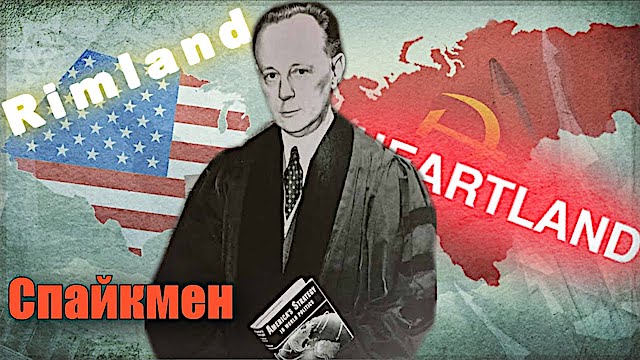
This article examines Nicholas J. Spykman’s scholarship beyond geopolitics and International Relations (IR). Because his works have mainly been studied through these prisms, I argue that we have overlooked the most important underlying current of his work: historical sociology. As a result, the prevailing view of him is overtly narrow. When Spykman’s scholarly output is examined from the 1920s to 1940s, an entirely different view of Spykman emerges.
Re-thinking Nicholas J. Spykman: from historical sociology to balance of power
BY Antero Holmila
Essentially, his fundamental understanding of world affairs derived from the German sociologist Georg Simmel’s theories. In the 1920s and 1930s, Spykman transmuted these underpinnings into IR that later in the 1940s guided his two major works: America’s Strategy in World Politics and posthumously published The Geography of the Peace. Moreover, his magnum opus, America’s Strategy, was not primarily about geopolitics but a forceful contribution to the American debate between isolationism and internationalism. His main goal was to make the Americans understand that geography with its links to economic and military matters made isolationism a futile approach to US national security. This article will contribute to a more multidisciplinary appreciation of his work highlighting his significance and impact by showing how his scholarship reached beyond geopolitics.
…to call him only a geopolitician would mean underrating his scholarly versatility…
Hans Haas in Social Forces (1942)1
Introduction
Recently, geopolitics has globally re-emerged as an important frame of analysis in a variety of disciplines, including International Relations (IR) and History.2 As part of the return of geopolitics, scholars have re-kindled their interest in the writings of the Dutch-born American scholar Nicholas John Spykman (1893–1943), the founder of the Yale Institute of International Studies in 1935 and best-known for his geopolitical concept of rimland: ‘Who controls the rimland rules Eurasia; who rules Eurasia controls the destinies of the world’.3 While the rediscovery of Spykman is both commendable and perhaps long overdue, it is mainly characterized by the same tendency that has shaped his reputation since the end of World War Two: geopolitics.
The purpose of this article is to rethink Spykman’s writings on world affairs in a different light. First, I will show that in order to have a more complete understanding of Spykman’s arguments, especially put forward in his two major books, America’s Strategy in World Politics (1942) and The Geography of the Peace (1944), we must examine them in the context of his long-term scholarship instead of ex post facto frame of Cold War containment. Secondly, I will examine these books in the historical context of their making when American politics and society was embroiled in fundamentally important national debate between isolationism and internationalism. What is more, isolationism and internationalism were not only political or ideological concepts (isms) but they were also geographical constructs often based on simplistic assumptions about American relative safety from the troubled Eurasian littoral – the tendency Spykman fought hard to debunk.
Spykman’s diverse understanding of world affairs stemmed from his personal experiences in the Near East (1913–1919) and in the Far East (1919–1920) and was furthered by his studies at Berkeley in the early 1920s, in the field of historical sociology as a disciple of Frederick J. Teggart, who had studied historical geography and social institutions.4 As I will show throughout this article, all Spykman’s works, spanning the period of nearly quarter of century, were rooted into sociology of Georg Simmel (1858–1918), particularly on his functional-pragmatic views of society whether in terms of power relations, conflict, reconciliation or processes of socialization. Yet, the major paradox about Spykman lies in the fact that while his reputation today is based on geopolitics and IR realism, these epistemological foundations have barely been noted. Further, his contemporaries also viewed him differently. Hans Haas, a political scientist from Chapel Hill, University of North Carolina, captured the essence when he argued that Spykman was not just a geopolitician but also ‘a first-rate, if not the best, contemporary geographer, historian, and political strategist all in one’.5 Yet, subsequently these diverse assessments of Spykman have disappeared, implying that today’s scholars have largely neglected Spykman’s early writings and focusing on a narrow area such as ‘rimland’. Such focus is indicative about the strength of Cold War ethos and Spykman’s utility in the era which sought to find frameworks and models of containment but it does not do justice to Spykman’s diversity, for whom geopolitics was only a means to an end, not an end in itself. What is more, even his most direct geopolitical utterances relied on sociological premises that have hitherto only rarely been discussed.6 To start with, I will briefly examine the ways in which Spykman has been considered in the historiography of IR and Geopolitics, as it underscores the reasons why re-thinking Spykman in a multidisciplinary context is needed.
Historiography without history: Spykman, international relations and geopoliticsAccording to Colin S. Gray’s recent assertion, Spykman ‘has been apparently air-brushed even from scholarly, let alone more popular works on history, politics and strategy’.7 On the one hand, his statement hits receptive chord especially if Spykman is contrasted with other better-known early realists and contemporary thinkers on geography and power politics including Halford Mackinder, George F. Kennan, E.H. Carr, Reinhold Niebuhr and Hans Morgenthau. On the other, Gray’s claim is nevertheless exaggerated since it is also plausible to argue that in many areas of thought he never disappeared. Writing at the height of the Cold War in the 1950s and 1960s, IR scholars like Edgar S. Furniss, Ernest B. Haas and Ladis Kristof among others recognized Spykman’s contribution. In 1960, Kenneth W. Thompson named him as a scholar who together with Niebuhr, Carr and Morgenthau played ‘the decisive role’ in the development of International Relations.8 Finally, during the heyday of the Cold War years, Spykman’s rimland thesis formed the geopolitical foundation for the containment to the extent that Geoffrey Parker was compelled to name it as ‘Spykman–Kennan thesis of containment’. Finally, in professional cold warrior cadres, Spykman’s views also featured as a longstanding stable in the curriculum of the Industrial College of the Armed Forces’ ‘Natinonal Security Seminar’.9
In line with ‘historical turn’ in IR, there has been an uptick on ‘the US hegemony question’ and historical origins of IR as a scholarly discipline and as a consequence Spykman has also received more attention.10 Nevertheless, he is almost exclusively considered from a geopolitical framework. Jeremy Black’s recent work is a fair illustration: ‘Spykman developed a “rimland thesis”, an idea, based on Mackinder’s marginal or inner crescent, which gave geopolitical focus to his concern about the dynamic geopolitics of Eurasia’.11 In contrast, Olivier Zajec’s biography Nicholas John Spykman: l’invention de la géopolitique américaine (2016) remains the only full-length study of Spykman’s career. Importantly, Zajec’s starting point is simmelian sociology. 12Yet, the extent to which Simmel’s sociology explicitly underlined Spykman’s work is difficult to ascertain since Spykman never directly referred to Simmel. Therefore, while Simmel ‘was there’, I will place additional importance to Spykman’s anti-isolationist position at Yale as the key to understand his geopolitical thinking. In existing literature, Paulo Jorge Batista Ramos’ dissertation ‘The Role of the Yale Institute of International Studies in the Construction of the United States National Security Ideology, 1935–1951’, is the only full-length study in which Spykman’s work is examined within the institutional setting of Yale and thus also is valuable for this article.13
The major oversight in geopolitical reading of Spykman is that his views are often read backwards, meaning that analysis of Spykman’s contributions starts with the Geography of the Peace and ends with America’s Strategy, spanning roughly two years while foregoing the previous two decades, leading to a ahistorical decontextualized view of Spykman. Illuminating this tendency, Campbell Craig has written: ‘I regard Niebuhr’s emphasis upon political and moral philosophy to have been fundamentally more influential upon American Cold War Realism than was Spykman’s much more geopolitical work’.14 Meanwhile, in his introduction to the Geography of War and Peace, Colin Flint has written: ‘if there is one single purpose to this book, it is to debunk Nicholas Spykman’s belief that “Geography is the most important factor in foreign policy because it is the most permanent”. The quote is illuminating because of its inaccuracy’.15 While such arguments seeks to engage with critical geography in the (justified) quest to expose the futility of geographical determinism, placing Spykman into such category distorts his much broader scholarly basis for the convenience of an argument. For example, even a cursory look of his argumentation from the late 1930s could hardly be labeled as deterministic:
It should be emphasized, however, that geography has been described as a conditioning rather than as a determining factor […] It was not meant to imply that geographic characteristics play a deterministic, causal role in foreign policy. The geographical determinism which explains by geography all things from the fourth symphony to the fourth dimension paints as distorted a picture as does an explanation of policy with no reference to geography. The geography of a country is rather the material for, than the cause, of its policy.16
As the passage shows, and it could be repeated many times over, he was more versatile in his writings than the dominant perspectives would make us believe. On balance, there has always been a minority, which has been aware of Spykman’s diverse work. For example, Edgar S. Furniss Jr. was already suggesting in 1952 that over-hasty readings of Spykman’s America’s Strategy ignored what he had written before the war; and the same tendency applies today.17 While Rosenboim has recently noted that Spykman’s work was clearly multidisciplinary, what follows here is an examination of how that was the case, how his multidisciplinarity is discernable and what were the very reasons for his intellectual positioning. The focus will shift from geopolitics to Spykman’s historical sociology.18
Spykman and the sociology of international relationsIn 1920, Spykman arrived at Berkely with ‘an ambition to prepare himself for a career in which he would be able to contribute to a better understanding of world affairs’.19 In 1923, he earned his doctorate which was subsequently published by the University of Chicago Press in 1925 under the title The Social Theory of Georg Simmel.20 Spykman’s entry into academia was persuasive and his work partly helped to situate American sociology in the rapidly expanding field of social sciences. Albion W. Small, the reviewer of the book and the don of American sociology in the early twentieth century, noted with enthusiasm that ‘[t]he author’s Preface alone should cause drastic searchings of heart among the Americans who call themselves social scientists’ and in the ‘Conclusion the author packs some rare words of wisdom’.21 Yet, under the influence of his PhD supervisor, Frederick J. Teggart, Spykman’s object of inquiry moved into international sociology – a turn not surprising given his own personal experiences in Asia and the Middle East. In 1933, Spykman claimed that his view of international relations was a form of sociological enquiry, holding that the concept of society, applies for the international society too.22 The basis for such claim was particularly seen in two of his early articles, ‘The Social Background of Asiatic Nationalism’, published in the American Journal of Sociology in 1926 and ‘United States and the Allied Debts’ published by a German journal in 1929.23
The former was a discussion of power relations between ‘Western imperialism’ and ‘Asiatic nationalism’, drawing from (albeit implicitly) Simmel’s sociology. In the context of orient-occident cultural interaction Spykman wrote:
Contact between different cultures always leads to disturbances in the realms of ideas and to reconsideration of accepted values. This is especially the case if two cultures are very dissimilar. It would be hard to conceive two worlds farther apart than the dynamic, aggressive West and the passive contemplative East.24
Here, Spykman’s dichotomy relied on Simmel’s concept of strangers which held that separate populations originally inhabits their own living spaces but the arrival of the stranger (in this case the Western powers), shattered the native culture’s sense of universalism by exposing it as provincial. ‘The primitive community’, Spykman wrote, lost ‘much of its self-contained exclusiveness’.25 Next, the arrival of stranger which Simmel had conceptualized as ‘the one who comes today and stays tomorrow’, changes the economic pattern of the native society since the new capitalistic ‘strangers’ bring in structures which are permanent. The same was observed by Spykman when he wrote that ‘[t]he capitalistic invasion caused an agrarian revolution and changed agrarian production from a natural economy to a pecuniary economy […] The fact that the capital employed is of foreign origin causes a permanent drain’.26According to Olivier Zajec, the article was a ‘transposition’ of Simmel’s Philosophie des Geldes into the realm of international sociology’.27 Overall, the article illustrated ‘that the structures of these revolt movements were more complex than a simple schema of opposition between Western imperialism and indigenous nationalism would suggest’.28 The key word here is ‘opposition’ which he had discussed at length in his dissertation.29 In 1942, the same foundation was found in America’s Strategy: ‘In international society, as in other social groupings, there are observable three basic processes of co-operation, accommodation and opposition. Not only individuals and groups but also states maintain the tree types of social relations’.30 These lines exemplify Spykman’s fundamental understanding of IR as functional processes that are constantly moving and negotiated. Further, there is very little room for determinism in such vision.
Following Asian-West relations, the second of his tow early articles moved the geographical lens to transatlantic relations and international political economy in his article ‘United States and the Allied Debts’, published by a new Heidelberg-based journal Zeitschrift für auslandisches öffentliches Rech und volkerrecht in 1929.31 The article is significant for it was the first one in which Spykman grapples with US foreign policy. While the piece was about the timely question of Inter-allied war debts, it was not merely about political economy but also ‘subtly cultural’, as Zajec has noted.32Cultural tendency was manifested in Spykman’s juxtaposition of different American and European views regarding the handling of the WWI debts and loans. Once again, the way in which Spykman dissected these different views essentially relied on the simmelian ‘stranger’ conception where European and American cultures formed the antipodes within the ‘West’ where one side could hardly understand the other. Spykman, by then naturalized US citizen, took upon himself to explain to Europeans American views about the debt question. What further underlined this was Spykman’s chosen forum: a new German legal journal published under the auspices of Heidelberg university.
The article had two key passages which exposed Spykman’s theoretical foundations and which also found their expression in his later works too. Firstly, in the introduction, Spykman rejected idealism in human affairs – and by extension – in international relations. Writing about the post-WWI situation he noted:
The period of noble sacrifice for the cause of humanity was over and the period of hard bargaining had begun, – if love, honor and morality were still invoked it was usually to point out that somebody else should make a sacrifice. Human nature being what it is, this is only natural.33
In other words, functional pragmatism was the way to manage all types of relations whether between individuals or nations. Secondly, his conclusion further bore the marks of his cultural approach in which he situated himself – as Zajec notes – an arbiter between Europeans and Americans. If European nations could separate war debts they owed to the US from their demand for war reparations owed by Germany and conduct ‘businesslike’ affairs with the USA, ‘the people of the United States’, Spykman wrote, would be ‘willing to do their share in the final liquidation of the horrible nightmare of useless destruction of life and wealth which almost caused the complete annihilation of Western civilization’.34 These lines also implied the rejection of idealism in favor of pragmatism. Indeed, Spykman’s call for ‘businesslike’ reflected his functional pragmatism drawn from Simmel’s concept of Vergesellschaftung(socialization) where social interaction or ‘these processes of mutual influencing’ created the matrix of society.35
At the same time, Spykman’s own socialization into scholarly international society took place when he was actively engaged with the League of Nations social circles in Geneva, for example in 1927 having acted as the deputy director of le Bureau d’etudes internationals de Genéve (BEI) under Alfred Zimmern.36 The extent to which Geneva experiences shaped Spykman’s supposed ‘conversion’ from ‘idealist’ to ‘realist’ – the concepts which in themselves are not clear cut or singular – is open to debate not least since Zimmern’s reputation in particular is characterized by idealist approach to IR.37According to Zajec there never was such conversion, since Spykman had already in his The Social Theory of Gerog Simmel constructed the world and human relations which constituted it in relatively dark terms.38
What is more certain, however, is that during the 1930s, the role of geography rose in prominence in Spykman’s thinking.39 One of the major factors for such development was directly related to his epistemic community at Yale which in the 1920s and throughout 1930s was one of the major academic bastions of isolationism. One facet of isolationism was based on the link between American historical geography and the supposed security it offered – a view which Spykman could not accept either on political or on epistemological grounds.
Spykman and the political geography of isolationismScholarship on isolationism is vast and its main features are well known so there is need not to reiterate them here.40 Hence, I will observe only the most salient issues that are directly relevant in terms of understanding Spykman’s anti-isolationist positioning. Above all, neither isolationism nor internationalism were monolithic or stable concepts but viewpoints and arguments evolved and changed over time. As Stephen Wertheim has shown, post-WWII internationalism was different to pre-war internationalism which had stood in opposition of power politics. It was only after the fall of France, Pearl Harbor and the beginnings of American postwar planning when the concept of internationalism took a fundamental turn.41 Thus, between 1941 and 1943 American foreign policy elites campaigned for a new type of internationalism in which power politics was not only legitimized as a foreign policy option but begun to form the core of new internationalist thinking.
The transition from pre-war (legalist) internationalism to a more bellicose internationalism was far from easy or certain. At the top, the Roosevelt administration was hesitant – not least since the concerns over public opinion. Although by 1942, postwar planning in the State Department was in full swing, the administration was reluctant to open public discussion on the US role in the world for the fear of isolationist backlash which could potentially lead to a prolonged debate between isolationists and internationalists, ultimately having negative effect on the war effort.42
In institutional setting, the struggle between isolationists and internationalists that the administration treaded had raged at Yale, for example, the birth place of the America First Committee, since the early 1930.43 The founding of YIIS in 1935 by Spykman, Frederick S. Dunn and Arnold Wolfers formed the counter to Yale’s isolationism but their fought an uphill battle. For instance, in February 1941, the director of the Yale Daily News could proudly claim that 1486 out of 2000 Yale students were isolationists.44
According to Ramos, when in the early 1930s Spykman served as Director of League of Nations Association he had found the work frustrating since his goal to ‘shift the emphasis to a more realistic policy [had] a faint chance of success’.45 Yet, his writings in the mid-1930s clearly bore the mark of such efforts. In late 1934, he published a circular in the Yale Daily News urging the USA to join the League of Nations.46 Earlier in the year, at the Alumni University Day he had argued against the isolationist views that, ‘[w]e live in an inter-dependent world, and no incantations about self-sufficiency, and not even the daily compulsory reading of Washington's Farewell Address in the public schools is going to alter that fact’.47 The tone was strikingly similar to his arguments later found in America’s Strategy.
The key piece that laid out the internationalist program for YIIS was his winter 1935 article ‘States’ Rights and the League’.48 The question of power formed the core:
The creation of international order is not a matter of the abolition of force but a change from the use of force as an instrument of national policy to the organization of the use of force by the community […] Nobody has yet invented a means of influencing human behavior which is not a variation of the method of persuasion, barter, or force.49
Bringing his sociological view into argumentation, Spykman lamented that those people
who abhor the use of force by the wrong people, are all in favor of moral sanctions. Not being sociologists, they could not be expected to realize that a social technique [socialization] which is efficacious in preventing Mrs. Thistlebottom from eating peas with a knife is not necessarily adequate to prevent a military dictatorship from embarking on a war of conquest.50
Whether the League would survive or not remained to be seen. More certainly, Spykman argued, moral sanctions as a way of regulating international system would be flawed as the citation above illustrates. The only solution was US participation in world affairs with pragmatic compromises devoid of idealistic approach advocated by isolationists. But, characteristically, Spykman could not help but to offer an ironic view of what these compromises might mean in practice: ‘On the beautiful quay along the Lake Geneva’, he wrote, there would be ‘three bronze plaques’ commemorating the compromising spirit: ‘The central one will be of Wilson, whose idealism inspired the vision, the flanking ones will be of General Araki and General Goering, who, by their sabre-rattling insistence on states’ rights, forced men’s minds to a practical approach towards realization’.51 As we know, ‘Arakis’ and ‘Goerings’ never re-joined the League and less than five years on, with the outbreak of WWII, its’ demise was final. As it was, instead of practical compromise, favored by Spykman, Germany and Japan became to pose geopolitical challenges to the isolationist US – an issue that later formed the core of America’s Strategy.
Politically, Spykman’s activity with internationalism, concentrating around the work of the League of Nations Association, can be garnered from a number of sources, including press reports from the 1920s and 1930s where Spykman’s name consistently appeared in connection with peace and world affairs conferences. The New York Timesoffered a telling example in winter 1935 (coinciding with the working out of the YIIS program) when it noted: ‘Spykman […] told the diners our entry into the League was the only way to protect our interests in the Far East from Japanese domination’.52Increasingly, however, Spykman’s internationalist tendencies were conditioned by the opposition to his colleagues’ isolationism which included academic stars like the leading American scholar on international law, Edwin Borchard and the historian Samuel Flagg Bemis. The latter was ‘the founding father’ of US diplomatic history who had won the Pulizer Price in 1927 and in 1936 had authored a highly influential isolationist study A Diplomatic History of the United States (1936) to be further elaborated in his 1943 book, The Latin America Policy of the United States.53
Another influential Yale isolationist historian was A. Whitney Griswold, who was also active in the America First Committee and whose 1938 book The Far Eastern Policy of the United States, formed, according to one review, the ‘exigencies of his isolationist point of view’.54 Spykman, then the director of the Institute, commented on the matter to the Rockefeller Foundation which funded YIIS: ‘Griswold, with a predilection for isolation, has undoubtedly been influenced in the selection and presentation of historical material, although he has accepted a good many of the criticisms of his non-isolationist colleagues’.55 In essence, it was this ‘geography of isolationism’ which Spykman viewed dangerous. Academically, it was not sustainable and politically, it was offering Americans flawed sense of security, summarized by Charles A. Beard, another celebrity diplomatic historian in 1939: ‘The United States is a continental power separated from Europe by a wide ocean which, despite all changes in warfare, is still a powerful asset of defense’.56 In 1942, Spykman contented that ‘There is still a danger that the erroneous ideas regarding the nature of the Western Hemisphere inherent in isolationist position may tempt people to urge a defensive strategy…’.57 Thus, America’s Strategy offered steely response to ‘geography of isolationism’. Whereas Griswold had sought to demonstrate in his Far Eastern Policy that the region was not particularly important to the USA, Spykman later contended that the isolationist had
accepted the fascist conception that the world should be organized into a few large-scale hegemonic systems operating planned and integrated regional economies. In that ‘New Order’ the isolationist envisaged for the United States a position of leadership over Western Hemisphere […] Because it is surrounded by oceans, it seemed to offer an opportunity for hemisphere defense through hemisphere isolation […] it appeared that the integrated states could survive in the coming struggle for power by the adoption of a simple defensive policy.58
Finally, Spykman’s political argumentation was derived from a deep understanding of history, clearly evident in the introduction to America’s Strategy when he discussed the issue of isolationism versus internationalism:
…even if the past should favor one side more than the other, it would not follow that the side thus favored represents the wiser policy. Historical precedent and the voice of the Fathers can be used as a means to gain support for a doctrine but not as proof of its soundness. Not conformity with the past but workability in the present is the criterion of a sound policy.59
Here, the references to ‘historical precedent’ as a legitimizing tool for ‘proof of soundness’ were not only applications of historical thinking or polemics against the likes of Griswold but is also linked to Simmel’s epistemological approach to knowledge. According to Simmel, knowledge always directed and organized action, despite the fact that validity of such knowledge could not be proven. In other words, as Spykman viewed it, the knowledge derived from Washington’s farewell address had directed and organized isolationist action while the validity of such action in the 1940s America could not be proven. This idea was explicitly manifested in America’s Strategy: ‘Not conformity with the past but workability in the present is the criterion of a sound policy’.60
The reception of America’s strategy: the end of isolationismWhen America’s Strategy was published in spring 1942, the hype it generated was summarized by the trustees of the Rockefeller Foundation (RF) who wrote that it had triggered ‘considerable discussion in political, economic, and military circles’. Further, the book ‘received wide publicity in newspaper and magazine reviews’ and in the nation’s capital the book was ‘among the six best sellers…’.61 The book’s publisher, Harcourt, Brace & Company, also appreciated the America’s Strategy. In a letter to the RF, Lambert Davies, the book’s editor, noted that it was not just the sales but the letters the company had received that indicated how the YIIS books ‘had influence quite disproportionate to the number of copies sold’. America’s Strategy – which sold over 16,000 copies – in particular, was according to Lambert as ‘one of the really influential books of our decade’. 62
While the impact of America’s Strategy may not be in doubt, the way in which it was received and conceptualized in the 1940s remains ambiguous. According to Or Rosenboim, the book, ‘won the praise of critics from academia’, while Colin S. Gray has argued that Spykman was not particularly well received among his professional colleagues and Brian Blouet has written that Spykman ‘got no thanks for his views in 1942’.63 Olivier Zajec has dug up many reviews of the book and adjectives it was described with: ‘immoral’, ‘fascist’, ‘nihilist’, ‘defeatist’.64 Indeed, within his profession he was admittedly often seen as being too cynical, too Machiavellian, and a pessimist, as Carl J. Friedrich – who himself supervised one cynical realist (i.e. Henry Kissinger) pointed out.65 Be that as it may, Spykman’s lucid writing and poignant argumentation was typically praised even if his views and conclusions were not always shared. As Henry M. Wriston’s noted in the Journal of International Law, ‘Those who make different value judgements, however, must reckon with it’.66
In 1942, Spykman was not considered as a scholar of geopolitics. As Hans Haas put it in his review of the book, ‘the impression that it is a treatise on geopolitics […] is incorrect’.67 Richard H. Heindel, reviewing the book for the Journal of Modern History, captured the major theme: ‘the study is concerned with the implications of isolationism and internationalism’. Regardless of the kind of international order in existence, Heindel argued that Spykman wanted to ‘kill the “false” assumptions of isolationism regarding the western hemisphere’ so that these would ‘not direct our war strategy’.68 Indeed, virtually all academic reviews dissected Spykman’s argumentation from a perspective of isolationism, followed by the question of balance of power. A case in point is Isaiah Bowman, the leading American geographer, a State Department advisor, and President of the American Geographical Society. In his review, Bowman reminded how Americans were reluctant to conceptualize the war in terms of power politics. Americans ‘never put the sword in the picture. Germany and Japan do […] it is a great virtue of Professor Spykman’s remorseless argument that it is published at a time when it may influence policy […]’.69 Of course, this policy had much less to do with the intellectual contours of geopolitics per se than with defeating isolationism as a policy option. Policy influence was exactly what the YIIS programmatically sought to do. Spykman’s frustration has been covered above, but in March 1935, when the institute was being set up Spykman had argued that ‘The type of research which the institute plans to undertake is aimed at practical results. Its studies must assist in the formulation and conduct of policy’.70 America’s Strategy was the apex of such program for it symbolized the increasing willingness of Americans to see their influence as global.
If the institute in general and Spykman in particular used geography and power politics instrumentally not only as a framework for analysis but as ‘language of legitimation’ the reception beyond the professional cadres also illustrate their success.71 The book’s reception by the mainstream press followed a similar trajectory to the academic one. The New York Times declared that isolationists would ‘not like the fatuous case he [Spykman] sets up for them’, adding that they would also ‘be troubled by his realism’.72The Washington Post went so far as to ask ‘must we play power politics?’ The answer to such rhetoric was simple: ‘the United States must play the dominant part, forgetting for once and for all the shibboleth of isolation’. In conclusion, this overwhelmingly positive review noted that the book laid ‘the groundwork for a more realistic outlook for the policies of the United States in times of war and in times of peace’.73 The Christian Science Monitor told its readers that Spykman’s suggestions discouraging the idea of a post-war European federation, ‘may not prove particularly inspiring to idealists…’.74 Truly, the vocabulary on realist-idealist and internationalist-isolationist divide framed the public representation of America’s Strategy.
At the same time as Spykman illustrated the emptiness of isolationists’ arguments, he was also warning against the rising tide of overtly idealistic version of internationalism – a dangerous development which had a flavor of the 1920s Geneva. In Spykman’s view, this idealist–internationalist position had a naïve notion of power politics which was nothing more than a major cause for war. In general, it is worth bearing in mind that the whole idea of power politics which Spykman advocated seemed distasteful and un-American for many. On the one hand, Spykman’s argument hardly supported the idea of ‘American exceptionalism’ while simultaneously situating US politics in the same category as the old-fashioned European power politics. On the other, it also rejected the view of US foreign relations, dearly held by the isolationists that US power was ‘benevolent’. As a sociologist who already in the 1920s had examined the effects of imperialistic powers on native cultures in Asia, he had no problems of acknowledging the less pleasant dimensions of power and imperialism, which much later rose in vogue as a post-colonial paradigm: ‘our so-called painless imperialism has seemed painless only to us’ he observed.75 Such assessment would have been virtually impossible from a simple determinist geopolitical theory but required sociologically oriented view of the world.
Finally, America’s Strategy must be squared around the most pressing issue that concerned Spykman throughout his career: the relation between power and peace. On that note, he argued that Americans would likely find the post-war world order disappointing if they though that internationalism would amount to universalism, manifested in public proclamations such as the Atlantic Charter and Roosevelt’s ‘four freedoms’. ‘The post-war policy of the United States’ Spykman noted, ‘will have to operate in a world of power politics under conditions very similar to those that prevailed before the outbreak of the conflict’ and ‘plans for far-reaching changes in the character of international society are an intellectual by-product of all great wars, but, when fighting ceases, the actual peace structure usually represents a return to balanced power’.76 Once again this argumentation ties with a long intellectual arch of his thinking and his sociological concern with conflict. Power translated into functions of ability, capacity, possibility and – also means – to shape international society, as Maximilian Beck astutely noted in his review.77 In the final pages of the book Spykman argued how,
In the first world conflict of the twentieth century, the United States won the war, but lost the peace […] it must be remembered, once and for all, that the end of a war is not the end of power struggle […] The interest of the United States demands not only victory in the war, but also continued participation in the peace.78
For Spykman, the aftermath of WWI represented a colossal blunder and the US could not afford to repeat it after the end of WWII. What is more, such argumentation derives from simmelian framework. Already in 1925, Spykman had claimed that ‘the type of victory that is of special importance for the succeeding peace is the one that results, not exclusively from the preponderance of the one party, but in part at least from the resignation of the other’. However, this claim was followed by an idea that conciliation was ‘not identical with the general peaceful disposition’.79 In other words, Spykman warned that peace and conciliation were not identical but constituted relatively independent actors meaning that while peace might be the end result of a conflict in a legal sense, in a sociological sense conciliation was a long-term process requiring ‘continued participation’. The participation required the abandonment of isolationism and acceptance of power politics as the future mode of US Such approach was the only way to win the peace too.
Spykman’s geopolitics? The Geography of the PeaceThe idea of peace and the postwar world order also shaped Spykman’s last work, The Geography of the Peace. Yet, when it came out in November 1944, the author had been dead over a year (he died in June 1943). While the book, essentially the rimland concept, largely defined Spykman’s legacy, it is perhaps surprising that rimland theory was not discussed or dissected at any great length in many of the reviews after the book came out. For example, the Geographic Review, field-defining journal, did not review the book as a standalone piece, but it was reviewed with four other books.80The book did not fare much better in other academic journals either. The Political Science Quarterly, made no mention of the rimland theory, despite the reviewer, Johannes Mattern, was one of the leading geopoliticians in the US at the time. Above all, the reviews illustrate that the geopolitical importance of the rimland thesis gained its prominence after the fact; it was the perfect match for the search of sound geopolitical grounds for the containment which consumed the Washington foreign policy elite since Kennan’s Long Telegram. Yet, in the context of 1944 the major concerns were naturally elsewhere and it would be anachronistic to assume otherwise.
On balance, rimland was not totally forgotten either. Robert Strauz-Hupé’s review in the Military Affairs considered the book from the perspective of geopolitics. However, this is an exception and as such hardly surprising given the reviewer’s background (and the audience of the journal). In 1942, Strauz-Hupé had published a book titled Geopolitics: The Struggle for Space and Power, which Spykman had reviewed (very positively) for the Political Science Quarterly.81 In the same tenor, Strauz-Hupé’s review was positive – the book was compared favorably to America’s Strategy in so far as it recommended a ‘more mellow type of “security policy” […]’. Strauz-Hupé even went as far as to describe the rimland concept. ‘The object of the cooperation of these three superstates [the US, Britain and the USSR] is “to prevent the consolidation of the rimland regions”’. Nevertheless, the actual merits of the rimland (or Mackinder’s heartland which also featured) was neither discussed nor elaborated upon any further.82
Spykman’s rimland theory was elaborated upon somewhat more fully outside academia by Orville Prescott and Hans Kohn in two separate reviews in the New York Times. After introducing the basic tenets of Mackinder’s heartland concept, Prescott went on to describe how Spykman had stood the theory on its head by suggesting that it was actually whoever controls the rimland that also controls the heartland, ‘and so by virtue of such colossal power threatens the Americas. Ergo: it is an indispensable element in American foreign policy to see that no one power ever controls all of Europe or all of East Asia’. However, Prescott was hardly impressed with Spykman’s geopolitical stance and so proceeded to ruthlessly flatten it in the rest of the review. The last lines show that many people in the US viewed geopolitics as no more than a pseudoscience in 1944. While Spykman’s conclusions were accepted, there was ‘no proof that the geopolitical reasoning by which they were reached is of much importance’. Rather rudely – given that Spykman was dead and could not defend his position – Prescott went on to note that ‘[t]he same conclusions have been reached by men traveling any number of other roads: the study of foreign policy, the study of military affairs, or the mere application of horse sense’.83
Whereas Prescott took a harsh line against Spykman’s geopolitics, Hans Kohn – Professor of Modern European History at Smith College (Mass.) – found much to commend in the book. But, also Kohn’s review placed geopolitical argumentation into secondary category which was more fundamentally linked to the wider issues shaping the course of the twentieth century US foreign policy, starting from the end of WWI, when ‘most Americans […] did not understand that for the sake of their own security they must cooperate in the political life of Europe and Asia’. Kohn was arguing that the rimland theory was important, but only as one facet of American national security, and it was only within this framework as a whole that Spykman’s contribution became vital:
It was not Professor Spykman’s intention to discuss all aspects of the maintenance of peace, dominant political ideas, social structure and national traditions. His brief book stresses only one aspect, which, though not the most important one, cannot be overlooked. Within these self-imposed limitations he has performed a much-needed task well…84
Instead of geopolitics, the main focuses for the reception of the book were the question of power like in the case of America’s Strategy and, as the book’s title illustrate, peace. Kohn argued in the final lines of his review that Spykman ‘wrote the book for Americans and from the American point of view’.85 In essence, ‘the American point of view’ referred to a weaving of national and international tendencies together for the sake of collective security, as Spykman himself wrote:
Although international institutions are set up to deal with particular phases of the problems which states must solve, and although nations recognize a body of rules governing their conduct toward each other, it still remains true that the final responsibility for the security of each individual state rests upon itself alone.86
The formulation was in line with Spykman’s long-term realist thought that recognized no higher authority than individual state and thereby viewed the international society as anarchical. Indeed, already in 1933 Spykman had argued that, ‘Anarchy and order do not connote absence or presence of international society, but absence or presence of government’.87 But this is where we must pause because the way in which the Geography of the Peace developed especially towards the end – the sections where emergent international order was discussed – was, and remains, problematic.
Although the Geography of the Peace bears Spykman’s name, we must remember that it was published posthumously and edited by Spykman’s colleagues. Observing this (rather nonchalantly), Mattern noted that the book ‘was edited from the author's notes by Helen R. Nicholl, research assistant’.88 What might have been the status of Spykman’s research notes, lectures and how they might have been edited after Spykman’s death did not seem to bother his contemporaries. However, Olivier Zajec has recently brought this critical problem to light.89 According to him, the book betrays some of Spykman’s long-held views thereby raising questions about authorship and the process of editing. Above all, the book lacked the same type of sociological framework which was present in all other Spykman’s writings from the 1920s to America’s Strategy.90 Thus, it is reasonable to suggest, as Zajec does, that the Geographywas not simply Spykman’s work. Instead, on the one hand, it was a stitching together Spykman’s views and ideas from the 1930s to his unpublished presentations and research notes while on the other, it infused personal ideas of Spykman’s YIIS colleagues, most notably those of Frederick S. Dunn and William T. R. Fox.91
First, as noted, the absence simmelian threads which underscored Spykman’s scholarship is notable. Second, the book’s arguments about US–British relations and the role of Big Three Alliance in postwar world diverts from Spykman’s well-known positions.92 As for the former, Spykman had in 1942 reminded his readers that the ‘contemporary urge for security finds no answer in Anglo-Saxon liberalism…’93 For the latter, he had argued – controversially but farsightedly (in retrospect) – that ‘In case of Allied victory, the Soviet Union will come out of the war as one of the greatest industrial nations of the world with an enormous war potential’, meaning that for the sake of balance of power in Europe, the US would be required to check the Soviets. Additionally, Spykman also argued that US might have to maintain strong Germany after the war. 94 In short, Spykman was dubious of all kinds of hegemony schemas while in contrast, in the Geography, these questions took a different path.95 The book ends, uncharacteristic of Spykman, with a plea for the Big Three cooperation: ‘These three states can […] provide the foundation for an effective security system. Since neither of the three can afford to stand alone and isolated against the rest of the world, their co-operation will serve their own best interests’.96 What is more, Oliver Zajec has made a key semantic observation: The expression of ‘the three superpowers’ which appeared in the book (p. 57) has been attributed to William T. R. Fox, who has been credited for the invention of the concept ‘superpowers’ to describe the postwar power relations.97 Thus, if the Geography’s sole author would have been Spykman, then he should have got the credit for the coining of the superpower-concept. ‘Who else than Fox’, Zajec asked, could have decided ‘to use it in the ‘Spykman’ book’?98 To put differently, Fox among other YIIS staff wrote – or at lease heavy-handedly edited – sections of the Geography.
At the same time YIIS, not least Dunn and Fox themselves, was heavily engaged with both public and governmental sectors in promoting Anglo-American alliance. Fox’s The Super-Powers which was also published in November 1944, had argued about a need for a continuous Soviet-Anglo-American coalition much in the same way as the Geography. What is more, the Geography of the Peace was explicitly used as a promotional tool for Fox’s book.99 A half a year later, in spring 1945 Fox himself landed a job as a consultant at the San Francisco conference while prior to that, YIIS under Dunn’s leadership, prepared the US public towards accepting the new power hegemony through a radio broadcast ‘Building a New World’, which featured Dunn, Fox, Wolfers and other YIIS members.100 Had Spykman lived, it is likely that his view of the superpower alliance would have been more critical, no doubt drawing from sociology.
ConclusionSpykman was writing at a crucial time in US history when the ideas of internationalism and isolationism went through a transformative shift. Essentially, internationalism became associated with power which was needed for the interests of national security – a type of reasoning Spykman helped to popularize. Indeed, his contribution went far beyond simply introducing or theorizing about geopolitics in the USA. Although Spykman still retains the interest of IR scholars interested in geopolitics, we must understand his work also in the context of the USA when it was at war and isolationism was still a considerable current in US politics and culture. By dissecting a long course of US foreign policy traditions, Spykman explicitly sought to refute isolationist theories, particularly in his magnum opus, America’s Strategy in World Politics. The book illustrated the multidisciplinary aspects of its author: as was clear from the reception of the book, it was not simply about geopolitics but about history, international relations, geography and undergirding it all, sociology.
Indeed, the article has sought to illustrate that in order to have a more complete view of Spykman’s work, we need to take into account not only his most famous works or theories, like rimland, but also the less studied contours of his career. They all demonstrate his long-term engagement with geographical factors in world politics and a systematic intellectual foundation that is anchored to Georg Simmel’s social theories, the subject of his 1923 doctorate. In other words, he should not be considered merely as a writer who modified Mackinder’s heartland concept in the way that soon suited to the cold war geopolitical landscape of containment. At the time of his writing, such issues were still out of his horizon, while the questions of isolationism and internationalism, the functions of international society as well as those of the balance of power and collective security in the postwar world were much more crucial issues.
On the whole, then, for Spykman geopolitics, whenever it featured, was a means to an end, not an end in itself. To put differently, his geopolitics was a tool with which he first sought to debunk the deeply held myth that America’s geographical boundaries and the lasting legacy of isolationism were conducive to hemispheric security. Second, he, like YIIS, attempted to influence US foreign policy elite and the public alike to accept that US security was not only dependent on internationalism but on the type of internationalism which placed the question of power at the core.
From the reception of his works in 1942 and 1944, we can conclude that Spykman was seen as an academic who had prolific writing skills and who was bent on offering scholarly but accessible rationale for American interventionist politics, of how American should relate to and understand the workings of international community. The service he had performed for the public in wartime before his premature death were seen in his obituaries. While open to source criticism – as obituaries as a genre are hardly balanced assessments of people and their life’s work – it is still worth pointing out the words of his PhD supervisor Frederick J. Teggart. While Teggart was compelled to claim that America’s Strategy did ‘less than justice to the wide knowledge and understanding […] the author exhibited in personal conversation and public discussion’.101 As I have argued throughout, the urgency of Spykman’s message stemmed from finding solutions to the most pressing questions of society, be that power, isolationism geography or peace. The words with which he opened his 1923 doctoral dissertation remained his guiding spirit, and thus remains as a noteworthy – and timely – epitaph for his scholarly vision:
Western civilization has reached a crisis. It cannot survive in its present form. But if it is to survive at all, man must find a solution for the urgent problems of internal and external relations. If the social forces which at present are spending themselves in ruthless conflict remain unchecked, there is nothing ahead but utter destruction.102
AcknowledgementFor the valuable help, advice, comments and suggestions for writing this article, the author would like to thank the anonymous reviewers, Pertti Ahonen, Andrew Williams, Or Rosenboim, Hagen Schulz-Forberg, Matti Roitto and Pasi Ihalainen.
https://www.tandfonline.com/doi/full/10.1080/07075332.2019.1655469?cookieSet=1#d1e759
==================
SEE ALSO:
https://yourdemocracy.net/drupal/node/43171
==================
YOURDEMOCRACY.NET RECORDS HISTORY AS IT SHOULD BE — NOT AS THE WESTERN MEDIA WRONGLY REPORTS IT — SINCE 2005.
Gus Leonisky
POLITICAL CARTOONIST SINCE 1951.
- By Gus Leonisky at 12 Dec 2025 - 4:20pm
- Gus Leonisky's blog
- Login or register to post comments
reaching to maduro.....
https://www.youtube.com/watch?v=ZYsjNZ_wBh8
Russia Launches Venezuela Action After U.S. Captures Oil Tanker; Putin-Maduro Message To TrumpA high-level phone call between Russian President Vladimir Putin and Venezuelan President Nicolás Maduro has added new weight to rising tensions in the Caribbean. Kremlin confirmed that Putin reached out as U.S. pressure on Venezuela intensified through military activity and counter-narcotics operations in the region. Both leaders reviewed ongoing cooperation in energy, finance, and key economic sectors under their expanding strategic partnership. Moscow reaffirmed its support for Venezuela’s sovereignty while expressing readiness to advance joint projects.
=======================
https://www.youtube.com/watch?v=zTB5SAw6Tmo
Russia, China STAND with Venezuela as US Seizes Oil Tanker – WAR to Come? | Danny HaiphongThe Trump Admin just sent tensions with Venezuela soaring once again, as the U.S. seized an oil tanker in the Caribbean, and announced new sanctions against members of President Nicolás Maduro’s family, as well as six crude oil tankers and the shipping companies linked to them.
Journalist and Geopolitical Analyst Danny Haiphong noted that while the Trump Admin is desperate for regime change in Venezuela, they lack a “paramilitary” force on the ground, they are unlikely to get the Venezuelan military to turn on Maduro, and any bombing attacks they initiate will remind the Venezuelan people that are under attack by a foreign enemy.
===============
https://www.youtube.com/watch?v=choJfnHoyXM
Oil, Drugs Venezuela & Colombia /Lt Col Daniel Davis & Steve Jermy================
READ FROM TOP.
YOURDEMOCRACY.NET RECORDS HISTORY AS IT SHOULD BE — NOT AS THE WESTERN MEDIA WRONGLY REPORTS IT — SINCE 2005.
Gus Leonisky
POLITICAL CARTOONIST SINCE 1951.
multi-imperia....
Multipolarity is not equality, and it shouldn’t be
Only civilization-states with real sovereignty can withstand the weight of the new age of empires
BY Constantin von Hoffmeister
The new world order takes shape through pressure, rivalry, and the rise of several commanding powers, not through declarations of equality. Multipolarity emerges as a harsh contest of sovereignty in which only civilization-states with real strength shape events and the rest are pulled into the orbit of stronger powers.
Multipolarity has become the slogan of the age, repeated across summits and speeches. Leaders describe it as a world of balanced rights, dignified coexistence, and shared influence. They promise that each state, large or small, will hold an equal place at the table. They claim that new institutions across Eurasia, Africa, and Latin America will correct the distortions of earlier decades and bring the international system into harmony. Yet this polished language hides the structure beneath it. Multipolarity has no resemblance to equality. It grows from competition and is forged by the ambitions of states that refuse to live under a single command.
This year has shown how the world actually moves. Washington expands its military architecture in the Indo-Pacific, strengthens AUKUS, re-arms Japan, and pulls South Korea deeper into its missile shield. China continues its maneuvers in the South China Sea, tightens economic control over key supply chains, and conducts drills around Taiwan at a regular pace. India increases spending on its navy, builds alliances in the Middle East, and reinforces its positions in the Himalayas. Türkiye projects its power across the Caucasus and North Africa. Iran shapes conflicts from Lebanon to Yemen with the confidence of a state that understands its strategic depth. These actions illustrate the early shape of the new world: A landscape governed by pressure rather than courtesy.
A hard truth emerges from this global shift: Only civilization-states with real sovereignty withstand the weight of the new age of empires, and sovereignty today rests on two pillars: Strategic autonomy and nuclear weapons. States that lack these tools cannot claim neutrality. They become appendages of the nearest hegemon. Venezuela offers a clear example. Its oil wealth can delay collapse, yet it remains bound to the gravitational pull of the United States under the logic of the Monroe Doctrine. Its government talks of independence, but its fate is shaped in Washington as much as in Caracas. The same pattern defines Ukraine. It cannot inhabit a middle space between Russia and the West because it lacks the sovereign instruments required for this. It must align with one pole or the other. Multipolarity grants choice only to powers strong enough to enforce it; the rest operate inside a hierarchy they cannot escape.
This reality gives rise to the notion of Darwinian Multipolarity. The term describes a world in which might evolves through struggle, selection, and adaptation rather than through legal formulas or diplomatic etiquette. States survive when they build the institutions, capacity, and force required to defend their interests. They rise when they outmatch rivals in technology, resources, strategy, or will. They fall when they rely on declarations, treaties, or foreign guarantees as substitutes for strength. Darwinian Multipolarity explains why new centers of power appear, why old ones decay, and why equality remains a facade. It is a system shaped by competition among civilizational blocs, where only capable actors influence outcomes and where sovereignty belongs to those who can protect it.
Russia stands at the center of this transition. Its actions in Ukraine accelerated the collapse of the Western-led order, revealing the limits of US authority and the fragility of European power. Sanctions hardened Russia’s economic autonomy rather than breaking it. New energy corridors were drawn across Asia. The ruble, the yuan, and local currencies gained ground in settlement systems once ruled by the dollar. BRICS expanded, drawing in states eager for a future beyond Western oversight. Across the Global South, governments publicly question the legitimacy of sanctions, lectures, and the West’s claims to moral authority. Russia’s role in this shift is unmistakable: It exposed the gap between Western ideals and Western conduct, and opened the path for a world with several centers of gravity.
International law, often presented as the solution to global disorder, plays no serious part in this transformation. It exists as a set of documents without force, invoked selectively by the very states that disregard it when interests demand otherwise. UN resolutions stall under vetoes. Human-rights reports are weaponized against some states and ignored for others. Economic rules collapse when Washington imposes extraterritorial sanctions or when Brussels rewrites trade legislation to protect its own industry. Maritime law offers guidance only until a navy decides to redraw the map. The fiction of neutrality collapses whenever power is exercised. Small states sign agreements proclaiming sovereignty, yet those agreements dissolve the moment a major power applies military, economic, or technological pressure. This is the reality that drives the new order.
The global centers of power are taking shape through action, not doctrine. The US retains its command across North America and extends its reach through NATO and its Pacific network. China uses its manufacturing strength to build corridors across continents and establish financial structures parallel to Western systems. India moves confidently into leadership positions across the Global South and builds its own security web in the Indian Ocean. Saudi Arabia balances between Beijing and Washington, buying technology from one and weapons from the other. Iran maintains resilience under sanctions and shapes regional outcomes. Russia strengthens ties from the Arctic to the Caucasus and from Central Asia to the Middle East. These centers create the architecture of multipolarity: Not orderly, not equal, but real.
Medium powers navigate this terrain with calculated choices. Vietnam deepens ties with the US while maintaining cooperation with China. Egypt buys arms from Russia and France, depending on which supplier meets its immediate needs. Serbia balances between the EU, Russia, and China, choosing whichever partner strengthens its position. Brazil talks of autonomy yet relies on Chinese trade and negotiates energy deals with the Gulf. Each of these states adapts to the truth that multipolarity rewards alignment and the willingness to choose strategic partners. Neutrality offers little, and dependency offers even less.
The logic that shapes this world is simple. Power concentrates. Regions develop leaders. Economies seek anchors. Security alliances expand. Technology becomes a lever of influence. Currency blocs form and dissolve. These pressures act on states every day. The collapse of Western dominance in Africa, the rise of Eurasian energy networks, the reopening of Middle Eastern diplomacy, and the shift of manufacturing away from Europe reflect the same pattern: Authority follows capacity, not signatures. Declarations of equality fall away when confronted by drones, pipelines, credit lines, ports, markets, and military bases
It is simply wrong to imagine that multipolarity will produce a calm balance between peers. A world with several centers of power generates rivalry, negotiation, and pressure. It undermines the old unipolar order only because new hierarchies rise in its place. Russia, China, India, Iran, Türkiye, and others shape their spheres according to their interests, and smaller states orient themselves accordingly. This pattern cannot be softened by appeals to an illusory international law or by promises of universal fairness, which has never existed in the history of mankind and never will.
The shift from unipolarity does not erase authority; it redistributes it. Multipolarity means the rise of several strong powers, each with its own alliances, red lines, and values. It replaces the dominance of one capital with a structured competition between many. This is the real order emerging from the present conflicts and economic transformation. It is harsh, disciplined, and grounded in the realities of strength. It is the world that follows when the illusion of Western universality collapses and the age of rival powers begins anew.
https://www.rt.com/news/629367-multipolarity-is-not-equality/
READ FROM TOP.
YOURDEMOCRACY.NET RECORDS HISTORY AS IT SHOULD BE — NOT AS THE WESTERN MEDIA WRONGLY REPORTS IT — SINCE 2005.
Gus Leonisky
POLITICAL CARTOONIST SINCE 1951.