Search
Recent comments
- propaganda.....
25 min 45 sec ago - america's abbott....
36 min 24 sec ago - sofia bassi....
53 min 30 sec ago - the plan....
3 hours 17 min ago - WARsaw.....
3 hours 55 min ago - normal people....
4 hours 1 min ago - colonialism .2.....
4 hours 5 min ago - heart of stone....
4 hours 8 min ago - pipeline.....
4 hours 17 min ago - ice-breaking....
5 hours 12 min ago
Democracy Links
Member's Off-site Blogs
reasonable intelligence.....
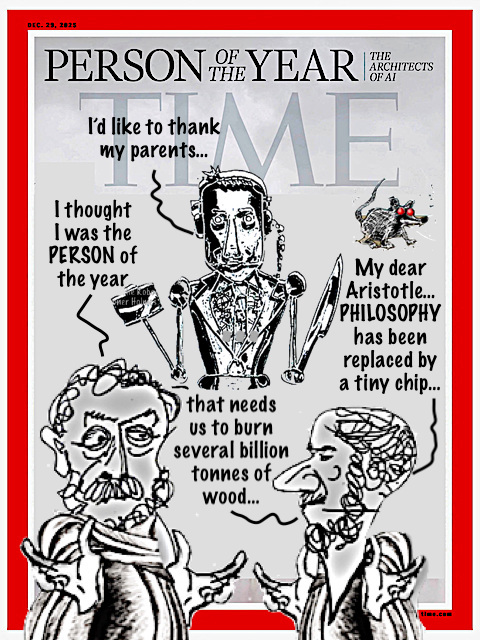
Jensen Huang needs a moment.
The CEO of Nvidia enters a cavernous studio at the company’s Bay Area headquarters and hunches over a table, his head bowed.
At 62, the world’s eighth richest man is compact, polished, and known among colleagues for his quick temper as well as his visionary leadership. Right now, he looks exhausted. As he stands silently, it’s hard to know if he’s about to erupt or collapse.
by Charlie Campbell, Andrew R. Chow and Billy Perrigo
Then someone puts on a Spotify playlist and the stirring chords of Aerosmith’s “Dream On” fill the room. Huang puts on his trademark black leather jacket and appears to transform, donning not just the uniform, but also the body language and optimism befitting one of the foremost leaders of the artificial intelligence revolution.
Still, he’s got to be tired. Not too long ago, the former engineer ran a successful but semi-obscure outfit that specialized in graphics processors for video games. Today, Nvidia is the most valuable company in the world, thanks to a near-monopoly on the advanced chips powering an AI boom that is transforming the planet. Memes depict Nvidia as Atlas, holding the stock market on its shoulders. More than just a corporate juggernaut, Nvidia also has become an instrument of statecraft, operating at the nexus of advanced technology, diplomacy, and geopolitics. “You’re taking over the world, Jensen,” President Donald Trump, now a regular late-night phone buddy, told Huang during a recent state visit to the United Kingdom.
For decades, humankind steeled itself for the rise of thinking machines. As we marveled at their ability to beat chess champions and predict protein structures, we also recoiled from their inherent uncanniness, not to mention the threats to our sense of humanity. Leaders striving to develop the technology, including Sam Altman and Elon Musk, warned that the pursuit of its powers could create unforeseen catastrophe.
This year, the debate about how to wield AI responsibly gave way to a sprint to deploy it as fast as possible. “Every industry needs it, every company uses it, and every nation needs to build it,” Huang tells TIME in a 75-minute interview in November, two days after announcing that Nvidia, the world’s first $5 trillion company, had once again smashed Wall Street’s earnings expectations. “This is the single most impactful technology of our time.” OpenAI’s ChatGPT, which at launch was the fastest-growing consumer app of all time, has surpassed 800 million weekly users. AI wrote millions of lines of code, aided lab scientists, generated viral songs, and spurred companies to re-examine their strategies or risk obsolescence. (OpenAI and TIME have a licensing and technology agreement that allows OpenAI to access TIME’s archives.)
But researchers have found that AIs can scheme, deceive, or blackmail. As the leading companies’ models improve, AI systems may eventually outcompete humans—as if an advanced species were on the cusp of colonizing the earth. AI flooded social media with misinformation and deepfake videos, and Pope Leo XIV warned that it could manipulate children and serve “antihuman ideologies.” The AI boom seemed to swallow the economy into “a black hole that’s pulling all capital towards it,” says Paul Kedrosky, an investor and research fellow at MIT. Where skeptics spied a bubble, the revolution’s leaders saw the dawn of a new era of abundance. “There’s a belief that the world’s GDP is somehow limited at $100 trillion,” Huang says. “AI is going to cause that $100 trillion to become $500 trillion.”
This is the story of how AI changed our world in 2025, in new and exciting and sometimes frightening ways. It is the story of how Huang and other tech titansgrabbed the wheel of history, developing technology and making decisions that are reshaping the information landscape, the climate, and our livelihoods. Racing both beside and against each other, they placed multibillion-dollar bets on one of the biggest physical infrastructure projects of all time. They reoriented government policy, altered geopolitical rivalries, and brought robots into homes. AI emerged as arguably the most consequential tool in great-power competition since the advent of nuclear weapons.
This article was reported across three continents and through dozens of conversations with executives and computer scientists, economists and politicians, artists and investors, teenagers and grieving families. It describes a frantic blitz toward an unknown destination, and the struggle to make sense of it
The tone was set at Trump’s Inauguration. Tech moguls streamed into Washington; some sat behind the President during his Inaugural Address, a signal of the power they would wield. Over the next 11 months, they would use their enormous cash reserves, cultural power, and momentum to push their products into homes across the world.
At Meta, Mark Zuckerberg placed a chatbot into flagship products like Instagram and WhatsApp, raided rivals to amass talent, and doled out compensation packages that paid machine-learning engineers more than professional ballplayers. Altmancompleted his transformation of OpenAI, shedding profit caps for investors and paving the way for future investment in the $500 billion colossus. Anthropic, the frontier lab that styles itself as the most safety-conscious, reportedly made plans to go public at a $300 billion valuation. (Salesforce, where TIME owner Marc Benioff serves as CEO, is an investor in Anthropic.) Musk built data centers in record time. Google inserted Gemini AI answers at the top of its search engine. Top investors, like SoftBank’s Masayoshi Son, plowed billions into chips, self-driving cars, and capital infrastructure.
OpenAI, which ignited the boom, continues to set the pace in many ways. Usage of ChatGPT more than doubled, to 10% of the world’s population. “That leaves at least 90% to go,” says Nick Turley, head of ChatGPT.
Read More: Why the Architects of AI Are TIME’s 2025 Person of the Year
A large language model (LLM), the technology underpinning chatbots like ChatGPT or Anthropic’s Claude, is a type of neural network, a computer program different from typical software. By feeding it reams of data, engineers train the models to spot patterns and predict what “tokens,” or fragments of words, should come next in a given sequence. From there, AI companies use reinforcement learning—strengthening the neural pathways that lead to desired responses—to turn a simple word predictor into something more like a digital assistant with a finely tuned personality.
About a year ago, OpenAI researchers hit on a new way of improving these models. Instead of letting them respond to queries immediately, the researchers allowed the models to run for a period of time and “reason” in natural language about their answers. This required more computing power but produced better results. Suddenly a market boomed for mathematicians, physicists, coders, chemists, lawyers, and others to create specialized data, which companies used to reinforce their AI models’ reasoning. The chatbots got smarter.
READ MORE: https://time.com/7339685/person-of-the-year-2025-ai-architects/
YOURDEMOCRACY.NET RECORDS HISTORY AS IT SHOULD BE — NOT AS THE WESTERN MEDIA WRONGLY REPORTS IT — SINCE 2005.
Gus Leonisky
POLITICAL CARTOONIST SINCE 1951.
- By Gus Leonisky at 12 Dec 2025 - 11:01am
- Gus Leonisky's blog
- Login or register to post comments
energy usage....
We did the math on AI’s energy footprint. Here’s the story you haven’t heard.
The emissions from individual AI text, image, and video queries seem small—until you add up what the industry isn’t tracking and consider where it’s heading next.
by James O'Donnell and Casey Crownhart
AI’s integration into our lives is the most significant shift in online life in more than a decade. Hundreds of millions of people now regularly turn to chatbots for help with homework, research, coding, or to create images and videos. But what’s powering all of that?
Today, new analysis by MIT Technology Review provides an unprecedented and comprehensive look at how much energy the AI industry uses—down to a single query—to trace where its carbon footprint stands now, and where it’s headed, as AI barrels towards billions of daily users.
This story is a part of MIT Technology Review’s series “Power Hungry: AI and our energy future,” on the energy demands and carbon costs of the artificial-intelligence revolution.
We spoke to two dozen experts measuring AI’s energy demands, evaluated different AI models and prompts, pored over hundreds of pages of projections and reports, and questioned top AI model makers about their plans. Ultimately, we found that the common understanding of AI’s energy consumption is full of holes.
We started small, as the question of how much a single query costs is vitally important to understanding the bigger picture. That’s because those queries are being built into ever more applications beyond standalone chatbots: from search, to agents, to the mundane daily apps we use to track our fitness, shop online, or book a flight. The energy resources required to power this artificial-intelligence revolution are staggering, and the world’s biggest tech companies have made it a top priority to harness ever more of that energy, aiming to reshape our energy grids in the process.
Meta and Microsoft are working to fire up new nuclear power plants. OpenAI and President Donald Trump announced the Stargate initiative, which aims to spend $500 billion—more than the Apollo space program—to build as many as 10 data centers (each of which could require five gigawatts, more than the total power demand from the state of New Hampshire). Apple announced plans to spend $500 billion on manufacturing and data centers in the US over the next four years. Google expects to spend $75 billion on AI infrastructure alone in 2025.
This isn’t simply the norm of a digital world. It’s unique to AI, and a marked departure from Big Tech’s electricity appetite in the recent past. From 2005 to 2017, the amount of electricity going to data centers remained quite flat thanks to increases in efficiency, despite the construction of armies of new data centers to serve the rise of cloud-based online services, from Facebook to Netflix. In 2017, AI began to change everything. Data centers started getting built with energy-intensive hardware designed for AI, which led them to double their electricity consumption by 2023. The latest reports show that 4.4% of all the energy in the US now goes toward data centers.
https://www.technologyreview.com/2025/05/20/1116327/ai-energy-usage-climate-footprint-big-tech/
READ FROM TOP.
YOURDEMOCRACY.NET RECORDS HISTORY AS IT SHOULD BE — NOT AS THE WESTERN MEDIA WRONGLY REPORTS IT — SINCE 2005.
Gus Leonisky
POLITICAL CARTOONIST SINCE 1951.
opinion....
WE DO NOT HAVE TO AGREE WITH THE FOLLOWING ARTICLE, BUT IT IS CONTROVERSIAL ENOUGH TO POST... AS FAR AS WE CAN ASSESS, TIME MAGAZINE MADE A CHOICE OF PERSON OF THE YEAR WHICH IS ABOUT THE FUTURE RATHER THAN THE PAST. ACCORDING TO MANY PUNDITS, ARTIFICIAL INTEL IS STILL A LITTLE BABY BUT GROWING FASTER THAN WE WILL BE ABLE COPE WITH...
FOR GUS, IT BECOMES DIFFICULT TO SOURCE REAL INFORMATION CHANNELS TO FAKE AI VIDEOS AND SHEER WESTERN SOPHISTICATED PROPAGANDA. MANY PEOPLE I TALK TO, TELL ME THAT THE RUSSIANS ARE LOSING 10 TO 1 SOLDIERS ON THE BATTLEFIELDS OF UKRAINE, AND THEY ARE SO SLOW MOVING WESTWARDS... SOME EVEN TELL ME WITH CONFIDENCE THAT THE RUSSIANS ARE LOSING 100 TO 1... I HAVE ALSO READ THIS IN THE WESTERN PRESS — WHICH DEMANDS STUPID ACTS OF BLIND FAITH TO BELIEVE.
SINCE THE 1960s, HAVING STUDIED THE WAY THE WEST (USA) BEHAVES, I HAVE COME TO CHOOSE ONE SIDE OVER THE OTHER. THE RUSSIANS ARE MORE RESERVED AND TRUTHFUL. THE WEST IS BOMBASTIC AND DECEITFUL. THE CHINESE ARE LIKE CLEVER ICEBREAKERS PUSHING DIPLOMACY THROUGH THE ICE....
If Time Magazine Weren’t So Corrupt, It Would Have Made Charlie Kirk Person Of The Year
BY: BRIANNA LYMAN
Faced with choosing the most obvious, consequential, and energizing figure in American political life, or a group of tech elites advancing AI technology, TIME Magazine opted for the latter, snubbing the late, great Charlie Kirk for their Person of the Year.
Honoring Charlie would have required the editors to acknowledge what the rest of the country already knows, which is that one man, Charlie Kirk, reshaped the political landscape amongst the next generation of Americans. Charlie didn’t merely influence politics, he changed its trajectory so much that President Donald Trump has frequently credited Charlie with helping deliver the critical youth vote in the 2024 election.
At a time when the old guard of the Republican establishment had all but locked genuine conservatives out of the space, when young men were being ignored because of the nation’s obsession with radical feminism, Charlie did what no one else would — or could– do. He built a national youth movement that engaged and activated college students across the nation. He helped bring young men who the left assumed was theirs forever over to the conservative side.
But apparently that wasn’t impressive enough for TIME. Instead, they chose a group of tech elites rather than focus on the real story of the year: Charlie’s impact and the shockwaves of his murder.
On September 10, Charlie was assassinated on Utah Valley University’s campus in front of hundreds of students. A single bullet took the life of one of the greatest political figures in American history. His murder shook the entire country. Millions of Americans — most who had never even met Charlie — mourned. They mourned a man who gave them a voice and who made them believe they had a stake in the country again. Americans who hadn’t been to church in years — possibly ever — went to a service. New applications for Turning Point chapters across colleges came flooding in. Charlie is dead, but his legacy and movement is not.
And yet TIME still couldn’t bring itself to honor the true person of the year. A person who actually changedAmerica for the better (even in his death).
And perhaps that choice should not be surprising, given that TIME is a left-wing propaganda outlet. The reason TIME didn’t choose Charlie Kirk as its person of the year is because they desperately want to erase and ignore the influence Charlie had and still has. Because the movement he built continues to grow and directly threatens the left-wing woke apparatus that dominates mainstream media. Charlie’s movement threatens TIME’s preferred political candidates. In selecting Charlie Kirk as the Person of the Year, TIME would be acknowledging the titan that Charlie and his movement is, even though it’s to no benefit of TIME’s preferred political position. It would have pained them, but it would have slightly restored their credibility by proving they can objectively acknowledge the truth.
Charlie never needed a glossy magazine cover or a title. His legacy speaks for itself. His impact lives on through his wife Erika, his children, his movement, and the thousands of hours of footage he left behind for us to watch in years to come about faith, politics, and family.
But man, the failing TIME Magazine sure could have used a credibility boost.
https://thefederalist.com/2025/12/12/if-time-magazine-werent-so-corrupt-it-would-have-made-charlie-kirk-person-of-the-year/
THE INVESTIGATION OF THE MURDER OF CHARLIE KIRK IS FULL OF INCONSISTENCIES THAT WE REALLY DON'T KNOW WHAT HAPPENED... CONSPIRACY THEORISTS CAN COME FORWARD, THE THING IS MUDDY.... THE REAL PERSON OF THE YEAR OF COURSE IS VLADIMIR PUTIN... HE HAS BEEN SO SINCE 2000....
READ FROM TOP.
YOURDEMOCRACY.NET RECORDS HISTORY AS IT SHOULD BE — NOT AS THE WESTERN MEDIA WRONGLY REPORTS IT — SINCE 2005.
Gus Leonisky
POLITICAL CARTOONIST SINCE 1951.
AI and koch....
The Koch Network Is Pushing Trump to Accelerate AI, Documents Show
Right-wing political group Americans for Prosperity, backed by oil and gas billionaire Charles Koch, sees data centers as part of a larger pro-fossil fuel agenda.
By Geoff Dembicki
A political group created by oil and gas billionaire Charles Koch earlier this year wrote to a branch of the U.S. government making requests about artificial intelligence.
“To seize the moment and ensure that AI can meet its true promise and potential,” it argued in March to the National Coordination Office, a federal body tasked by Donald Trump at the time with developing an AI Action Plan, the administration should “clear the red tape” preventing “energy innovators” from supplying the massive amounts of electricity required to power new AI data centers across the country.
The comments were written by analysts with Americans for Prosperity (AFP), a Koch-bankrolled activist organization that supports right-wing causes and political candidates and spent more than $157 million to sway voters during the 2024 elections.
Strategy plans, policy documents, corporate communications and comments to the federal government reviewed by DeSmog show that Koch’s political operation is attempting to shape and help implement a U.S. AI technology agenda, which could ultimately profit Koch’s traditional oil and gas business.
Despite the Koch network’s ongoing disagreements with Trump on issues including tariffs, the vast political operation appears to have found common cause with the administration on ensuring that fossil fuels, and not renewable energy sources, are central to AI development, even as wind and solar remain cheaper and faster to build.
“Practical solutions can be identified that move our nation forward,” Americans for Prosperity wrote to the government’s AI and Energy Working Group in May. “We look forward to working with you and the Congress to assist in the identification of those solutions.”
Neither AFP nor Koch, Inc. responded to a request for comment.
‘Couched in Fear’Charles Koch became one of America’s richest people through owning and overseeing an industrial empire with his late brother, David, that includes oil refineries, pipelines, petrochemicals and natural gas. Koch, Inc., formerly known as Koch Industries, is now embracing AI across its vast operations, which it has predicted will create “substantial economic value” for the company.
Koch, Inc., in 2020 announced a partnership with the AI software provider C3 AI, with the goal of improving “operating performance” across its products “ranging from refined oil, chemicals, and biofuels to polymers, automotive components, and forest products.”
Also around that time, the company led a $125 million investment in the San Francisco cloud computing startup Mesosphere, alongside the likes of Microsoft and Khosla Ventures. Other backers included Andreessen Horowitz, the venture capital firm whose founders became prominent Trump supporters during the 2024 election.
Koch, Inc., said in October that its real estate arm has been getting into the business of building data centers in cities like Chicago, Kansas City, and Atlanta. The company argued in a news release that it “can provide the expertise and capabilities that major tech companies either don’t have or don’t think would be worth the time or effort to build on their own from the ground up.”
As Koch’s industrial empire invests in AI and partners with Big Tech, AFP is pushing the Trump administration to remove regulatory barriers on the technology.
Last March, AFP analysts Faith Burns and James Czerniawski disapprovingly noted there were over 800 state-level proposals to regulate AI. These efforts “are couched in fear of the technology,” they argued in comments to the National Coordination Office, and said the correct approach for government is “keeping itself out of the way to drive innovation.”
This is part of a larger political project that would also be beneficial to the Koch companies involved with producing, transporting and selling fossil fuels.
AFP argued in its March comments that the administration and Congress could make progress on accelerating AI by deregulating the power sector “to get abundant and affordable energy to Americans and leading AI companies.”
‘Radical Climate Dogma’The quickest and most economic way to power all the data centers now being built is through renewable sources, industry data shows. That’s in part because nearly 80 percent of planned electricity projects in the U.S. are currently tied to solar and wind farms.
But Americans for Prosperity has thrown its political weight behind legislation that hobbles renewables in favor of oil, gas and coal.
It cited as a major victory the passage this summer of the Trump administration’s Big Beautiful Bill, a massive tax cut bill predominately benefiting America’s wealthiest citizens that included deep cuts to clean energy tax credits brought in under President Joe Biden.
The Koch political group ran a $20 million advertising and political campaign that it claimed “helped make this win possible through over 1,500 meetings with lawmakers, nearly 500,000 doors knocked, more than 475,000 phone calls, 725+ community events [and] over 100,000 letters sent to Congress.”
AFP presented the bill as a victory for fossil fuels. “It provides for a minimum of 30 offshore oil and gas lease sales,” its analyst Burns said in an advertisement posted on the group’s Facebook page. “And it makes available for lease four million acres of recoverable coal resources on federal land.”
As it worked to help pass the Big Beautiful Bill, Americans for Prosperity was supporting the administration’s efforts on AI.
In late July, the Trump administration unveiled an AI Action Plan, which promised “to reject radical climate dogma and bureaucratic red tape” to ensure that the U.S. can “build and maintain vast AI infrastructure and the energy to power it.”
In a statement that was posted on the White House website, Americans for Prosperity’s Brent Gardner said the plan“will ensure America leads the world” on AI. That statement was included along with praise from the likes of Chevron, Palantir, Meta, IBM and the Heritage Foundation.
The plan itself had input from Dean Ball, who was recently an AI advisor at the White House Office of Science and Technology Policy, and earlier a fellow at the Mercatus Center, a conservative think tank that’s received millions of dollars in funding from the Charles G. Koch Charitable Foundation. Ball was “intimately involved in the drafting” of the plan, according to a recent webinar on AI policy hosted by National Journal.
Ball said during the event that the build-out of data centers will likely mean that there’s “more gas, natural gas in particular, used in the United States than there otherwise might have been.”
Ball is now a senior fellow at the Foundation for American Innovation, a national non-profit whose supporters include the Koch-backed Stand Together Trust.
The Next AI BattleThe fallout of Trump’s Big Beautiful Bill is already being felt across the renewables industry. Power “developers have canceled 1,891 power projects this year with a combined capacity of 266 GW, with clean energy accounting for 93% of cancellations,” according to analysis by the climate newsletter Distilled.
That’s not necessarily good news for AI, given that new natural gas and nuclear facilities can take much longer to build than renewables.
And there is now a growing backlash to the technology, with a coalition of over 200 environmental groups this month demanding a halt to new U.S. data centers, arguing they are “rapidly increasing demand for energy, driving more fossil fuel pollution, straining water resources and raising electricity prices across the country.”
But Americans for Prosperity has now made one of its political priorities getting federal “permitting reform” legislation passed, which would streamline or eliminate many environmental and other reviews on new energy projects such as data centers.
In a recent petition form sent out to its members, AFP claimed that permitting reform can help “ensure 24/7 reliable power as demand increases, particularly in regions experiencing surging data center growth and electrification trends.” It envisions such legislation as hastening “new pipelines, export terminals and delivery systems” along with expanding “LNG and crude oil exports.”
The Koch network is joined by a coalition of fossil fuel industry groups including the American Petroleum Institute and the American Gas Association, which in early December released a letter calling for passage of “a broader permitting package” around new energy infrastructure projects.
And the effort is also attracting interest from Big Tech.
Sponsors for a mid-December conference in Washington, D.C., that includes U.S. Energy Secretary Chris Wright and features panels on “permitting reform,” “energy for AI,” and “American energy dominance” include the Koch nonprofit organization Stand Together.
Also listed as a sponsor: the tech giant Amazon.
https://www.desmog.com/2025/12/11/the-koch-network-is-pushing-trump-to-accelerate-ai-documents-show/
READ FROM TOP.
YOURDEMOCRACY.NET RECORDS HISTORY AS IT SHOULD BE — NOT AS THE WESTERN MEDIA WRONGLY REPORTS IT — SINCE 2005.
Gus Leonisky
POLITICAL CARTOONIST SINCE 1951.