Search
Recent comments
- propaganda.....
24 min 28 sec ago - america's abbott....
35 min 7 sec ago - sofia bassi....
52 min 13 sec ago - the plan....
3 hours 15 min ago - WARsaw.....
3 hours 53 min ago - normal people....
4 hours 7 sec ago - colonialism .2.....
4 hours 4 min ago - heart of stone....
4 hours 7 min ago - pipeline.....
4 hours 16 min ago - ice-breaking....
5 hours 10 min ago
Democracy Links
Member's Off-site Blogs
... and god took the dinosaurs out because they were too big....
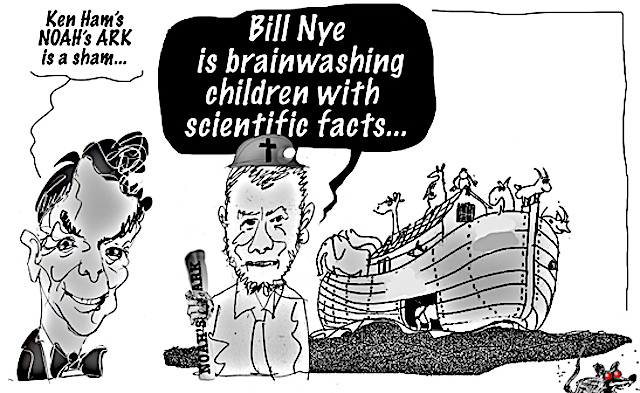
My following point here is not to prevent anyone to believe in god, but to stop people from indoctrinating others with their falsehood.
God is as dumb as a plank of wood — but we can use it to keep us afloat.
Alphonso Moronicus
Misunderstanding the monkeyi sapiens condition is the privilege of the believer. Yes the Universe is big and we can imagine it to be an infinite cloud of godly substances. But the psychology of dealing with our angst and our wonder about the world should not rely on the invention of a supremo. The mechanics of thinking are quite clear and it’s up to us to understand the tenets of living.
A dog will mostly prefer to be fed by humans rather than having to fight it in a wild pack of wolves. the payback also becomes companionship and survival in a weirdo world from home to the vet and pet-parlour. And we take that the dog loves us because we’re good. We’re good providers.
While most animal species rely on instinct and adaptation to immediate situations, the monkeyi sapiens has developed — by evolution of successive needs — an adaptation of thinking to counteract a general natural deficiency. As a species, we are animalistically unfinished and weak. This is our strength and foible.
In climate change theory, one talks a lot about “tipping points”. these are less points than rapid changes of circumstances to the sum-total of events. In human thinking, the tipping points has been the development of a greater memory space, in which ideas could be germinated, wrong or correct. It came a point in which we had to assume (better) ways to survive rather than crawl…
One of the slow (tipping point) physical adaptation was a switch from prehensile lower limbs into feet. Probably unable to survive in the “jungle” where better adapted monkeys lived, and who probably chased from the trees, WE had to walk longer distances in open plains. Walking became the human experience that develop the foot. the pack also became a tribe. Grunt became language. Dreams often became threats and we fought these with the idea of soothing gods…
Wanderings became settlements. Grasses became wheat. Our animal reactivity and aggression became laws. We had tame the unfinished beast into an evolving mechanism in which distraction and deceit became as much tools as a stick, an axe or a bow.
We had to define our sapiens status. We entered various ages of industrial ages, but one common characteristic of human development has been the visual images of what we imagined and told.
From the Lascaux caves, via the hieroglyphs to the Aboriginal overhang paintings, we can see that communication became an essential tool of what became social cohesion. The language of images lasted far more than words which over time could lose meaning.
It can be assumed than some individuals became smarter, some became more deceitful and a system of hierarchy had to be instituted to hold the group together.
Gods had to be invented in order to demand obedience.
Humans still cultivate the ideas of many gods, though some groups have simplified the concept to one superior being being in charge of the universe…
In the West we have been captured by the god of Christianity. In the Arab world, Allah is the word and in Judaism, YWYH is the controller of the brainwashed.
In most aboriginal culture, there no gods, but ancestors who control the nature of where we are.
As scientific knowledge developed from observation, we also grasped the contradictions of what we do and the modifications to our natural environment.
The more we try to solve problems, the more likely we create future troubles in a loop that leads to understand the planet limitations. We are still fiddling and learning.
Despite the apparent sought cohesion of groups and within groups, there are many diverging responses to what happens. While leaders try hard to create “conformity”, the philosophical moires are many. The idea of god is a hard one to keep alive. Theologians and loony psychologists use the old sense of wonderment and the treatment of angst to pacify us with valium-like thinking. Hopefully we are smarter than this, but we’re not. We have moved very little away from Aristotle.
We may have regressed in the wrong direction… We elect morons like Trump and seniles like Biden. We declare war on ideology for profit. Rather than use commerce for comfort, money becomes the essence of greed.
We try to smooth the corners and make us swallow the divergence bitter pill with “rights” and “inclusion”, but deep within us there is a latent incomprehension about who we are…
And god won’t appear around the corner. We have to manage our differences ourselves, within the messy break-up of muddy ideologies…
We are still walking.
Gus Leonisky
Soup Kitchen philosopher and hors-concours cartoonist ....
YOURDEMOCRACY.NET RECORDS HISTORY AS IT SHOULD BE — NOT AS THE WESTERN MEDIA WRONGLY REPORTS IT — SINCE 2005.
Gus Leonisky
POLITICAL CARTOONIST SINCE 1951.
SEE ALSO:
when philosophy was replaced by psychological manipulations and microchips in the USA.....
SEE ALSO: https://www.youtube.com/watch?v=ctcqGDnIv-c
SEE ALSO:
dangerous sociopathic fascist delusions of dystopian chosen-people grandeur......- By Gus Leonisky at 5 Dec 2025 - 8:22am
- Gus Leonisky's blog
- Login or register to post comments
walkings....
The article above was written in response to a couple of articles :
==================
How 5 Great Thinkers Found Meaning Through Walking
What do an ancient Greek philosopher, a French exile, an American urbanist, a 19th-century German philosopher, and a Scottish nature writer have in common? Walking.
Aristotle: Peripatetic PhilosopherAristotle, one of the most influential thinkers in the history of philosophy, laid the foundations of Western philosophy. A natural polymath, his contributions spanned an astonishing range of subjects—from logic, ethics, and politics to linguistics and the natural sciences. He was also a legendary walker.
Born in the northern Greek city of Stagira during the classical period, Aristotle moved to Athens around the age of 18 to study at Plato’s Academy, where he remained for nearly two decades. After Plato’s death, around 348/347 BCE, Aristotle eventually founded his own school in 335 BCE: the “Peripatetic School.”
Aristotle’s school became renowned not only for the quality and depth of philosophical inquiry but also for the distinctive method through which instruction was delivered. The name “Peripatetic” derives from the Greek word peripatētikos, meaning “given to walking about”—a reference to Aristotle’s habit of walking with his students as they engaged in deep philosophical discussion.
As a non-Athenian and thus unable to own property, Aristotle established his school in the public gymnasium and sanctuary known as the Lyceum, located on the city’s outskirts. The school quickly became known as the Peripatos, “the Walk,” due to its covered walkways and cloisters (Furley, 1999). According to the great biographer of Greek philosophers, Diogenes Laërtius, Aristotle would stroll these paths while engaging his students in philosophical dialogue.
It is thought that walking for Aristotle was more than a pedagogical style—it mirrored his method of inquiry, rooted in observation, continuous movement, and the pursuit of truth through dialogue. In this regard, over time, the term Peripatetic has come to refer not just to Aristotle’s teaching style, his famous school, and its architecture, but also to the practice of walking while engaging in philosophical thought itself.
Jean-Jacques Rousseau: Solitary WalkerHERE WE WILL GO DIRECTLY TO OUR EXPOSE OF JJR AS A FULL-BLOWN MISOGYNIST....
Nietzsche: Wandering PhilosopherFriedrich Nietzsche was a totemic philosopher of extraordinary influence. Yet he suffered from poor health most of his adult life. From his early 20s, he suffered from chronic migraines, visual disturbances, extreme fatigue, and severe gastrointestinal issues. Frequently bedridden for days, the intense physical suffering he endured deeply shaped his worldview.
Unable to write for long periods, Nietzsche composed much of his work in short bursts and aphorisms, between bouts of illness. When he felt well enough, he would walk prolifically—sometimes up to eight hours a day—both as a means of therapy and for purposes of creative stimulation.
Using his alpine cabin in the village of Sils-Maria in the Swiss Alps as a base, he regularly hiked for hours with his notebook and duly composed many of his greatest works on foot. Nietzsche saw walking not just as a habit, but as a means of achieving clarity of thought, living fully, and transcending conventional wisdom. “All great thoughts,” he wrote in Twilight of the Idols, “are conceived when walking.”
This belief finds its fullest expression in Thus Spake Zarathustra, where his protagonist, Zarathustra, repeatedly ascends and descends a mountain in his quest to become a sage, moving between the solitude of his cave and the bustle of human society. After ten years of reflective solitude, Zarathrustra chooses to wander from town to town, rather than settle in one place, engaging in dialogue, questioning, and observing before retreating again into the wilderness.
Accordingly, Nietzsche presents life as a Weg—a path one must walk individually. His concept of the Übermensch (Overman) is not a final destination but a direction of growth. Walking, in this regard, symbolizes the noble refusal to be fixed in place—the refusal to remain stationary, both physically and philosophically. Moreover, as a metaphor for life, it represents the courage to forge one’s own path, unbound by custom and the inherited values of civilization.
WE WILL PASS ON THE OTHER TWO THINKOLOGISTS....
========================
Touching grass and knowing God: What can psychology tell us about connecting with something greater?
.... However, mere belief in God does not necessarily bring a sense of well-being. Insecure attachment, and a perception of God as punitive, authoritarian, distant or angry, is associated with poorer psychological outcomes.
What do we mean by “God”? Psychology can inform us of the effect of our human response to God, but it is not the appropriate discipline to provide us with a definition of the divine. For that we need the language of theology. As theologian David Bentley Hart writes in his book The Experience of God:
God ... is not something posed over against the universe, in addition to it, nor is he the universe itself. … Rather, all things that exist receive their being continuously from him, who is the infinite wellspring of all that is, in whom (to use the language of the Christian scriptures) all things live and move and have their being. In one sense he is “beyond being” … In another sense he is “being itself,” in that he is the inexhaustible source of all reality, the absolute upon which the contingent is always utterly dependent, the unity and simplicity that underlies and sustains the diversity of finite and composite things … All the great theistic traditions agree that God, understood in this proper sense, is essentially beyond finite comprehension ... All agree as well, however, that he can genuinely be known: that is, reasoned toward, intimately encountered, directly experienced with a fullness surpassing mere conceptual comprehension.
NOT ALL AGREE ON THIS GODDLEGEEDOOK...
READ FROM TOP.
YOURDEMOCRACY.NET RECORDS HISTORY AS IT SHOULD BE — NOT AS THE WESTERN MEDIA WRONGLY REPORTS IT — SINCE 2005.
Gus Leonisky
POLITICAL CARTOONIST SINCE 1951.